
Description
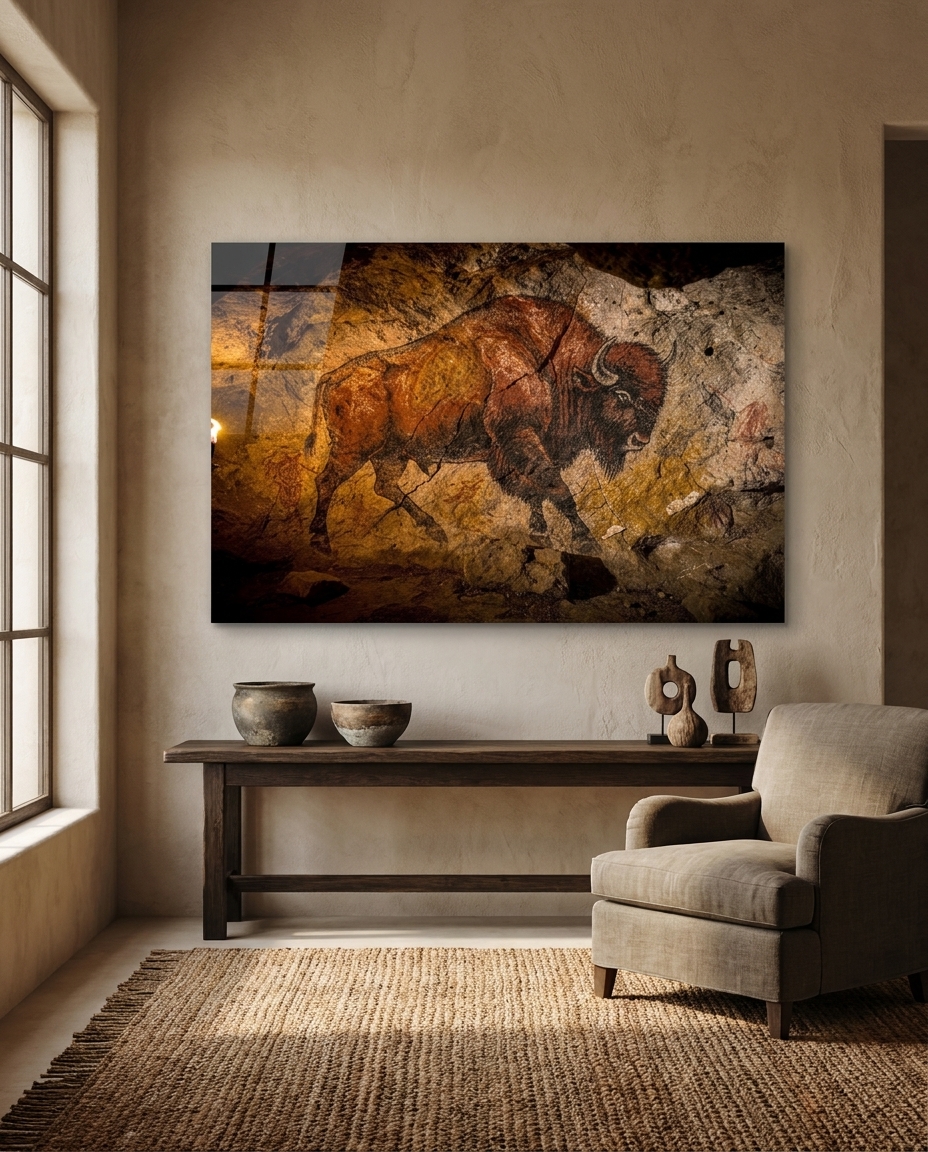
This work is a profound echo from the dawn of human expression, where the natural curvature of a limestone wall becomes the muscular heave of a great bison. The interplay of deep charcoal blacks and vibrant hematite reds creates a living presence that feels less like a painting and more like a manifestation of the earth itself. It captures the reverent moment when the first artists looked into the shadows of the cave and saw the spirit of the wild staring back.
Living with this piece is an exercise in grounding; it brings a sense of monumental history and raw, terrestrial power into a contemporary space. The warm, earthy palette and the rugged texture of the stone-frieze backdrop offer a tactile warmth that anchors a room. It serves as a silent guardian, reminding us of the eternal thread that connects modern consciousness to the primal instincts of the hunt and the hearth.
Purpose
This work seeks to bridge the chasm of millennia, evoking the spiritual connection between humanity and the animal kingdom while honoring the raw, unadorned beauty of natural pigments.
Interior Decorator’s Advice
- Position this in a space with warm, directional lighting to simulate the flickering torchlight of its cave origins
- Pair with organic materials like raw wood, unpolished stone, or heavy linens to enhance its earthy texture
- Best suited for a wall with significant presence, such as a study or a grand library, where its quiet dignity can command attention
Perfect For
- The collector who finds beauty in the origins of art and the rugged elegance of the natural world
- Those seeking an interior anchor that balances modern minimalism with deep, ancient warmth
- Admirers of historical narratives and the enduring power of the animal spirit
From the Paleolithic Cave Art collection:
This collection returns us to the oldest gallery on earth, the limestone walls of Lascaux, Chauvet and Altamira, where our ancestors pressed pigment to rock and gave the dark its first images. A bison gathers its weight, wild horses stream across the stone, the great aurochs lifts its horns, stags leap and a woolly mammoth looms from the shadow. Hands of the ancestors, blown in red ochre, sign the wall, and the hunt unfolds in a single charged breath. Together they trace an arc from the first creature to the spirit of the cave itself, the animal and the human meeting in the flicker of torchlight.
There is something quietly overwhelming in art made before writing, before cities, before memory. These images carry that primal hush, the awe of a figure facing the beast in the half-dark, the conviction that beauty was worth reaching for even then. To live with them is to keep a small fire burning at the very root of human creativity, ancient and yet startlingly close, a reminder that the urge to leave a mark on the wall is older than almost everything we know.
Key Features
- Material: High-definition Lambda Print — true silver-halide photographic exposure (Fuji Crystal DP II for colour, Ilford for black & white) on premium acrylic glass, glossy finish for exceptional depth and clarity.
- Finish: Face-mounted under 4 mm premium acrylic glass — Diasec technique.
- Backing: 3 mm alu Dibond composite panel.
- Style: Folk Art
- Edition: Unlimited.
- Mounting: Recessed aluminium subframe — ready to hang (invisible wall mounting, 25 mm offset).
- Longevity: 50–75 years archival conservation.


Reviews
There are no reviews yet