
Last updated: · Author: Olivier Cordoleani, founder of YTY (publisher of Photonumerique)
Every Photonumerique artwork is produced via the same gallery-grade process: true silver halide Lambda Print exposed by laser on premium photo paper, then face-mounted under glossy acrylic glass with a 3-layer Diasec sandwich, and delivered with a recessed aluminum subframe integrated on the back for invisible wall mounting.
Quick technical facts
- 4 mm premium acrylic glass on the front face
- 3 mm alu Dibond back panel
- ~7.5 mm total artwork thickness
- 25 mm wall offset via the recessed aluminum subframe
- 50 to 75 years archival longevity under proper conservation
- Over 45 sizes across 7 orientations
- TIPA World Award-recognized European production lab
- ~10 business days made-to-order production
4 mm acrylic glass — the gallery standard
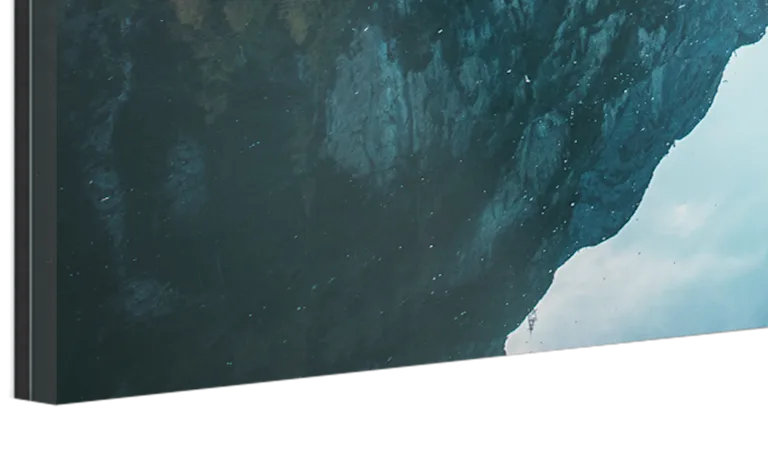
The front face is 4 mm of optical-grade premium acrylic glass — the gallery standard for face-mounted photography. Shatter-resistant, optically clearer than traditional glass, lighter, and easier to ship. The polished glossy finish enhances color brilliance.
Premium silver halide photo paper
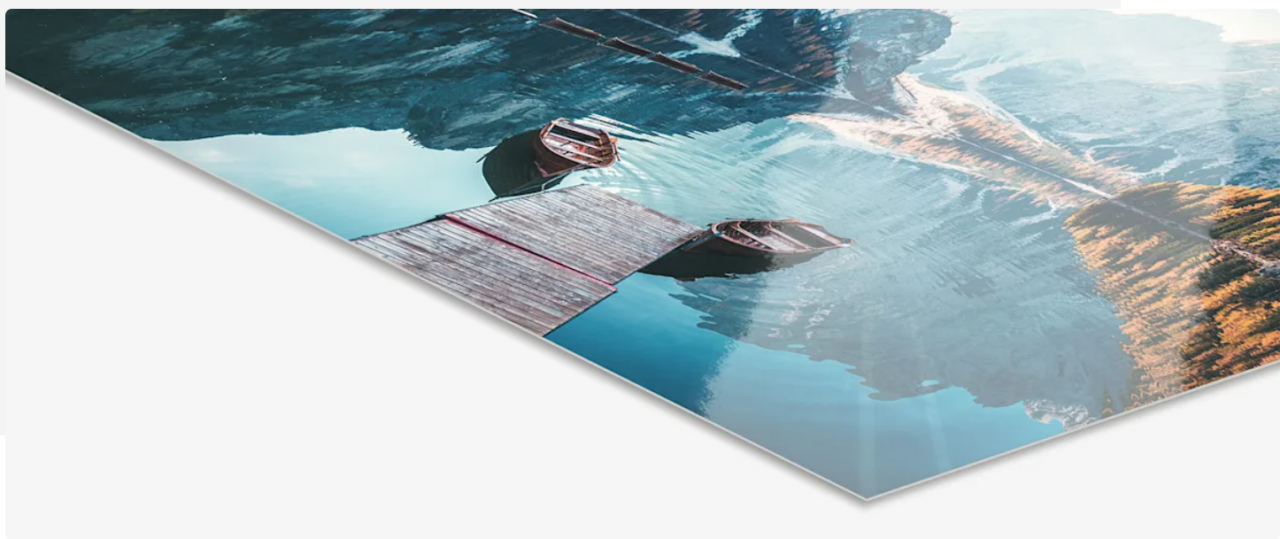
Your artwork is exposed using laser technology and developed in the classic photographic way. We use silver halide photo papers — Fuji Crystal DP II for color, Ilford for black and white. The same process used by major fine art photography galleries (Andreas Gursky, Wolfgang Tillmans, Thomas Ruff). Read the complete Lambda Print + Diasec technique guide →
Diasec face-mount: a robust 3-layer sandwich
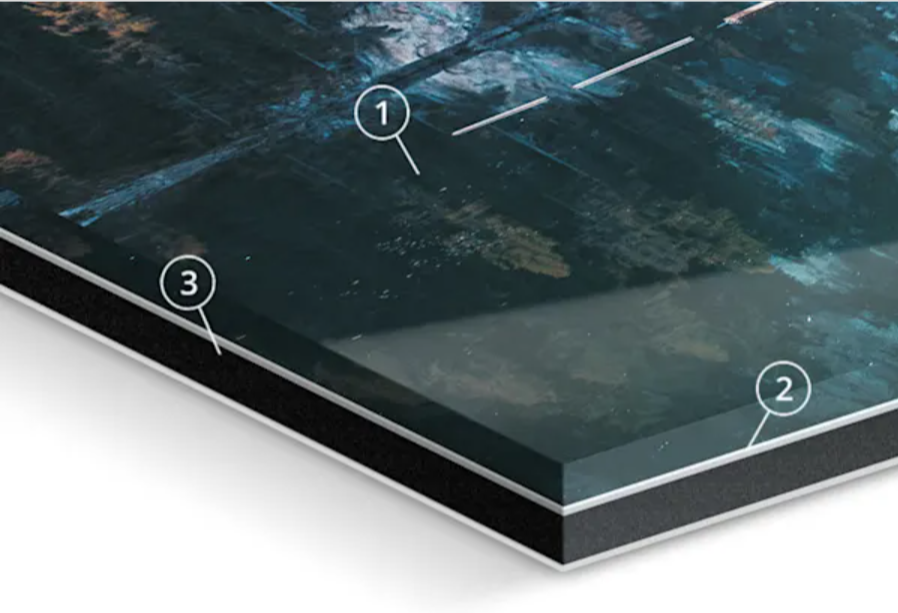
Combined with a 3-layer alu Dibond back panel, the acrylic glass gives your photographs exceptional stability. To seal the materials, we use durably elastic silicone that absorbs thermal expansion. The result: a face-mount guaranteed bubble-free and crack-free over time.
- Acrylic glass — 4 mm of glossy premium acrylic
- Photo paper + silicone — silver halide print sealed with elastic silicone
- Alu Dibond — 3 mm composite back panel (aluminum / polyethylene / aluminum)
Easy hanging: invisible aluminum subframe included

A custom recessed aluminum subframe is integrated on the back of every artwork. All hardware is included — your artwork arrives ready to hang. The artwork mounts with a wall offset of approximately 25 mm — appearing to float on the wall. Compatible with picture rails (cimaises).
Production, quality controls, and guarantees
- Made-to-order production — zero stock, nothing printed that has not been ordered
- 5-stage quality control on every artwork
- Lifetime warranty against manufacturing defects
- Hassle-free returns within 14 days
- Free shipping in metropolitan France
- Production by a TIPA World Award-recognized European lab
Want to go deeper into the technique?
The Diasec face-mount technique was developed in Switzerland in 1969 by Heinz Sovilla-Brulhart, who filed the patent in 1971, and it became the gallery standard in the 1980s. Combined with Lambda Print, it is the exact method used by Andreas Gursky, Wolfgang Tillmans, Thomas Ruff, and most contemporary fine art photographers represented by Gagosian, David Zwirner, and major museums. Our complete guide covers what Diasec and Lambda Print are, how they differ from direct-to-acrylic prints and metal posters, why they last 50 to 75 years, and a 10-step production walkthrough.
Looking for certified limited editions?
For limited edition numbered and certified artworks, compatible with the RELICKEEPER application, visit our sister gallery pixelrelic.art.
Frequently asked questions
Lambda Print is a true silver halide photographic process where Fuji Crystal DP II paper is exposed by high-resolution laser, then developed in a traditional photographic chemistry bath. The same process is used by Andreas Gursky, Wolfgang Tillmans, and Thomas Ruff. It produces deeper blacks and richer colors than inkjet printing.
Diasec is a face-mounting technique where a photographic print is sealed under a sheet of premium acrylic glass with an elastic silicone bonding agent. The silicone absorbs thermal expansion, preventing bubbles and cracks. Photonumerique uses 4 mm Diasec face-mount with alu Dibond backing for archival-grade longevity.
Each artwork measures approximately 7.5 mm thick: 4 mm of premium acrylic glass on the front, 0.5 mm of elastic silicone bonding, and 3 mm of alu Dibond on the back. The aluminum subframe extends the total wall depth to 25 mm when hung.
Acrylic glass is shatter-resistant, lighter than regular glass, optically clearer, and easier to ship without breakage. Premium 4 mm acrylic glass is the standard in fine art galleries and museums for face-mounted prints because it produces a visible depth effect impossible with traditional glass framing.
Alu Dibond is a 3-layer composite panel: aluminum, polyethylene core, aluminum. It is the industry standard for backing face-mounted photographic prints because it stays perfectly flat over decades, resists moisture, and won’t warp like wood or MDF. Photonumerique uses 3 mm Dibond on every artwork.
Photonumerique prints are produced at a European photography laboratory recognized by TIPA Awards for excellence in fine art reproduction. The lab specializes in silver halide Lambda Print and Diasec face-mounting.
TIPA (Technical Image Press Association) Awards are the photography industry’s most respected international awards, voted by the editors of 30 photography magazines and websites worldwide. A TIPA-Award lab certification indicates technical excellence in photographic reproduction, comparable to a Michelin Star for restaurants.
Lambda Prints on Fuji Crystal DP II paper retain color fidelity for 50 to 75 years under proper conservation conditions (indoor display, normal lighting). Face-mounting under acrylic glass protects the print from UV, humidity, and direct contact.
Yes. Every Photonumerique artwork ships with a custom recessed aluminum subframe integrated on the back. Installation requires only one wall screw — no additional hardware, no separate frame, no kit to buy. The artwork floats 25 mm off the wall and is compatible with picture rails (cimaises).
Photonumerique guarantees the artwork against manufacturing defects (bubbles in Diasec face-mount, warping of alu Dibond, separation of layers) for the lifetime of the customer. Damage from improper handling, direct sunlight exposure, or environmental factors is not covered.