

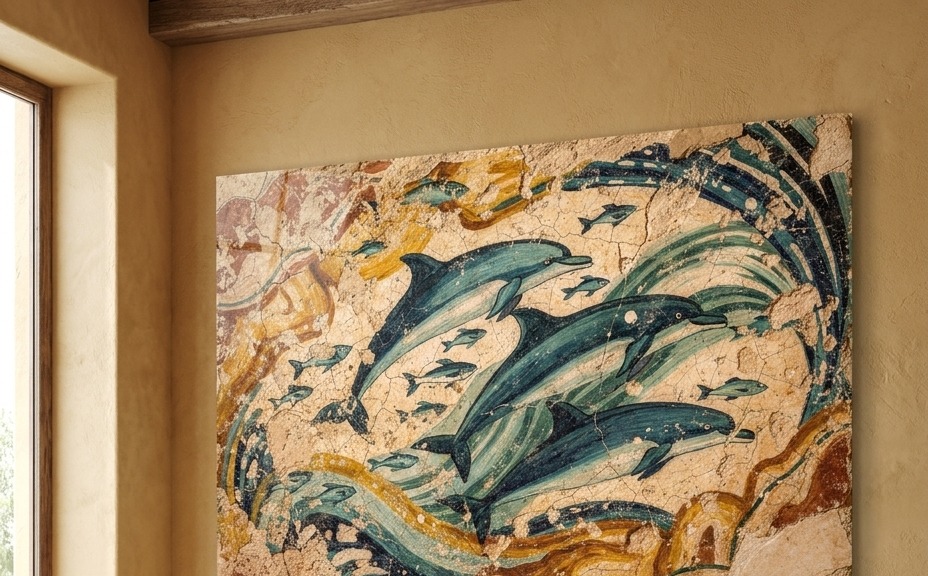
Eight original works from the Bronze Age Aegean — pure white marble idols and sun-warmed frescoes of the sea. Our Cycladic and Minoan Art collection continues our walk through the whole history of art, one movement at a time.
Where it sits in art history
Long before the temples of classical Greece, two island cultures of the Aegean created some of the most beautiful art of the ancient world. On the Cyclades (around 3000–2000 BCE), sculptors reduced the human figure to serene, almost abstract white-marble idols whose purity would astonish modern artists three thousand years later. On Crete, the Minoans (around 2000–1450 BCE) painted a civilization in love with nature and the sea — leaping dolphins, curling octopuses, saffron gathered among red rocks, youths vaulting a sacred bull — in luminous blues, ochres and terracotta. Together they mark the true dawn of European painting and sculpture. This collection is an original homage to that Aegean spirit, never a copy of a single relic.
The need — the decorator’s eye
Few things bring more calm and light to a room than the Aegean palette: cool marble, sea-blue, warm earth and cream. The marble idols anchor a wall with pure, modern silhouette; the frescoes fill a space with Mediterranean warmth and movement. Timeless, serene and quietly sophisticated — exactly the light, natural mood interiors are reaching for today.
The production — the art director’s vision
We created eight original scenes in the two Aegean voices: the pared-down marble of the Cyclades — The Folded-Arm Idol and The Marble Harpist — and the breathing fresco of Minoan Crete — Dolphins of the Blue Sea, The Bull-Leapers, Octopus of the Deep, The Saffron Gatherers, Lilies of the Spring and The Serpent Goddess of Knossos. Each keeps the aged plaster, fine craquelure and living line of the originals, painted entirely in their spirit.
The sale — the gallerist’s word
Eight works bound by the light of the wine-dark sea. Face-mounted under acrylic glass, the marble gains translucency and the fresco pigment real depth. Hang Dolphins of the Blue Sea as a single luminous statement, or pair a cool marble idol with a warm fresco for the full Aegean dialogue. This is the fifth chapter of a gallery walking the entire history of art, from the first cave wall all the way to 2026.