

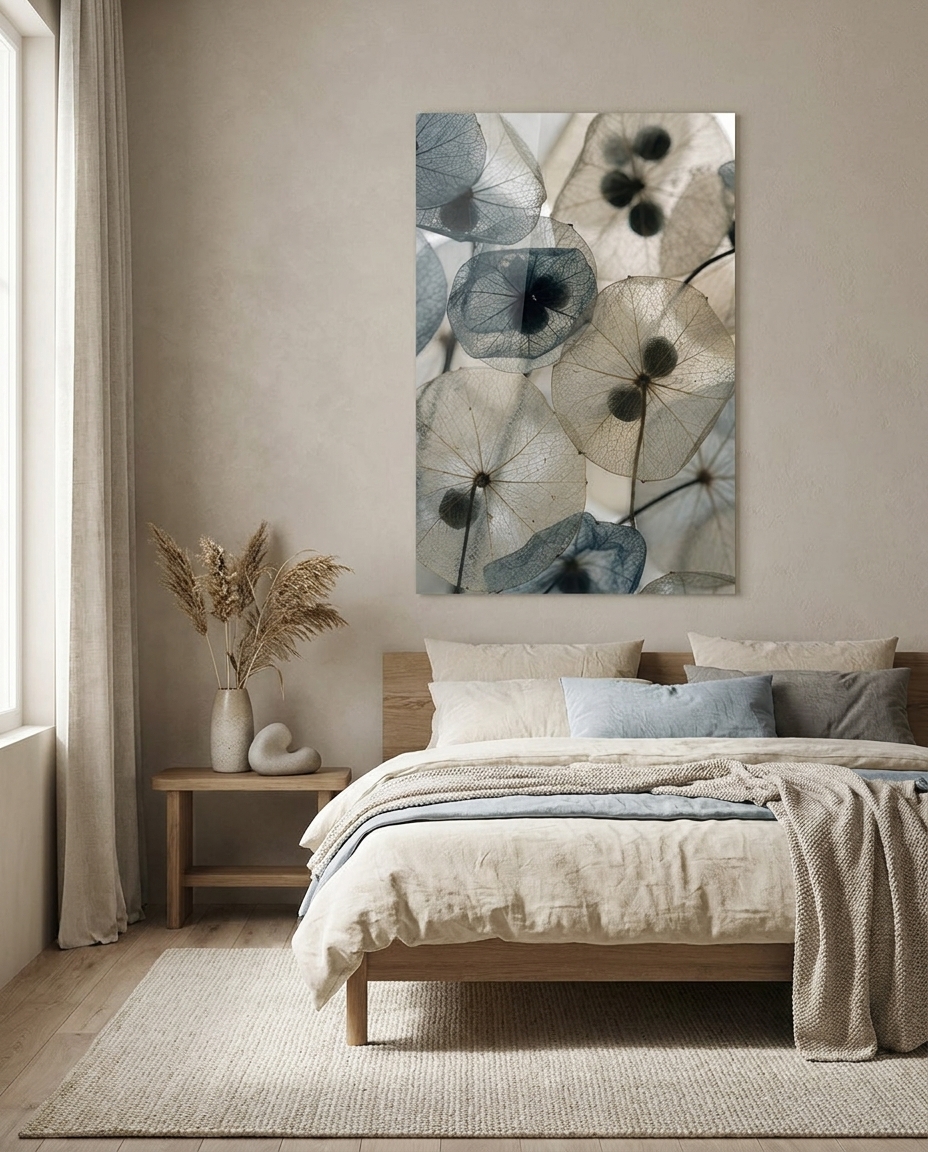
Botanical art has a sentimentality problem. Centuries of bouquets and pressed-flower plates have trained us to see plants as decoration — pretty, pleasant, unthreatening. This collection looks at them the other way: as engineering.
The plant as structure
Growth follows rules. A seed head arranges its florets in interlocking spirals whose counts are consecutive Fibonacci numbers, because that spacing packs the most seeds into the least area. A leaf distributes its veins in a branching network that solves the same problem a river delta solves. A fern unrolls from a spiral because a spiral is the most compact way to store a length of tissue that must later extend.
None of this is metaphor. It is the actual reason these forms look the way they do — and once you see the rule, the form stops being decorative and becomes inevitable.
Clarity instead of atmosphere
Everything here is rendered sharp, even and calm, lit as if by a north-facing window. There is no drama, no chiaroscuro, no soft focus. The structure is the whole event, so the light does nothing but reveal it. The palette follows suit: dusty blue, sage, olive, bone and oyster grey, with rust used sparingly and only where growth itself is warm.
The collection
Eight structural studies, each filling its frame edge to edge. The radial fan of veins on a leaf’s underside. The ordered spiral of a seed head. Backlit seed-pod membranes with their ribs showing through. An uncurling fern crozier. The concentric rings of a cut trunk. The lace ribs of a skeletal leaf. A cluster of succulent rosettes from directly above. And the delta-like vein network of a magnified petal.
Living with it
Soft blue and sage are the easiest premium colours to live with, which makes this the most placeable collection we have made: it will sit in a living room, a bedroom, a consulting room or an office without adjustment. Symmetrical, frontal compositions like these hang well in pairs and in grids, and they suit curved furniture — the circular geometry answers the arc of a rounded sofa. Even, indirect light serves them best; they have no shadows to lose.