

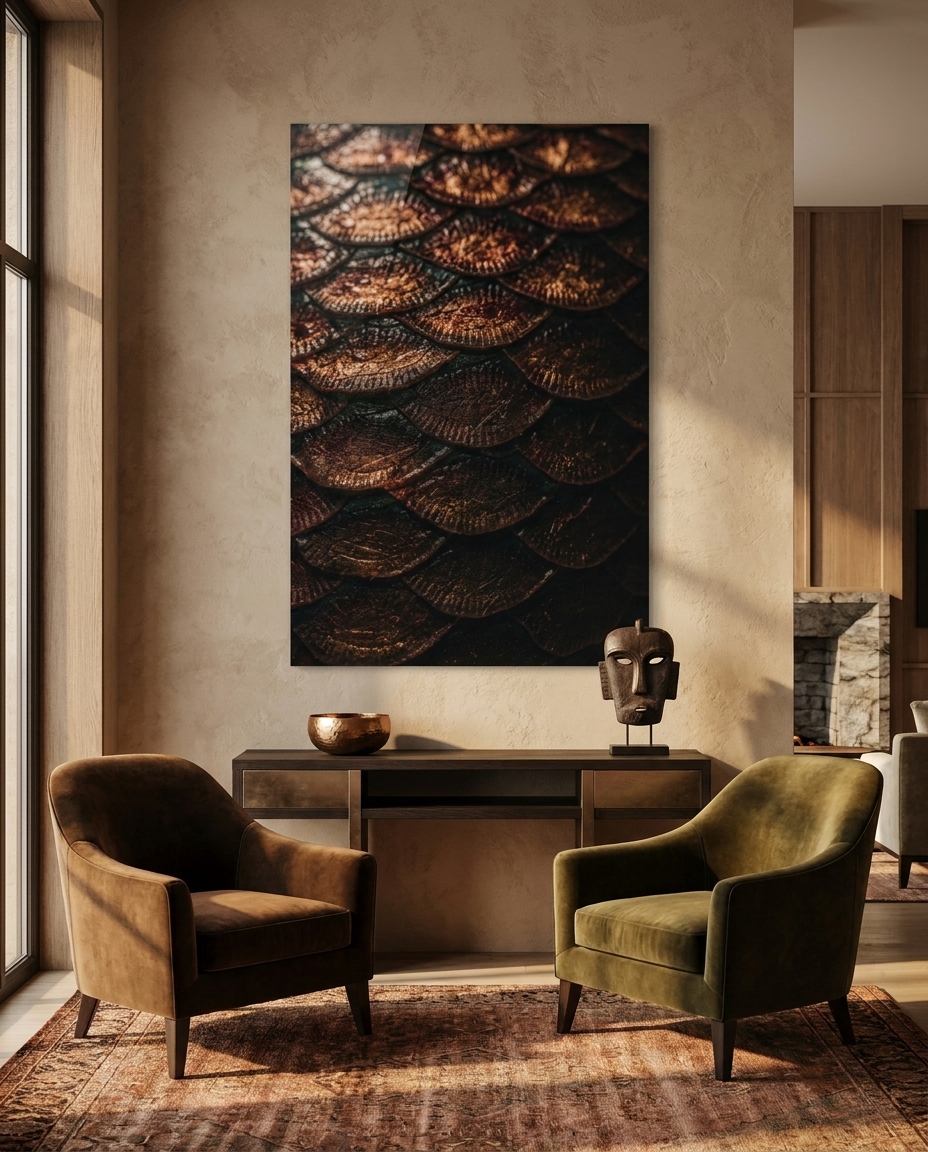
Dark Water Burning is our new collection of eight works, and it started from a colour problem rather than a subject. Autumn interiors have gone deep and warm — cognac, rust, oxblood, moss, petrol green — and almost nothing on the wall-art market is built for them. Most water photography is bright, blue and cold. We wanted the opposite: water so dark it reads as a field, with something warm burning inside it.
The need — art that has to win against the wall
Our interior decorator made the argument first, and it was blunt. Interiors have swung away from the curated calm of the last few years. People want a room that expresses them, not one that matches the sofa — and the single loudest consequence of that swing is that full-wall wallpaper is back. Pattern is on the wall again, sometimes floor to ceiling.
That changes what a picture has to do. Against a busy ground, a light, low-contrast image simply disappears. What survives is a dark field with one legible shape inside it, readable from three metres across the room. So the brief was set from the wall backwards: at least two thirds of every frame in darkness, one subject, one gesture, high contrast, no competing detail.
The second argument was about the surface itself. For years we treated the gloss of acrylic face-mounting as something to apologise for. This season the reasoning inverted: lacquer is back as a premium finish, and the rule everywhere is a single glossy surface framed by matte ones. A deep, wet, near-black image on a mirror-smooth panel is not a compromise — it is the one reflective object in a room of plaster, wool and unfinished wood. It is also genuinely useful: a face-mounted panel throws light back into dark rooms, which is exactly where these works belong.
The production — grain, halation, and one warm chord
The art director set three rules and refused to bend them.
First, the water is the picture plane. No tank, no glass wall, no shoreline, no object floating on a background. The frame is filled edge to edge with petrol green and ink, and whatever lives in it emerges from that darkness rather than sitting on top of it.
Second, one warm chord and nothing else. Oxblood, cognac, copper, rust — the living bodies and the light they catch. No pastel, no cold grey, no clinical aquarium blue. In Architecture of Scales that chord fills the whole surface; in The Eye Emerges it is reduced to a single wet eye and a gill plate, with the rest of the animal dissolving back into black.
Third — and this is the one that defines the set — the softness stays in. The dominant fine-art register this season is what the design world has started calling grainy blur: silver grain, halation blooming around highlights, edges diffusing, slight chromatic drift, motion smeared rather than frozen. It is an image the viewer finishes rather than one that arrives finished. Water is its natural home. So there is no maximal micro-contrast here and no seamless polish; the works are closer to Pictorialist night studies and Tonalist painting than to underwater photography.
Only one work fought back. The first version of Under the Ice came out with the frozen sheet reading as a bright white field over half the frame, which broke both the darkness rule and the warm chord. We remade it with the weight inverted — the ice as a dark grey-green lens, thin and wet, its fractures showing only as faint hairlines, and the rust-coloured bodies below carrying all of the light.
The sale — one corpus, eight variations
The gallerist’s contribution was the discipline of the series. Prints and multiples are the one part of the art market where buying online is the norm rather than the exception, and what carries a series there is not scarcity but coherence: a body of work that is recognisable at a glance and re-readable over years. So the eight share one water, one light and one grain, and they are all in the same portrait format — because the gallery wall has thinned out to three or five pieces, and what sells now is a set of matching works hung with space around them, not an assortment.
They divide cleanly by temperature. Three Backs Rising, Rain on Water, Veils of Fin and Architecture of Scales carry the warm, close end — koi, fins and scale in copper and oxblood, at home in a living room, a bedroom, a lounge. One Turning Body, The Descending Column, The Eye Emerges and Under the Ice hold the cold, vast end — the shoal, the shaft, the eye, the frozen lid — and belong in a study, an entrance hall, a stairwell, a dining room that is already low-lit.
Our advice is the same for all eight: hang one large and alone, or hang three of them in a row at the same size. Surround the gloss with matte — a thin dark metal or matte walnut edge, a plaster wall, a wool rug. And light them indirectly: these blacks stay open and tender under soft light, and go hard and reflective under a spot.
The eight works
- Three Backs Rising — koi ascending toward the surface from below, oxblood and copper backs blooming with light against near-black water.
- One Turning Body — a shoal of thousands turning as a single olive-silver mass, its edges dissolving into the dark.
- Rain on Water — carp under a rain-pocked surface, concentric rings of impact scattering copper light across their backs.
- The Eye Emerges — one large fish coming head-on out of total darkness, only the eye and the gill plate in focus.
- Veils of Fin — trailing fins and tails in raking copper light, translucent veils layered over one another.
- The Descending Column — a vertical shaft of water seen from the surface down, a shoal falling into deep teal darkness.
- Under the Ice — rust-coloured bodies gliding beneath a thin frozen lid, the ice a dark wet lens.
- Architecture of Scales — overlapping scales in raking light, edge to edge, oxblood and cognac plates with wet highlights.
Each work is produced as a high-definition Lambda print, face-mounted under acrylic glass on an aluminium composite panel — a support that carries light into the image and gives these deep blacks the depth they were made for.