
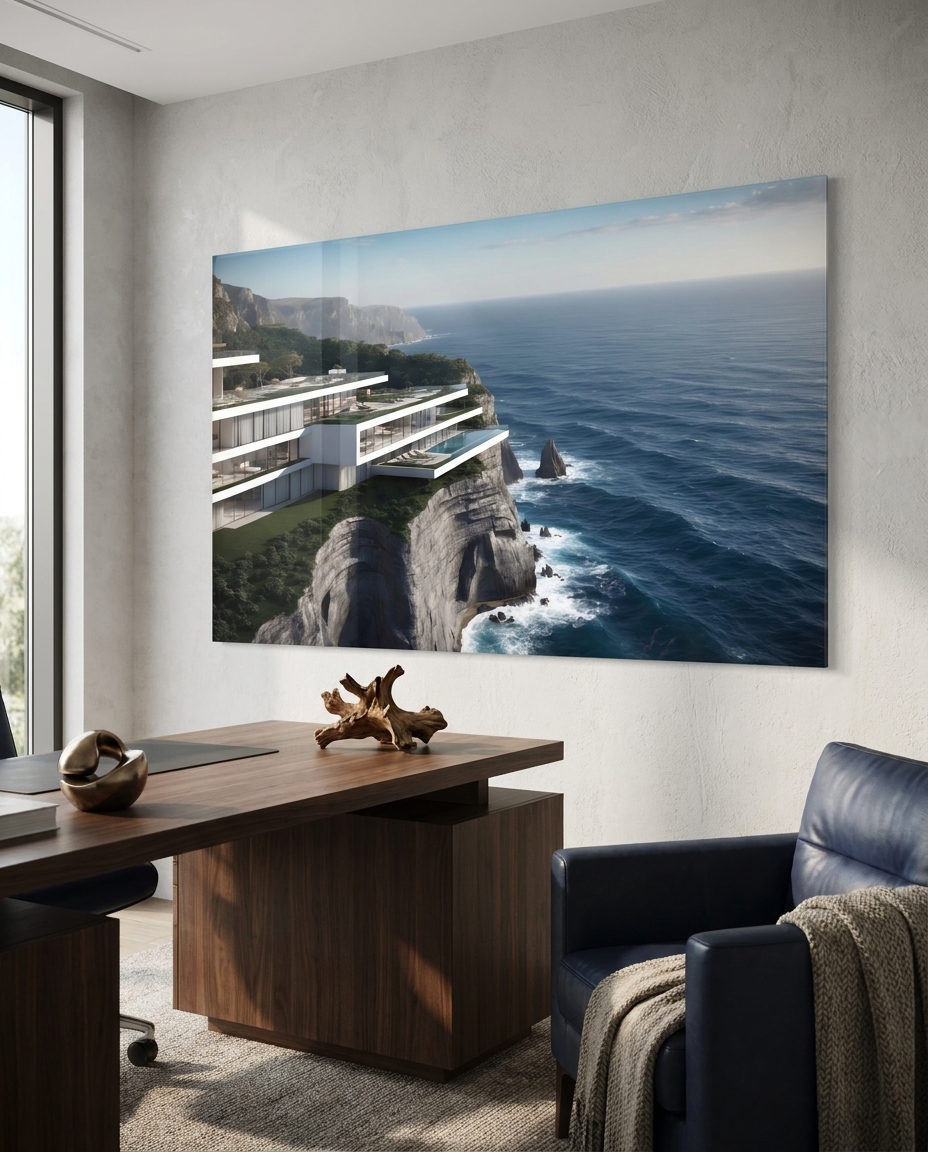
Modern Reflections: The Intersection of Architecture and Nature gathers eight modern dwellings poised inside wild landscapes — a cliff, a lake, a dune, a forest clearing — where glass and steel stop competing with the site and learn its quiet language instead. It is architecture photographed at the exact hour the building gives in to the weather around it.
The need — the calm that still has a point of view
Our decorator opened this collection from a very concrete demand. Interiors this season have moved away from safe neutrality toward rooms that make you feel something, but there is a room type that still needs to breathe: the office, the entrance hall, the hotel corridor, the bedroom that has to stay restful without going bland. Architecture answers that better than abstraction — it gives the eye a horizon, a structure, a place to stand — and it does it without imposing a mood on the whole room.
The pieces divide cleanly by room. Cliffside Retreat with Ocean View and Seaside Villa at Sunset are the wide horizontal anchors: above a headboard, above a sideboard, in the long stretch of a hallway where you want depth rather than incident. Glass Pavilion in a Forest Clearing and Floating House on a Tranquil Lake carry the green axis that is now leading interiors ahead of brown — mineral greens, teals, olive — and they sit naturally in a wellness room, a reading corner, a spa. Desert Mirage: Glass House in the Sand and Mountain Lodge with Panoramic Views bring the warm earths of the season, caramel and stone and rust, into rooms that need heat rather than coolness. Urban Park with Modern Sculpture and Urban Oasis: Rooftop Garden are the city pair, and they are the ones that work in a workplace without looking corporate.
One practical note our decorator insists on: this is a collection to hang as a single large piece or a spaced trio, not as a dense grid. And because the surface is a lacquer-like acrylic glass, it should be framed by matte — a thin unpolished metal edge, a chalky wall, wood, textile. The shine is meant to be the one reflective object in a tactile room, and it repays the compact, darker spaces where it throws light back at you.
The production — the hour that decides everything
The art director’s brief was narrow on purpose: build each image around the moment when the building and the landscape hold equal weight. Not the glossy architectural render where the house wins, and not the postcard where the landscape wins. That balance is decided almost entirely by light and by hour.
So each piece has its own hour. Seaside Villa at Sunset is worked in the low raking light where glass turns amber and the sea goes matte. Desert Mirage: Glass House in the Sand is built on heat haze — the edges of the structure are deliberately allowed to dissolve into the air, so the eye finishes the outline rather than reading it. Floating House on a Tranquil Lake is the collection’s essay on reflection: the water carries the second half of the composition, and the horizon between them is soft rather than ruled. Glass Pavilion in a Forest Clearing is the most atmospheric of the eight, canopy light and grain doing the work that hard rendering would ruin.
What the art director refused, deliberately, was the seamless technical polish that architectural imagery defaults to. Perfect surfaces are the cheapest thing to make and the least interesting thing to look at. There is grain here, there is haze, there are edges that go undefined — the atmosphere is the subject, and the building is what gives it a scale. Under acrylic glass that decision pays: the depth from a lit facade to a shadowed interior stays open instead of flattening, and the reflected surfaces in Urban Oasis: Rooftop Garden keep the sense that you are looking through something rather than at it.
The sale — the easiest yes in the catalogue
Our gallerist is straightforward about why this collection travels. Architecture is the subject that almost never generates an objection. It carries no politics, no figure to identify with or against, no style commitment a buyer has to defend to a partner. Someone who would hesitate over a portrait or an abstraction will hang a glass house on a cliff without a second thought — and the piece still has a point of view, which is what separates it from decorative filler.
That makes it our natural entry work, and it makes it the collection professional buyers come back to. Hotels and offices buy in repeated formats and rotate them by season; these eight are built for exactly that, with a shared visual grammar across very different sites. For a private collector, the strongest purchase is a spaced trio — one water, one desert, one forest — which reads as a considered series rather than three separate decisions.
Each work is produced as a museum-quality print face-mounted on acrylic glass, made and shipped from our own studio, and each carries its own documented origin. What we are selling here is not technical perfection, which has become common; it is a consistent eye applied eight times to the same question — what happens when a building stops arguing with its landscape.
→ Discover the Modern Reflections: The Intersection of Architecture and Nature collection