
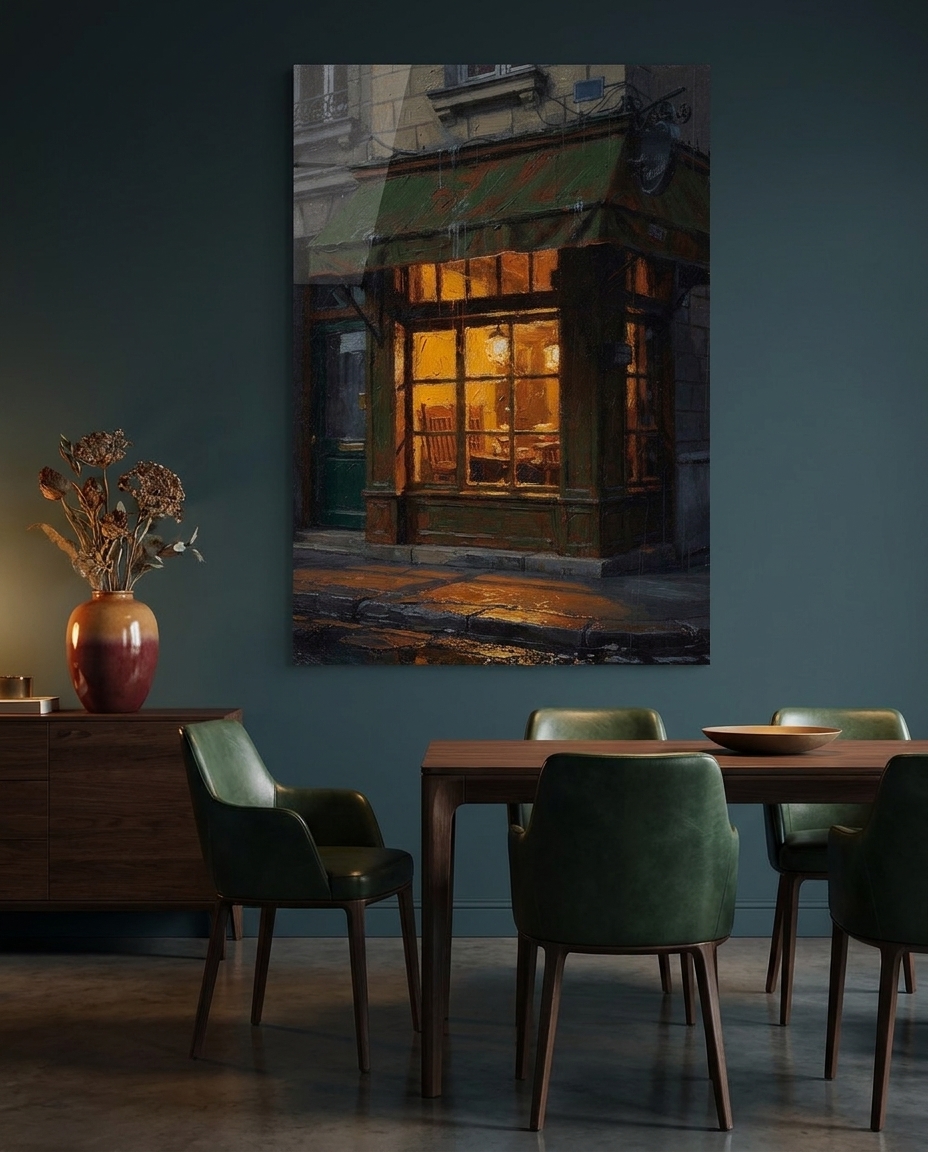
There is an hour, late in a wet evening, when a city stops being a place you cross and becomes a place you look at. The shops have closed, the traffic has thinned to nothing, and the only things still awake are the lamps. Each one throws its small room of amber onto the stone, and the rain doubles it. Lamp Hours is eight vertical oil paintings made inside that hour.
It is a collection of urban nocturnes — streets, a bridge, a quay, a stair, a closed café, a lit vitrine, a single lamp in the snow — painted as easel pictures, with the weight and the hand of fine art. Nothing in them is a real address. They are the old city everyone carries in memory, rather than any city on a map.
The need — the decorator’s eye
“Fine Art” is the first box a collector ticks when browsing a gallery online, and until this week it was the one shelf we could not fill: our catalogue was rich in photography, in historic styles and in atmosphere, but it had no body of work that simply presented itself as painting. That was the gap to close.
The interior that asks for it in 2027 has changed its walls. The crowded salon hang has thinned to three to five spaced pieces, or a single large one; wallpaper has come back across whole walls, often dark and patterned. Against that ground, a pale, polite picture disappears. So every work here is built to hold a wall from three metres: a dark field covering at least half of the canvas, one or two clear sources of light, and a simple structure the eye reads at once — a street receding, an arch, a stair climbing, a window glowing. They belong in the rooms that are lived in after dark: the living room, the study, the dining room, the hallway. Hung in threes, in the same vertical format, they read as one decision.
The production — the art director’s vision
The series follows one internal rule: the night is green, and only the lamps are warm. The darks are deep petrol, blue-black and moss, laid in thin transparent glazes. Every light — lamp globe, shop window, lantern on a wall — is cognac, amber, rust or oxblood, and every light is built up in thick impasto, so it physically stands proud of the surface. Between the two, the wet ground does the work: reflections dragged downward in long vertical strokes across cobbles, asphalt and river water.
We did not chase a polished finish. Halation blooms around each lamp, edges are allowed to dissolve into the rain, and the brushwork stays visible from corner to corner. Perfect rendering is now the cheapest thing in the world; what remains rare is intention, and a surface that shows how it was made. There are no people here and no readable signs — nothing to date the scene or tie it to a place, only light, stone, water and weather.
The sale — the gallerist’s word
What we offer here is a coherent series rather than a single spectacular image: eight works that speak the same language, so that one piece is a quiet, glowing presence in a room and three are a wall with a point of view. That coherence is what carries a collection today, far more than scarcity or technical display.
Each work is printed on 4 mm acrylic glass, backed with Dibond. The gloss is not an accident here: in a room of matte surfaces, the lacquered face of the print behaves like the wet street in the painting, catching whatever light is in the room and sending it back. Give it a dark wall and a low lamp beside it, and the picture keeps glowing after everything else has gone quiet.
The eight works
- The Long Recessional — a rain-washed cobbled street running away under a line of lanterns, into petrol-green dark.
- Arch and Reflection — a heavy stone bridge over black water, its lamps doubled and broken by the current.
- After Hours — a corner café closed for the night, one window still full of honeyed light under a rust awning.
- The Stepped Ascent — a narrow stair-street climbing between old walls, a single lantern warming the wet steps.
- Boulevard at Rest — an empty avenue in fine rain, tram rails catching the amber of the lamps all the way to the vanishing point.
- The Vitrine — a curved glass kiosk glowing oxblood and gold, alone in a wet stone square.
- Quayside Slumber — two dark barges moored along a stone quay, one lamp standing guard above the river.
- First Snowfall — a single iron street lamp in falling snow, its halo turning the flakes to warm sparks.
See the whole series here: Lamp Hours.