
Signal Weather is our new collection of eight works, and it began with a simple observation: the most calming thing on a wall is rarely a quiet picture. It is a strong one, drawn with so few lines that the eye settles instead of searching.
Weather is the least quiet subject there is. Fronts collide, swells roll in from far away, fog swallows a coastline in minutes. We wanted to see what happens when that restlessness is translated into the calmest language modern design ever invented: hard edges, flat colour, and a great deal of empty space.
The need — a wall that anchors a room without shouting
Our interior decorator made the case first. The rooms people are furnishing this season are open and long: a living space that runs into a dining area, a home office that doubles as a guest room, a corridor wide enough to be a gallery. What they lack is not colour but an anchor, one piece that tells the eye where the room begins.
Busy images fight with open plans. Graphic ones hold them. A single disciplined shape, a clear horizon, a band of warm colour against a cool field: these read from across the room and still reward a close look. That is the brief the decorator handed over: works legible at ten metres, restful at one.
The production — the sky, drawn with a ruler
Our art director took that brief to the tradition that solved it a century ago: the geometric abstraction of the Bauhaus and the Swiss poster school, where a circle can be a sun and a diagonal can be a whole storm. Each work in Signal Weather takes one atmospheric event and reduces it to the fewest forms that still carry its temperament.
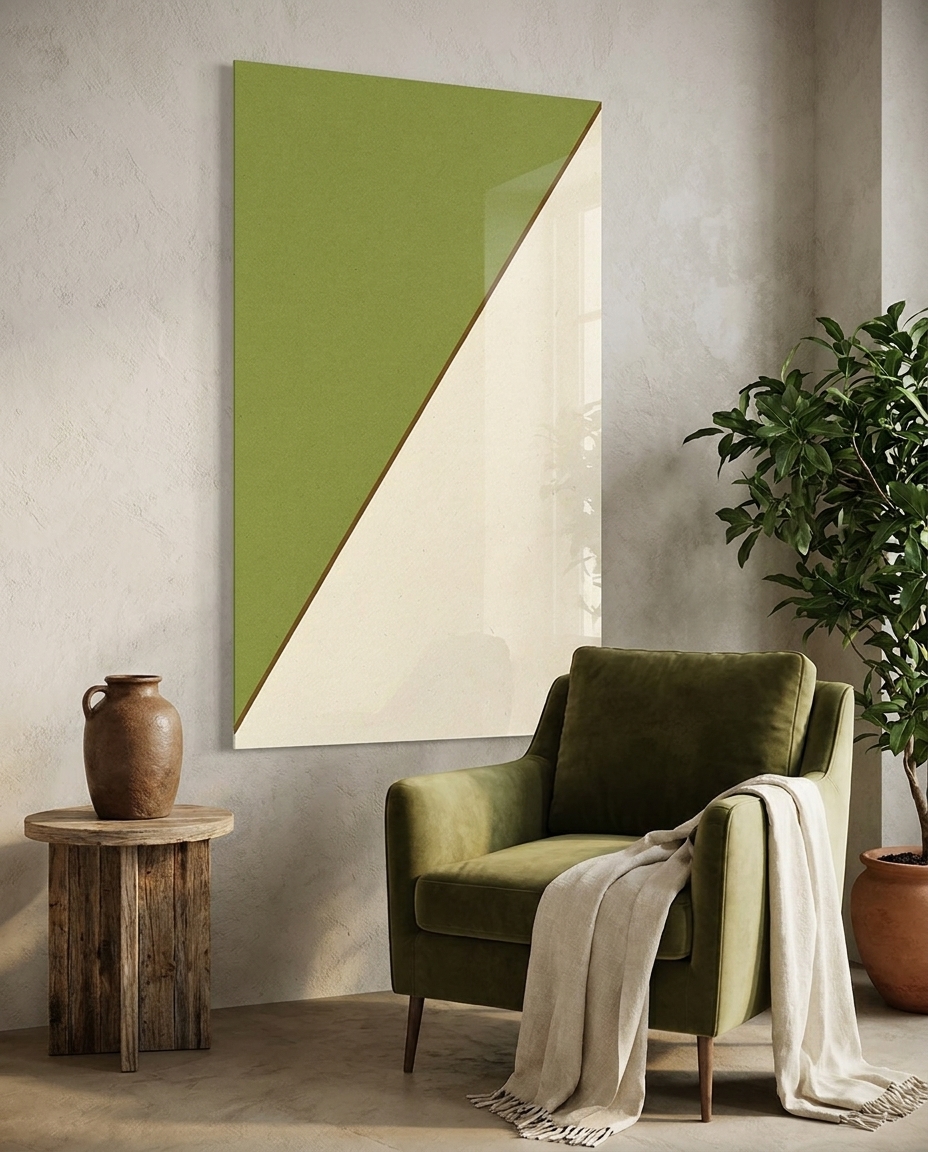
A cold front becomes a single razor diagonal between warm and cool. A long ocean swell becomes stacked bands of petrol blue with one ribbon of earth. Fog is a pale field broken by one strike of ochre light, and the wind is a sheaf of arcs sweeping across olive green. The palette is deliberately narrow: petrol teal, olive, ochre, oxblood and warm cream, so the eight works sit together as a family.
The surface matters as much as the drawing. Printed as a Lambda photographic print under 4 mm acrylic glass, flat colour takes on real depth: the teals turn liquid, the ochres glow, and the cream grounds stay perfectly even, without a trace of texture to distract from the geometry.
The sale — eight signals, one horizon
Our gallerist sees two ways to live with the collection. The first is a single piece chosen for a single room: Zenith above a sofa, Snow Line in a study, Fog Bank in a bedroom that needs to slow down. The second is a sequence. Hung in a line along a corridor or behind a long credenza, three or four works read like a forecast, one weather after another, held together by the shared palette and the same measured calm.
These are works for people who like their art bold but their rooms serene, and for designers furnishing hotels, offices and homes who need pieces that belong to a set without repeating each other.
The eight works
- Zenith: an amber sun balanced above concentric arcs, the poise of midday made graphic.
- Cold Front: one sharp diagonal, the exact line where warmth gives way to cool stillness.
- Long Swell: undulating petrol depths anchored by a single ribbon of sun-warmed earth.
- Occultation: amber and oxblood discs meeting in a silent, eclipse-like alignment.
- Windward: arcing lines sweeping across olive green, charting the paths of the wind.
- Fog Bank: the cool weight of coastal mist, pierced by one radiant strike of ochre.
- Rain Bands: the cadence of a summer shower translated into poised vertical order.
- Snow Line: a sunlit peak reduced to its geometry, above a vast and silent horizon.
Discover the full collection on its page: Signal Weather.