
A hanging scroll is read from the bottom up. The eye starts at a rock or a pool in the foreground, climbs a path, crosses a band of mist and arrives, finally, at a peak or a sky. Mineral and Mist is eight tall paintings built on that slow climb, in the manner of four Asian schools that each learned, in their own way, to paint a place you could stand in front of in silence.
Two works come from the ink-wash landscape of China, two from Korea, two from the mineral palette of Tibetan painting, and two from the painters’ villages of Bali. They are not copies of any known picture: the mountains, lakes and terraces are invented. What they share is a format, a ground and a colour key — enough to hang as one series.
The need — the decorator’s eye
Our catalogue is deep in Japanese art, but it had almost nothing to offer the collector who filters for Chinese ink painting, Korean, Tibetan or Balinese: two or three works in each, too few to make a real shelf. Those four traditions are exactly what people look for when they furnish a calm room — a study, a bedroom, a reading corner, a spa-like bathroom — and this collection was made to fill that gap.
The interiors of 2027 have also changed what a picture must do. Walls are darker, often green or slate blue, sometimes papered from floor to ceiling, and the crowded salon hang has thinned to three or four spaced pieces. So every work here holds at least a third of its surface in deep tone — ink mountains, night water, dense foliage — against the pale of the mist, and reads clearly from across a room. The vertical format is the scroll’s own, and it suits the places a scroll was always meant for: beside a doorway, at the end of a hall, above a low bench.
The production — the art director’s vision
The series rests on three shared rules. First, the ground: every picture is painted on an aged, toned support — tea-coloured silk, unbleached cotton, mulberry paper — with its grain, its foxing and the soft edge of its mount left visible. Second, the palette: the mineral colours these schools ground from stone, darkened and warmed for today’s rooms — carbon black, malachite, petrol teal, azurite turned towards slate, moss and olive — with a single warm note per picture, a cinnabar sun, a coral heliconia, the amber band of a dusk sky. Third, a private motif that runs through all eight: somewhere in each one, a pine, or a ribbon of drifting mist.
Within those rules, each school keeps its own hand. The Chinese works build their peaks wet into wet, from black to the palest grey. The Korean landscape cuts its granite with hard vertical strokes, while the folk panel lays out its longevity symbols in flat, cheerful colour. The Tibetan pictures draw clouds as ribbons outlined in a hair of gold. The Balinese works fill the frame edge to edge with leaves, one in the dense nocturnal manner, one in the bright flora-and-bird manner. The brush stays visible everywhere; the mist is allowed to blur and grain. And, unlike their models, none of them carries a seal, a poem or a name: the margins are left plain.
The sale — the gallerist’s word
This is a collection to live with in pairs or threes. Two works from the same school make a natural diptych; three from different schools, hung at the same height in the same format, make a wall that reads as one decision. A single piece works on its own in a quiet room — Pine in the Rain above a bed, The Turquoise Lake in a meditation corner, The Night Terraces at the end of a dark hallway.
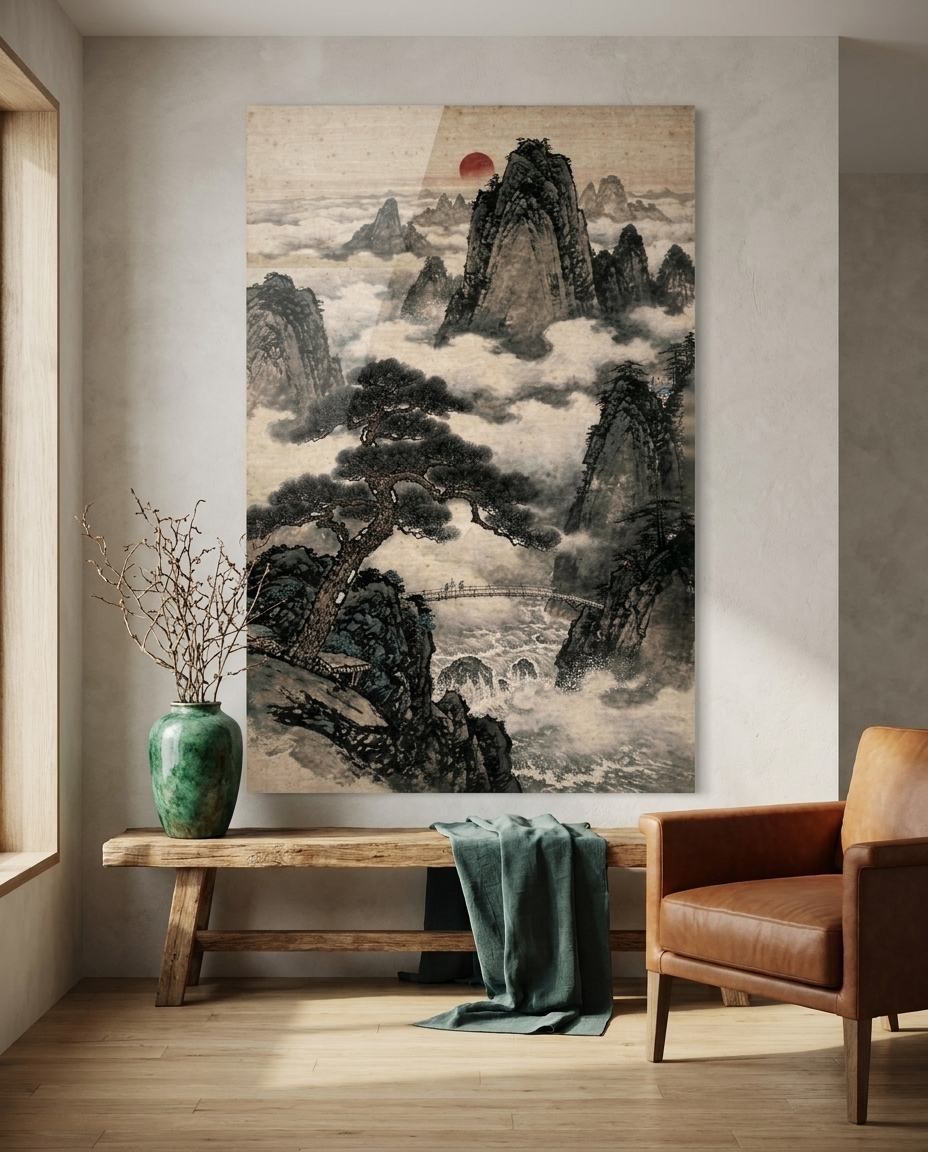
Each work is printed on 4 mm acrylic glass, backed with Dibond. In a room of linen, oak and limewash, that lacquered face becomes the one luminous surface: it deepens the blacks of the ink, makes the malachite glow, and gives back the light of a lamp after dark.
The eight works
- Cloud Above the Pass — ink peaks rising out of a sea of cloud, a crooked pine on the cliff and a small bridge over a torrent far below.
- Pine in the Rain — an old pine bending over dark water in slanting rain, the far shore lost in mist.
- True-View Granite — pale granite domes cut with strong vertical strokes, dark pines massed at their feet.
- Ten Long Lives — a folk panel of longevity symbols: red sun, blue-green mountains, waves, pine, cranes, deer and turtle.
- The Turquoise Lake — a round turquoise lake held in a crown of snow peaks, under ribbon clouds traced in gold.
- Lotus on Dark Water — three lotus flowers rising from indigo-black water drawn in concentric gold lines.
- The Night Terraces — rice terraces stepping down a dark ravine at dusk, white herons in the paddies.
- Kingfisher and Frangipani — a kingfisher on a frangipani branch among banana leaves and heliconia, on deep teal.
See the whole series here: Mineral and Mist.