

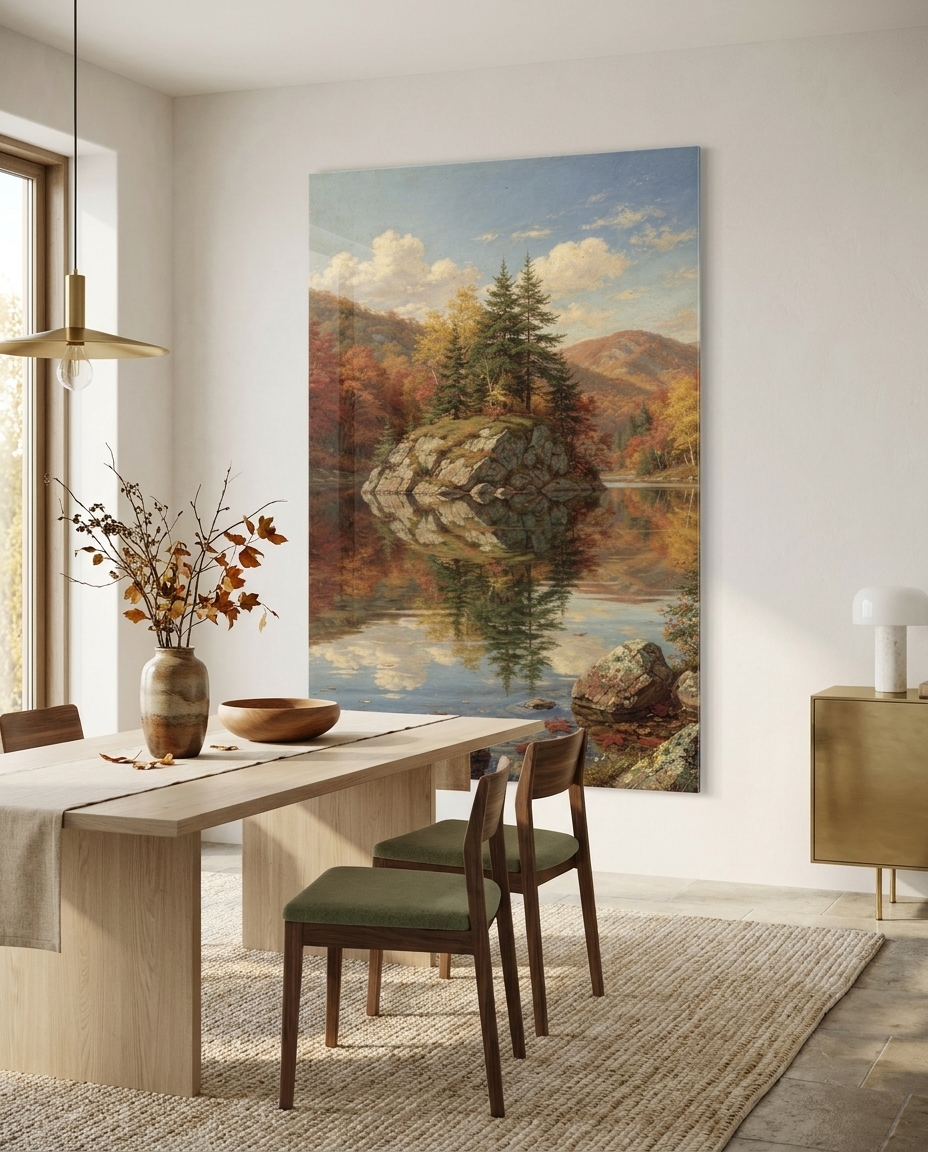
Last time we stood in European fields and forges with the Realists, who found dignity in ordinary work. At the same moment, on the other side of the Atlantic, a group of painters looked up from the farm and out at the wilderness. They saw rivers winding through valleys no one had cleared, gorges carved by storms, lakes so still they held the whole sky, and they painted all of it as if it were sacred. This is the Hudson River School, and its quieter offspring, Luminism.
Where the movement sits in the story of art
The Hudson River School takes its name from the valley north of New York where it began, around 1825. For about half a century, American landscape painters travelled the Catskills, the Adirondacks, New England and later the Rockies and the far West, sketching outdoors and finishing large, highly worked canvases in the studio. They inherited the sublime of European Romanticism — the sense that nature can overwhelm us — and gave it a new continent and a new faith: the untouched landscape as a sign of something greater than ourselves.
From the 1850s, some of these painters turned the volume down. Later called Luminists, they painted calm coastal bays, marshes and lakes under a radiant, hazy sky, with brushwork so smooth it almost disappears. Where the Hudson River School gives you the thunder of a mountain gorge, Luminism gives you the silence just after dawn. Together they form the first truly American school of painting, and their influence runs through landscape photography, the national park idea and the panoramic eye of cinema.
What actually defines it
The sublime wilderness. Deep valleys, cliffs, waterfalls and primeval forests, shown at a scale that makes the viewer feel small — often with a tiny boat or a distant herd to give the measure.
Transcendent light. Golden hour, first light, sun breaking through storm clouds, a glowing haze over the far hills. Light is the real subject, and it always carries a sense of awe.
A warm, radiant palette. Gold, amber, peach and rose skies, soft violets in the distance, deep greens and blazing autumn foliage, cool blue-grey water.
A highly finished manner. Smooth glazes, crisp detail in the foreground dissolving into blue distance; in the Luminist works, mirror-still water and brushwork you cannot see.
The need
Our interior architect sees many homes moving towards calm, natural rooms: warm white plaster, pale oak and walnut, linen and wool, sage and sand tones, a little brass. Those rooms need a window more than a picture — a view that opens the wall and lets the eye travel. This movement does exactly that. A golden river valley gives a living room depth and warmth, a still lake at dawn brings a bedroom its first light, a snowy mountain pass greets visitors in an entrance hall, and a moonrise over a marsh turns a reading corner into a place of quiet.
The production
The art director composed eight original landscapes in the language of the period, without copying any known painting or known view. The Golden River Valley opens the set from a rocky ledge above a silver river, an old blasted oak framing the low sun, while Chasm After the Storm lets a shaft of light strike a towering cliff as the clouds tear apart above a thin waterfall. Still Water at Dawn is pure Luminism: a lone rower on a mirror lake under a rose and apricot sky. Autumn on the Mountain Lake sets a pine-crowned rock island among blazing crimson and gold, and The Hidden Falls pours into an emerald pool deep in a sunlit forest. Sails on the Quiet Bay rests two small boats on glassy water at sunset, Dawn Across the High Pass sends a herd of elk across a high meadow above a sea of clouds, and Moonrise Over the Salt Marsh closes the set with a heron in the shallows as a full moon climbs over the tidal channels.
The sale
Our gallerist sees in this collection some of the most universally loved images in landscape art: instantly readable, uplifting and deeply calming. Acrylic glass suits them perfectly — the golden skies glow, the still water gains real depth, and the mist in the gorge seems to move. The valley and the autumn lake are natural centrepieces for a living or dining room; the gorge and the quiet bay suit a study or a home office; the dawn lake and the marsh bring serenity to a bedroom or a reading room; the mountain pass makes a striking first impression in a hallway. Hang them at eye level, alone or as a pair of contrasts — one grand, one hushed — where daylight can travel across the surface.
See the collection
The eight works are here: Hudson River School & Luminism.
Next in the chronological walk through art history: the Pre-Raphaelite spirit, with its medieval dreams, saturated colour and flower-crowned heroines.