

Last time we crossed the Atlantic with the Hudson River School and the Luminists, who painted the American wilderness as if it were sacred. We return to England now, to the same decade, where a small group of very young painters decided that art had taken a wrong turn three centuries earlier and set out to put it right. They wanted the honesty, the bright colour and the patient detail of the painters who came before Raphael. They got a nickname for their trouble, and the nickname stuck: the Pre-Raphaelites.
Where the movement sits in the story of art
The Pre-Raphaelite Brotherhood was founded in London in 1848 by seven students and friends, among them John Everett Millais, Dante Gabriel Rossetti and William Holman Hunt. None of them was older than twenty-one. They rejected the brown, polished, theatrical manner taught at the Royal Academy and looked instead to the fifteenth century, to Flemish panels and early Italian frescoes, for a way of painting that was sincere, brightly lit and true to what the eye actually sees. Their subjects came from the Bible, from Shakespeare, from Keats and Tennyson, from Arthurian legend and from the moral questions of their own Victorian world.
The Brotherhood itself lasted only a few years, but its spirit ran for half a century. Edward Burne-Jones and William Morris carried it into tapestry, stained glass, furniture and wallpaper, and from there into the Arts and Crafts movement. John William Waterhouse kept its heroines alive into the twentieth century. Standing between Romanticism and Symbolism, the Pre-Raphaelites are the bridge from the painting of feeling to the painting of dream, and their influence is still visible in illustration, fashion photography and fantasy cinema today.
What actually defines it
Jewel colour on a white ground. The Pre-Raphaelites painted thin, bright glazes over a wet white ground, so that emerald, crimson, ultramarine and gold glow from within, like stained glass with the sun behind it.
Truth to nature. Every leaf, petal, feather and strand of hair is observed and painted with the same sharpness, in the foreground and in the distance alike. There is no soft focus, no atmospheric blur: the picture is equally in focus everywhere, which is one reason it looks so strange and so modern.
The medieval dream. Long gowns, stone walls, leaded windows, tapestries, walled gardens, lilies and roses; a world of poetry and quiet longing rather than of action.
The Pre-Raphaelite woman. Long loose copper or auburn hair, pale skin, a grave and faraway expression, a flower in the hand or a crown of blossom. She is the movement’s signature, and she became the face of an era.
Symbolic flowers. Nothing grows by accident in a Pre-Raphaelite picture: the lily stands for purity, the rose for love, the poppy for sleep, the honeysuckle for devotion. Reading the flowers is part of looking.
The need
Our interior architect pointed out that the walls of 2027 are turning pale green, from sage to celery, and that pale green needs art that warms it up. The Pre-Raphaelite palette does exactly that: garnet, rust, deep emerald velvet, ultramarine and gold hold their own on a soft green wall and make it richer rather than disappearing into it. She asked for a set of upright pictures that read clearly from across a room, dense enough to reward a closer look, and calm enough to live with every day. A woman reading a rose, a harp beside a stream, a white stag in a wood: these are pictures to return to.
The production
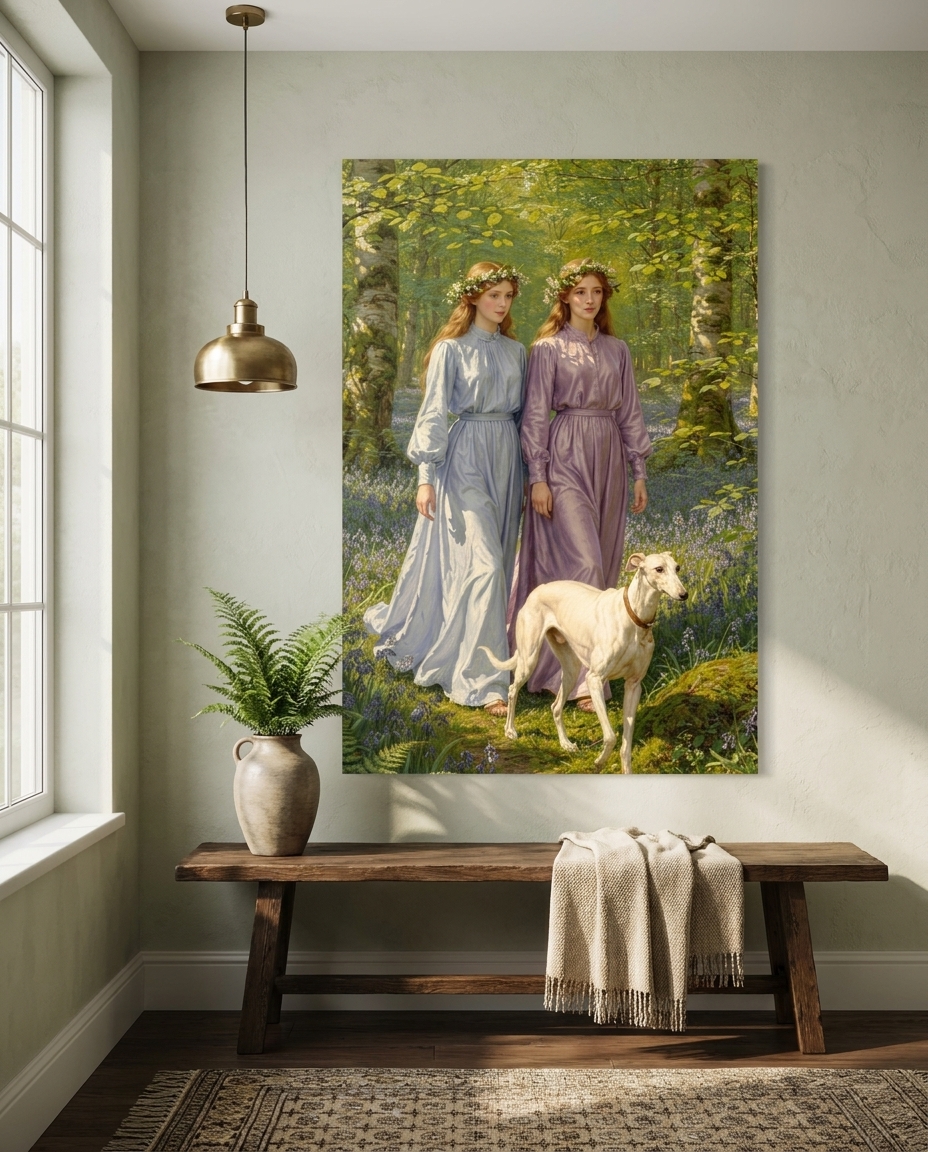
The art director composed eight original scenes in the language of the movement, without copying any known painting. The Rose Wall opens the set with a copper-haired woman in emerald velvet beside a stone wall smothered in roses. Lilies at the Leaded Window places a figure in ivory and gold at a casement, arranging white lilies in a brass urn while a formal garden shows through the panes. The Honeysuckle Embroiderer sits in garnet red before a forest tapestry, her needle caught in a glint of light. In the Bluebell Wood sends two flower-crowned companions and a white greyhound through a beech wood carpeted in blue. The Physic Garden brings a straw-hatted herbalist to her knees among poppies, lavender and marigolds under a stone dovecote. The Harp Beneath the Willow seats a musician in ultramarine velvet at the edge of a clear stream, with yellow irises and forget-me-nots at the water. Two works leave the figure out altogether: The White Stag of the Deep Wood, a motionless stag in a shaft of light among foxgloves, and Twilight in the Walled Garden, a stone well, lilies, roses and a peacock on the wall under a violet and gold sky.
The sale
Our gallerist sees in these works the rare combination of a strong decorative presence and a story worth telling to every guest. The enamelled surfaces of the Pre-Raphaelite manner are made for acrylic glass: the glazes gain depth, the velvet gowns and the water catch real light, and the flowers read with the clarity of a botanical plate. The Rose Wall and the Harp are natural centrepieces for a living room or a reading corner; the Lilies and the Embroiderer suit a bedroom or a library; the Bluebell Wood makes a luminous welcome in a hallway; the Physic Garden and the Walled Garden belong in a dining room, where their flowers keep company with the table. Hang them alone, at eye level, on a matt wall where the work is the only polished surface, and give them a lamp in the evening: these are pictures that glow.
See the collection
The eight works are here: Pre-Raphaelite Spirit.
Next in the chronological walk through art history: Barbizon and plein-air painting, when French painters left the studio for the forest and learned to paint the light they saw.