

Last time we stayed in Victorian England with the Pre-Raphaelites, who painted every leaf of a rose wall as if it were a jewel. We cross the Channel now, to the same decades, and walk into a forest an hour south of Paris. There, a handful of French painters did something that sounds simple and was then almost radical: they carried their easels outdoors, sat down in front of an oak, a pond or a field of haystacks, and painted what the weather was doing that afternoon.
Where the movement sits in the story of art
The Barbizon School takes its name from a small village on the edge of the Forest of Fontainebleau, where painters gathered from the 1830s to the 1870s. Théodore Rousseau settled there, and around him came Jean-François Millet, Charles-François Daubigny, Narcisse Diaz de la Peña, Jules Dupré and Constant Troyon, with Jean-Baptiste-Camille Corot as a close companion. Their teachers had trained them to paint “historical landscapes”: idealised scenery built in the studio as a stage for gods and heroes. The Barbizon painters wanted the opposite. They wanted the real French countryside, without a single classical temple in it, and they wanted it painted with the honesty of the Dutch masters and of the English painter John Constable, whose cloud studies had caused a stir in Paris.
Two inventions helped them. The railway brought Fontainebleau within reach of a day trip, and the collapsible metal paint tube, patented in 1841, meant colour could finally travel in a pocket. Painting en plein air, in the open air, became a practice rather than a sketching exercise. Daubigny went further and turned a small boat into a floating studio so he could paint the river from the river itself.
The Salon resisted for years, then gave way. By the 1860s these modest landscapes were collected across Europe and America. And a group of younger painters, among them Monet, Renoir and Sisley, came to the same forest to learn from them. Barbizon is the bridge between the Realism of Courbet and the light of Impressionism: without it, there is no Impressionism.
What actually defines it
Painted in front of nature. The picture reads as a direct encounter: a confident, slightly loose brush, masses of foliage rather than every leaf drawn, broad planes of ground, a few sharp accents where the eye stops.
A true, tonal palette. Olive and sap green, umber, raw sienna, silver grey and bone white. Warmth comes from ochre earth, rust bracken and a gold or rose light breaking through the clouds. Nothing is sweetened.
The sky is half the picture. Low horizons and huge, living skies, with a light that belongs to one hour and one weather: a silver dawn, a heavy afternoon, an amber dusk.
The dignity of the ordinary. Old oaks treated as individuals, sandstone boulders, ponds, stubble fields, haystacks, thatched roofs, cattle at water. Figures are small, working people at the scale of the land. There is no drama, only presence.
The need
Our interior architect pointed out that autumn interiors are turning towards slow images, natural materials and matte walls in warm limewash, clay and ochre. Landscape and seascape sales have risen sharply among buyers, and the season’s great Paris exhibitions are all about painting time and weather. What these rooms lack is a picture you can live with for years: calm, deep, not loud, readable from across the room and rewarding up close. The brief also carried one rule: a green landscape disappears on a pale green wall, so these works belong on warm matte walls, where their greens and golds come forward.
The production
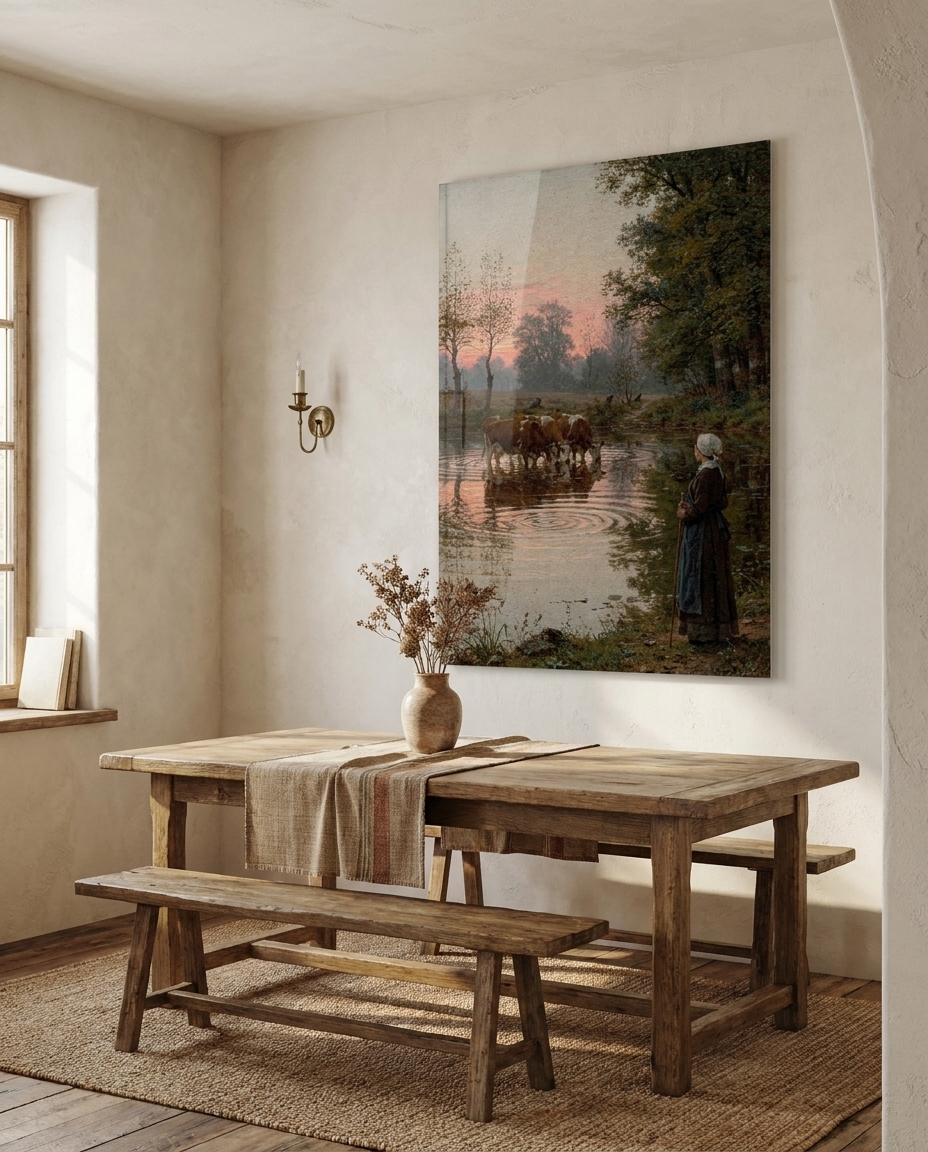
The art director composed eight original landscapes in the language of the school, without copying any known painting. Oaks in the Clearing opens the set with old twisting oaks among lichen-covered boulders on a sandy forest path. Cattle at the Forest Pond brings a small herd to drink at evening, watched by a herdswoman in a blue apron under a rose-grey sky. The Sandstone Gorge climbs through rounded grey rocks, birches, pines and heather. The Plain Under a Great Sky gives four fifths of the canvas to towering cumulus above a field of haystacks and a distant shepherd. Silver Dawn on the River moors a wooden punt among reeds and pollard willows while the mist lifts. The Village Edge at Twilight follows a lone walker home along a rutted track that holds the amber sky in its puddles. The Forest Road in Autumn sends a woodcutter’s cart through shafts of light under copper beeches. The Heath Pond at Evening closes the set in silence, with ducks lifting from a pond among heather, gorse and birches.
The sale
Our gallerist sees in these works the quiet strength that buyers now ask for: pictures chosen for the pleasure of looking, not for show. The varnished depth of a nineteenth-century landscape is made for acrylic glass. The darks of the forest gain depth, the skies and the water catch real light, and the whole picture glows like an old canvas freshly cleaned. The Oaks and the Forest Road are natural centrepieces for a living room, the Cattle at the Pond belongs above a country dining table, the Plain Under a Great Sky makes a generous welcome in a hallway, the Silver Dawn suits a bedroom, and the Village Edge, the Gorge and the Heath Pond are made for a study, a library or a reading corner. Hang them on a matte wall, where the work is the only polished surface in the room, and let the light of the day change them as it changed the forest for the painters who first sat in front of it.
See the collection
The eight works are here: Barbizon & Plein-Air.
Next in the chronological walk through art history: Impressionism, when the students of the forest painters took the easel to the riverbanks and boulevards and broke light into touches of pure colour.