

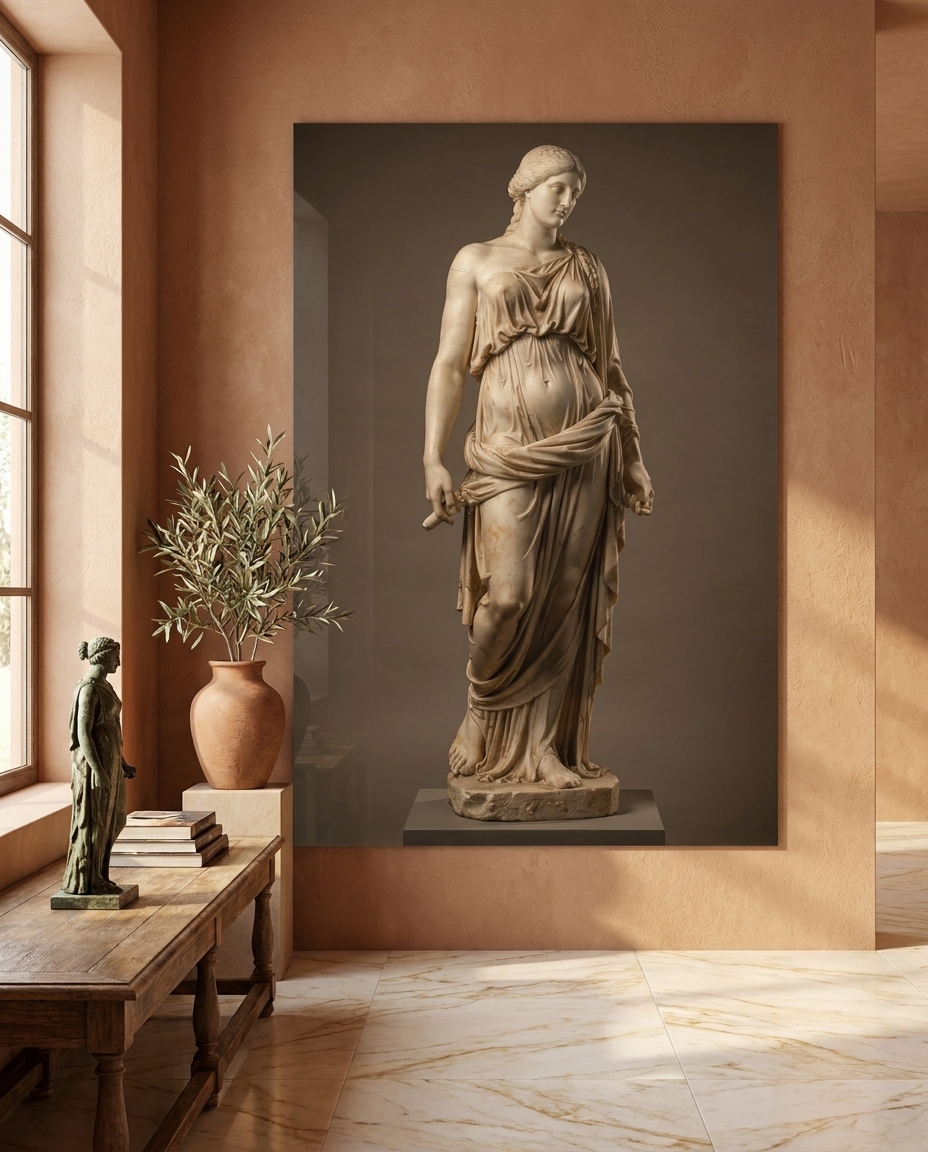
Sixth in our chronological journey through the history of art — a gallery survey unfolding from the first cave paintings toward the present day.
Between roughly 800 and 323 BCE, on a scatter of rocky peninsulas and sunlit islands, Greek artists asked a question that would echo for two and a half millennia: what does it mean to render a human being not as a symbol, but as a living presence? Their answer changed the course of Western art.
The Archaic smile
The story opens with the kouros and the kore — frontal figures, one foot forward, lips fixed in the enigmatic “Archaic smile.” They stand serene and stylised, still half-belonging to the world of Egypt and the Near East that came before. Yet the marble is already warming: in the beaded rows of hair, in the traces of ancient paint clinging to a maiden’s pleated drapery, one senses an artist beginning to watch life very closely.
The Classical breakthrough
Then, around 480 BCE, something extraordinary happens. Weight settles onto one leg, the hips tilt, and the body relaxes into contrapposto. This is the Classical invention of naturalism — the idealised form poised between motion and repose, a “noble simplicity and quiet grandeur” that later ages would spend centuries trying to recover. Wet drapery clings and pools; bronze catches a calm, downward gaze; the human figure becomes not a portrait of any one person but the measure of all.
Not only statues
Greek art was never only its marble. It lived in the black- and red-figure vases, whose athletes and armoured heroes circle the clay in ribbons of movement between borders of the endless Greek key. It rose in the fluted columns and scrolled capitals of the temple, where mathematics became architecture. It glittered in the hammered gold of a funerary wreath, each olive leaf beaten as thin as a living one. This collection gathers those threads — draped figures and painted amphorae, the Ionic volute and the Doric front, the gold of a victor’s crown — as original works in the movement’s spirit, an homage rather than a copy of any single masterpiece.
For the collector, for the room
Few artistic languages carry such quiet authority. A Greek marble or a red-figure vessel does not shout; it composes a room around itself, lending a space the hush of a museum gallery. These are pieces for the study, the entrance hall, the room where one wants thought to slow down — timeless and architectural, equally at home beside antiques or clean modern lines.