

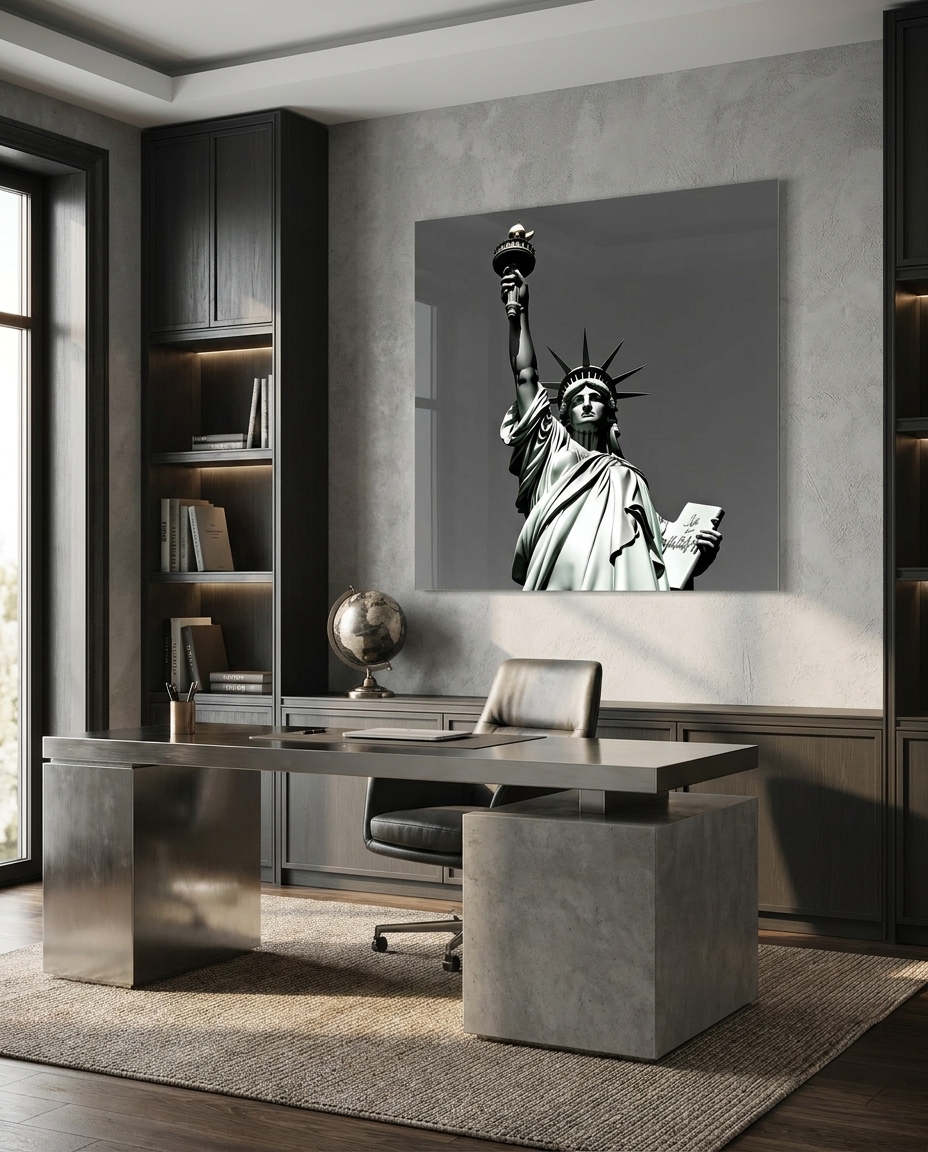
Photographed in colour, the world’s great monuments look like holiday. Photographed in black and white, they look like what they are: enormous acts of ambition, most of them outliving the civilisations that raised them.
The need
Hallways, studies, stairwells and offices want work with gravity and no colour argument — pieces that coordinate with everything and read as considered rather than sentimental. Monochrome is the most reliable way to achieve that.
The production
Each landmark is treated as a portrait sitter rather than a destination: strong directional light, deep tonal separation, no crowds, no sky drama. The Pyramids of Giza, Egypt and The Great Wall of China are handled as geology; The Taj Mahal, India and The Colosseum, Rome as architecture; The Eiffel Tower, Paris and The Sydney Opera House, Australia as engineering. Machu Picchu, Peru and The Statue of Liberty New York complete a set that spans four millennia.
The sale
This is the most gridable collection in the catalogue: monochrome, consistent treatment, identical register. Four in a square or eight in a run make an immediate architectural statement in a corridor. Acrylic glass gives black and white a depth of black that paper cannot reach — which is the entire difference between a print and a piece.