

Last time we sat with the Barbizon painters in the Forest of Fontainebleau, in front of old oaks and ponds under a heavy sky. Their younger visitors took the lesson further. They left the forest for the riverbanks, the gardens, the beaches and the new boulevards of Paris, and they stopped trying to paint things. They painted the light falling on them, at one precise moment, before it changed.
Where the movement sits in the story of art
Impressionism was born in France between the late 1860s and the 1880s. Claude Monet, Pierre-Auguste Renoir, Alfred Sisley, Camille Pissarro, Berthe Morisot, Edgar Degas and Gustave Caillebotte, among others, were refused again and again by the official Salon, which still preferred smooth, finished history painting. In April 1874 they organised their own exhibition in a photographer’s former studio on the boulevard des Capucines. A critic, mocking a harbour view by Monet titled Impression, called the whole group “impressionists”. The painters kept the insult as their name. Eight group exhibitions followed until 1886.
Several things made the movement possible. The paint tube let colour travel outdoors, as it had for Barbizon. New, brighter pigments, such as cobalt blue, chrome yellow and emerald green, gave a higher-keyed palette. The railway put the Seine villages and the Normandy coast within an hour or two of Paris. And photography had freed painting from the duty of exact likeness, while Japanese prints showed new ways to crop and frame a scene.
Ridiculed at first, Impressionism became one of the best-loved movements in the history of art, and the starting point of almost everything that followed: Neo-Impressionism, Post-Impressionism, Fauvism and, in the end, abstraction.
What actually defines it
Broken colour. Short, separate, visible strokes of pure colour placed side by side and left unblended, so the eye of the viewer does the mixing. The surface vibrates.
Light and the instant. One hour, one weather: midday sun on wet sand, a grey-pink morning of snow, the shine of a pavement after rain. Reflections break into flickers.
Coloured shadows. Shadows are blue, violet or green, never black. The whole palette is lighter and brighter than anything the Salon had shown.
Modern life, painted outdoors. Gardens, sailing boats on a river, village roads, city avenues with carriages, cliffs and beaches: the leisure and the landscapes of the painters’ own time, painted quickly and freshly, as if on the spot.
The need
Our interior architect pointed out that November rooms need light more than any other season. Days are short, walls are pale, and many interiors have become calm and neutral: warm white plaster, pale oak, linen. What they lack is a source of colour and daylight that does not shout. Impressionism does exactly that. Each picture brings a summer afternoon, a spring orchard or a bright sea into the room, and its broken touches of colour look different at every hour.
The production
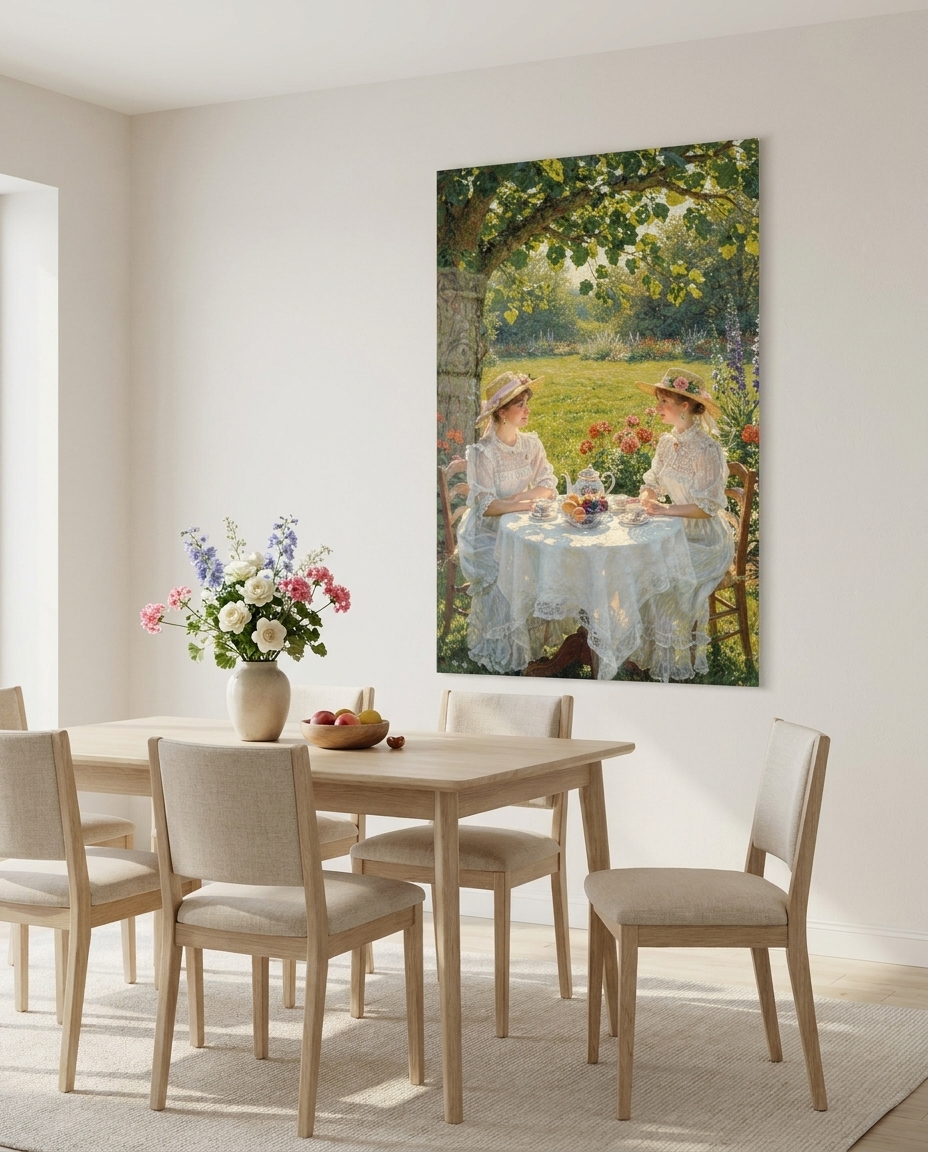
The art director composed eight original paintings in the language of the movement, without copying any known work. Sunlight on the Rose Path opens the set with a gravel path under arches of pink and white roses, irises along the border and violet shadows on the ground. Sails on the Summer River sends small white sailing boats across water broken into a thousand flickers of blue and green. Snow Morning in the Village paints a snowy road at dawn with blue and lilac shadows and a sleigh in the distance. Boulevard After the Shower turns a wet city avenue into a mirror of grey sky and lamplight, with carriages and black umbrellas. Wind over the Chalk Cliffs stands on a pale cliff top above a turquoise sea and racing clouds. Afternoon Beneath the Lime sets tea for two in white summer dresses under a great tree, the light scattering over the cloth. Spring Orchard in White Bloom fills a green slope with apple and pear blossom in thick dabs of white and rose. Low Tide at Midday closes the set with wooden fishing boats resting on wet, glittering sand.
The sale
Our gallerist sees in these works the most immediate pleasure painting can give: light you can hang on a wall. Acrylic glass suits Impressionism remarkably well. The depth of the face-mount gives the broken strokes a jewel-like brilliance, and the whites of the blossom, the snow and the sails seem lit from within. Sunlight on the Rose Path and Wind over the Chalk Cliffs are natural centrepieces for a living room, Afternoon Beneath the Lime belongs above a dining table, Spring Orchard in White Bloom brightens a kitchen, Sails on the Summer River suits a bedroom, Boulevard After the Shower welcomes guests in a hallway, Snow Morning in the Village warms a reading corner, and Low Tide at Midday is made for a study. Hang them on a pale matte wall, where the work is the only glossy surface in the room, and they will change with the daylight, as the painters intended.
See the collection
The eight works are here: Impressionism.
Next in the chronological walk through art history: Neo-Impressionism, when a new generation turned the Impressionist touch into a method and built pictures from dots of pure colour.