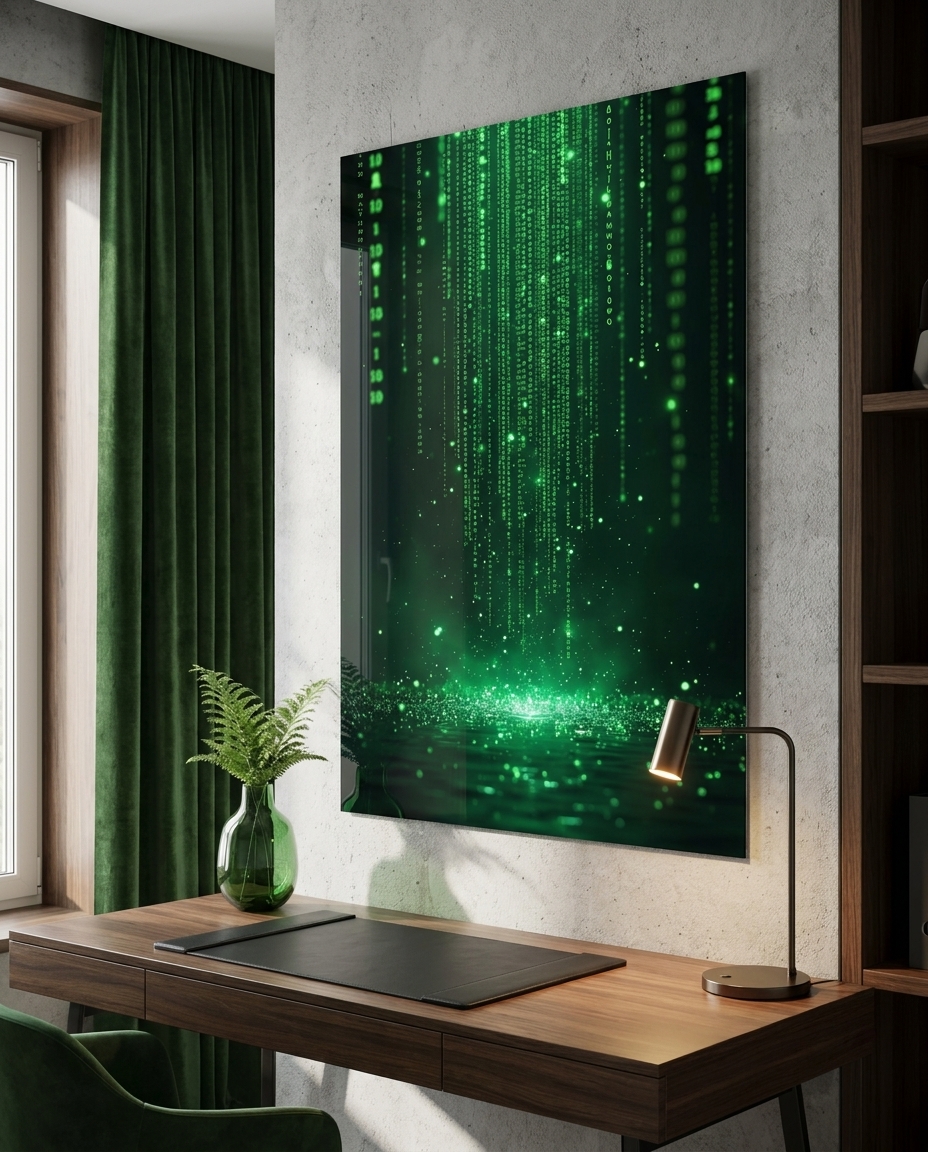
Neo Dreams: The Matrix Reimagined is an homage — eight original works inspired by the great machine-dream myth of late-1990s cyber cinema, made in our studio and owing nothing to any existing image. It is a tribute, freely interpreted, and no affiliation with, endorsement by, or partnership with the rights holders of the films that inspired it is claimed or implied. What the collection reimagines is not a film. It is a question the film made popular: what does it look like when reality flickers.
The need — the room that wants to be somewhere else
Our decorator sees this collection answering a demand that has grown rather than faded. Interiors have swung away from safe neutrality toward rooms with a declared personality — the home cinema, the studio, the office of someone who works in software, the young collector’s first apartment, the bar corner that is meant to feel like a set. Those rooms want an image that changes the temperature when you walk in, and they are usually rooms with controlled or low light, which is where a lacquered, reflective surface earns its keep by throwing light back rather than absorbing it.
The eight sort themselves by function. Code Cascade is the abstraction of the set — pure falling light, no figure — and it is the one that behaves like colour-field work: it will hang in a corridor, an entrance, an office, next to furniture that has nothing to do with the subject. Digital Awakening and Red Pill, Blue Pill are the quiet, close-in pieces, right for a study or a bedroom wall where you want ambiguity rather than incident. Neo vs Agent Smith, Bullet-Time Revolution and Zion Under Siege are the wide, cinematic anchors — single large statement pieces above a sofa, in a screening room, on a wall that already has a strong wallpaper and needs an image dark and contrasted enough to win against it. The Architect’s Chamber and Trinity’s Leap are the architectural and the kinetic, and they pair well with each other.
A note on palette, because it matters more here than usual. The collection runs on deep green, black and phosphor — and green has just moved ahead of brown as the leading interior axis, with olive and mineral teal structuring next year’s palettes. A collection built on green screen light is, for once, exactly in phase with where rooms are going. Frame it in matte: thin unpolished metal, matte wood, a chalky wall. The gloss of the acrylic glass should be the single reflective object in the room.
The production — the flicker, not the frame
The art director set one rule at the start and it shaped the entire collection: reproduce nothing. No frame from any film, no likeness of any performer, no copied composition. What was taken forward is a visual vocabulary that has long since escaped its source and become common property — falling glyph rain, phosphor green against black, the frozen instant seen from an impossible angle, the corridor that repeats past reason.
From there each piece takes one idea and commits to it. Code Cascade is the collection’s abstract, built as a vertical rain of luminous characters with depth of field doing the composing, so the image reads as weather rather than as text. The Architect’s Chamber is the architectural exercise: recursive screens and receding geometry, the coldest and most controlled image of the eight. Bullet-Time Revolution and Trinity’s Leap are the kinetic pair — a figure suspended, the air around it deformed, the world arrested mid-decision. Zion Under Siege is the widest, an industrial cavern lit from below in warm sparks against cold machinery, and it is where the season’s saturated earths meet the collection’s greens.
Red Pill, Blue Pill is the one built on restraint: two points of light, an open hand, nothing else — the entire myth compressed into a still life. And Digital Awakening and Neo vs Agent Smith deliberately withhold detail, working with halation, grain and dissolving edges so the viewer completes the figure. That atmospheric register is the strongest current demand among newer collectors, and it is also the honest answer to a subject about reality being unstable: an image that resolves completely would contradict its own premise.
Under acrylic glass, the very dark end of these images is where the medium justifies itself. A phosphor green against a near-black ground has almost all of its information in the shadows; face-mounting keeps that range open and gives the light in Code Cascade and Zion Under Siege the sense of coming from behind the surface rather than sitting on it.
The sale — instant recognition, on our own terms
Our gallerist is candid about the mechanics. Recognition is the shortest path from a scroll to a wall, and this is one of the most instantly readable collections we produce — a viewer knows what they are looking at in under a second, on a phone, which is where the decision now happens. Buyers here are typically younger, they buy by feeling and by cultural belonging, and they are buying a memory of something that mattered to them.
That is exactly why the framing has to stay honest, and it costs us nothing. This is a tribute: original works made in our studio, inspired by a myth, not licensed merchandise and not a reproduction of anything. Sold that way it is a stronger object, not a weaker one — a piece with its own authorship rather than a souvenir. Homage has been the ordinary condition of art for as long as art has existed, and it does not need to pretend otherwise.
As a group of eight, Neo Dreams gives a buyer either one large cinematic statement — Bullet-Time Revolution or Zion Under Siege — or the spaced trio our gallerist recommends most often for this collection: Code Cascade for the abstraction, Digital Awakening for the atmosphere, The Architect’s Chamber for the structure. Museum-quality prints face-mounted on acrylic glass, produced and shipped from our own studio, each with its documented origin. Digital work sold as art, on its own merits.