

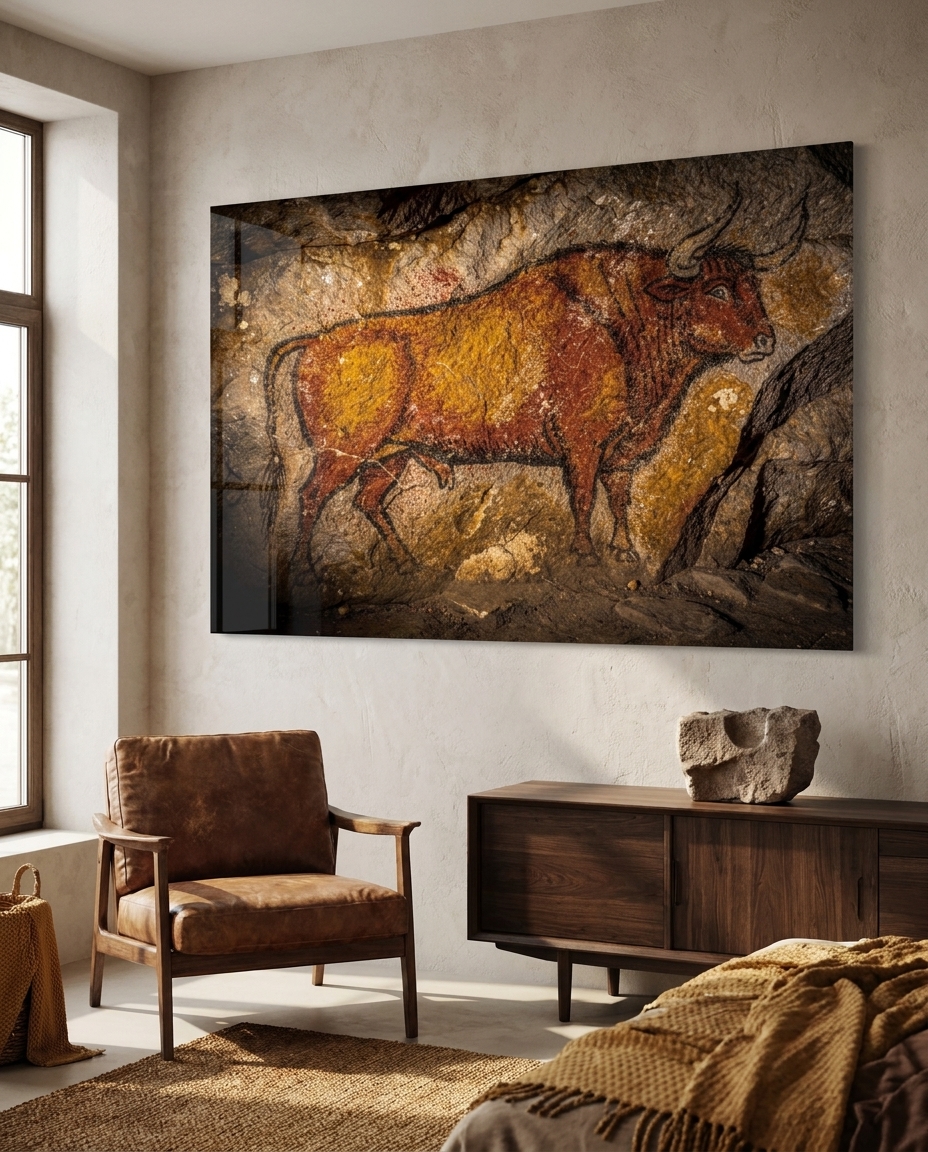
Eight original wall-paintings from the dawn of art — ochre and charcoal beasts brought alive on ancient, torch-lit rock. Our Paleolithic Cave Art collection opens a new series: the whole history of art, one movement at a time, beginning where it all began.
Where it sits in art history
Some forty thousand years ago, in caves like Chauvet, Lascaux and Altamira, humans first reached for pigment and left images on stone — bison, horses, aurochs, the press of a hand. It is the oldest art we know, and astonishingly assured: economical line, living movement, a feel for the animal that has rarely been bettered since. This collection is an original homage to that first artistic impulse — never a copy of a known wall, but new paintings made entirely in its spirit.
The need — the decorator’s eye
Earthy, primal art has a grounding power in a room: warm ochres and charcoal blacks, the texture of stone, a sense of deep time. These pieces anchor a living room, a study or a gallery wall with quiet strength — tactile, warm and timeless, exactly the mood 2026 interiors are reaching for, but with forty millennia behind it.
The production — the art director’s vision
We painted eight original scenes the way the first artists did — red and yellow ochre, hematite and charcoal, blown and finger-laid on rough limestone and raked by torchlight. From The First Bison and Herd of Wild Horses to The Great Aurochs and The Leaping Stags, each keeps the raw economy of cave painting: the animal caught in a few living strokes against living rock.
The sale — the gallerist’s word
Eight works bound by the oldest subject of all — the animal, the hand, the mark. Face-mounted under acrylic glass, the pigment and stone gain real depth and warmth. Hang The Great Aurochs as a single primal statement, or run the herd along a wall as a frieze from the dawn of time. This is the first chapter of a gallery that will, in time, walk the entire history of art — from this cave wall all the way to 2026.