

Last time we looked at Neo-Impressionism and Pointillism, where colour was assembled dot by dot with almost scientific patience. By the late 1880s a number of painters had absorbed everything Impressionism taught them about light, and then asked for something more: a picture that holds together like a structure, or one that carries a feeling rather than a moment.
Where the movement sits in the story of art
Post-Impressionism is not a single school. The name was coined in 1910 by the English critic Roger Fry, who needed a label for an exhibition in London that gathered painters working after Impressionism, from about 1886 to the early 1900s. They shared no manifesto and often no common studio. What they shared was a starting point: all of them had learned from Impressionism, and all of them walked away from it in different directions.
Paul Cézanne, working in Provence, set out to give the fleeting impression the solidity of the old masters. He rebuilt landscapes and still lifes out of planes and simple volumes, and his tilted tables and mountains seen in patches of colour paved the way for Cubism. Vincent van Gogh, who painted in Arles and Saint-Rémy in 1888–1890, pushed colour and brushwork to carry emotion: thick strokes that swirl, yellows that burn, skies that seem to turn. Paul Gauguin, in Brittany and then in Tahiti, flattened his compositions into broad areas of colour bounded by dark contours, and chose colours for what they meant rather than for what the eye saw. Henri de Toulouse-Lautrec added a draughtsman’s eye for the city at night.
The movement matters because it broke the idea that a painting must copy what we see. Fauvism, Expressionism and Cubism all grew out of the ground it cleared.
What actually defines it
Structure. Forms are simplified and built up from planes and volumes. A mountain, a jug or a row of trees becomes a solid object with weight.
Expressive brushwork. The paint is thick and visible. Every stroke has a direction and a rhythm, and the surface itself becomes part of the subject.
Colour with a purpose. Saturated yellows, deep blues and violets are chosen for the emotion they carry, not for how closely they match nature.
Dark outlines and flattened space. Forms are often framed by a firm contour, and perspective is shallow, which gives the picture a bold, almost poster-like presence.
The need
Our interior architect pointed out that Post-Impressionism is the movement that works best on a large, plain wall. Its pictures carry their own energy: a swirling night sky or a field of wheat under a storm needs no other decoration in the room. The golden and ochre palettes warm a cool, minimal space, while the deep blues give a dining room or a study a calm centre of gravity.
The production
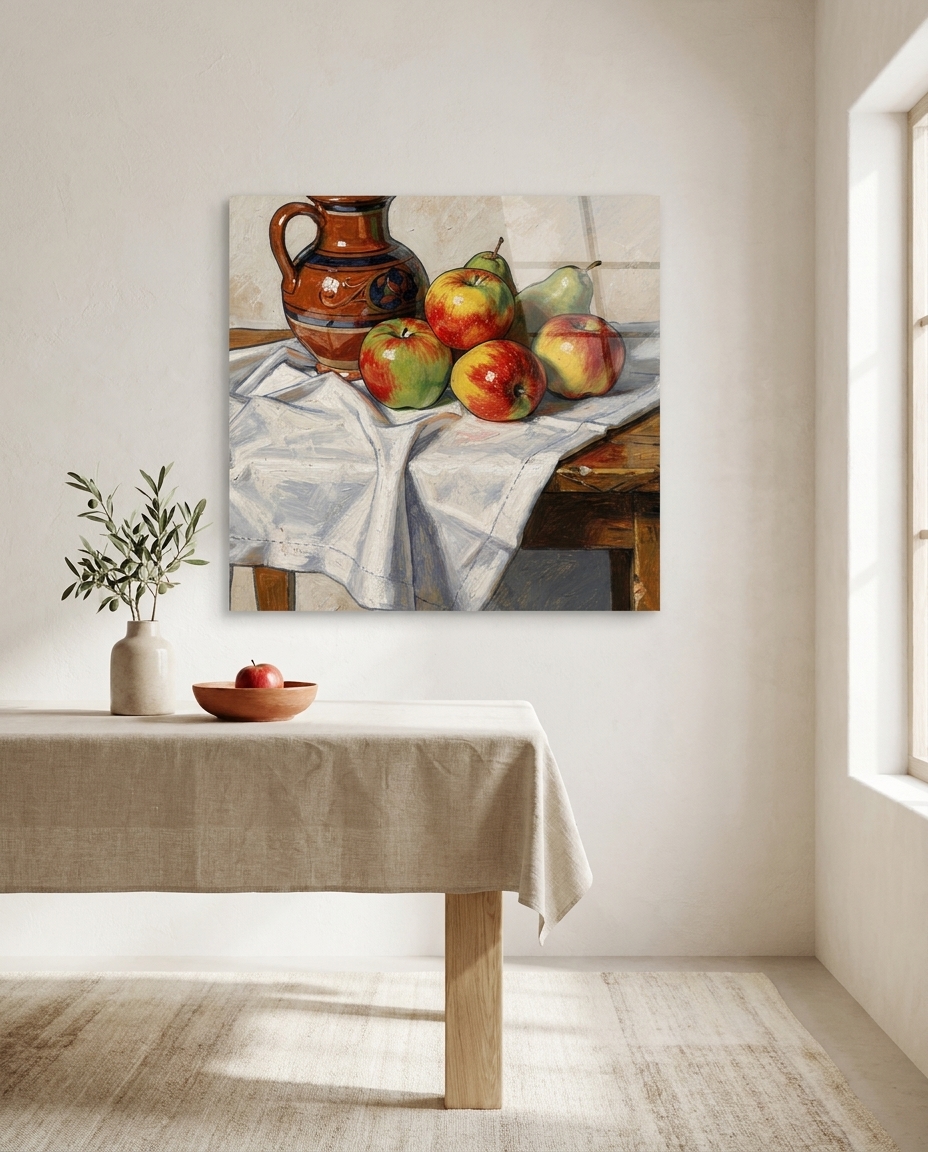
The art director composed eight original works in the spirit of the movement, without reproducing any known painting. Cypress over Golden Slopes lifts two flame-shaped trees over hills of rolling gold. Nocturne over the Sleeping Valley spins a night sky of indigo spirals above a quiet village. Golden Wheat Beneath Storm lets a ripe field ripple beneath heavy clouds. Harbor at High Noon moors red, blue and ochre boats in bright turquoise water. Apples and Earthenware on Linen tilts a table so that fruit and a glazed jug stand out like sculpture. Irises in Amber Vessel sets violet blooms against a field of thick yellow paint. Peak Beyond the Olive Grove builds a limestone mountain out of lavender and rose facets above silvery trees. Twilight at the Village Cafe pours lantern light over wet cobblestones. Each work was checked for fidelity to the movement and cleared of anything that does not belong in the image.
The sale
Our gallerist sees a collection for people who want a picture with presence. Acrylic glass suits thick, textured paint very well: it keeps every ridge of the brushwork readable and deepens the darkest blues without losing the glow of the yellows. The cypress hills and the wheat field suit a living room, the harbour a seaside home, the still life a dining room, the irises an entrance hall, the olive grove a bedroom, the cafe at dusk a reading corner, and the nocturne a study.
See the collection
The eight works are here: Post-Impressionism.
Next in the chronological walk through art history: Symbolism, where painters turned from the visible world to dreams, myths and mystery.