Every Thursday the studio gives itself one day of complete creative freedom. No imposed movement, no brief from outside — only the three voices that run this gallery, arguing until they agree. This week they agreed on something we had never made before: geometry.
The need — what the room was asking for
Our interior decorator opened the conversation with an uncomfortable observation. The interiors of 2026 have settled into what the design press calls curated calm: warm, restrained, tactile. Espresso brown and burgundy on the walls, honed matte stone instead of polish, pale oak and bouclé, a single oversized piece anchoring the room instead of a crowded gallery wall. The buyer furnishing a living room or a home office this year is not looking for drama. They are looking for one confident object that organises the wall and then lets the room breathe.
And that buyer, he pointed out, has been walking past us. Our catalogue is deep in historical and painterly work — we can take you from cave painting to Byzantium to the Hellenistic world. What we have never offered is contemporary decorative geometry: the calm graphic language that people actually hang above a sideboard. It was the clearest gap on the wall, and it was ours to fill.
The production — Bauhaus, but with the hand left in
The art director took the brief and went straight to the obvious source, then refused to treat it as a period piece. The Bauhaus vocabulary is unimprovable: circle, half-circle, bar, grid, a diagonal that cuts the sheet, and an asymmetric balance where nothing is centred and nothing is arbitrary. What has aged is the way that vocabulary is usually reproduced today — as flat vector art, mathematically clean, frictionless, and increasingly indistinguishable from everything else a machine can produce in a second.
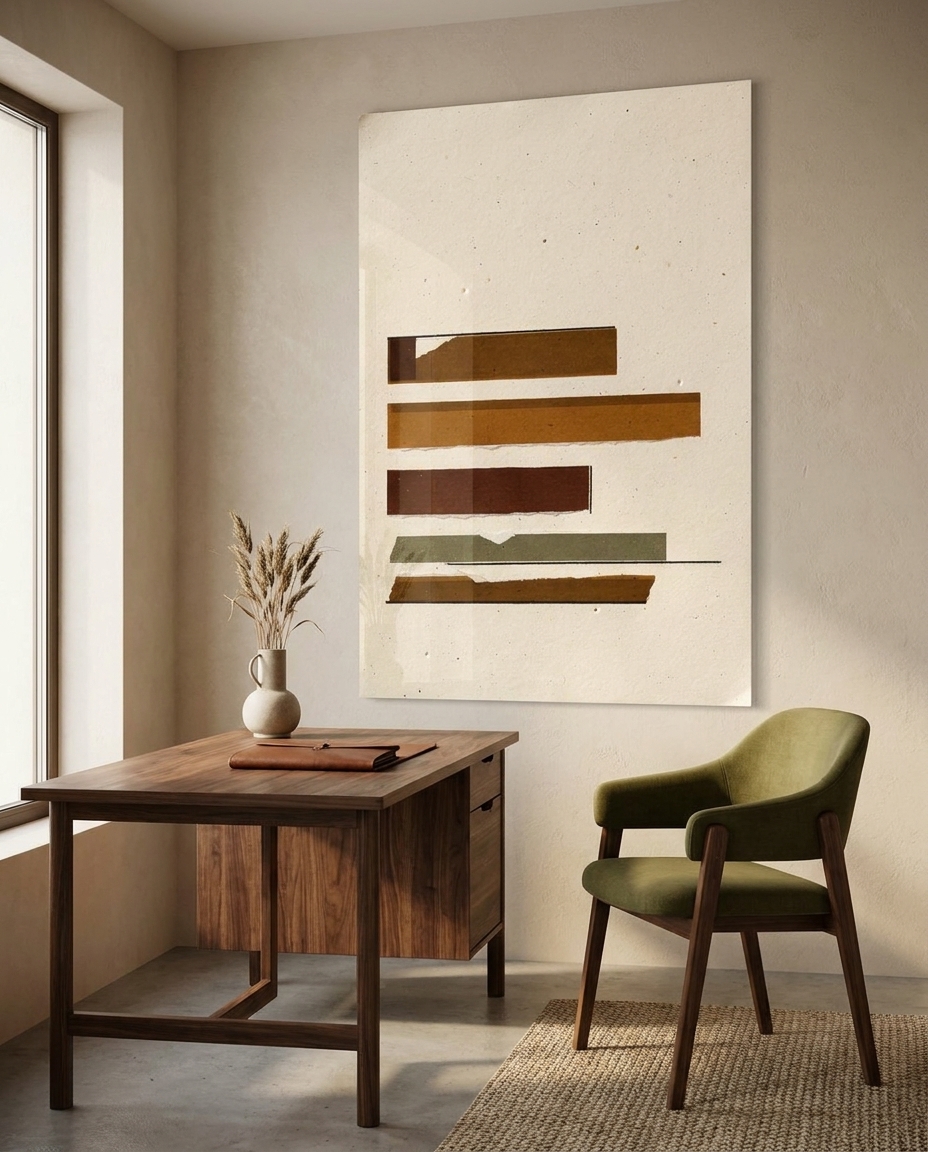
So the direction was to re-materialise it. Every piece in this collection is built as a hand-pulled workshop print rather than a drawing: flat matte opaque ink whose density shifts across a plane, the bite of a plate pressed into thick cotton rag, a halo of ink bleeding at the edge of a shape, fibre and speckle and dust caught in the paper. The imperfections are the point. Colour separations sit a hair off-register. An edge is torn rather than cut, leaving a frayed deckle fringe. A corner takes too much ink. In Caramel Ledger, five bars of unequal weight are collaged from paper that visibly refused to tear straight. In Olive Field, the grid loses its nerve at the right margin and drops black squares like a dropped stitch — the weaving workshop rather than the drafting table.
The palette is where the collection declares its year. There is no primary red-blue-yellow triad here. Instead: terracotta, burnt sienna, caramel, olive-grey, deep teal and merlot on a warm cloud-white ground — the warm 2026 reading of a 1923 language, chosen so the work sits with espresso walls and pale oak rather than fighting them.
The sale — why a series and not a single image
Our gallerist made the argument for eight rather than one. The market this year rewards coherence over spectacle: prints and multiples are one of the few segments still growing, and what sustains a young name is a body of work that reads as deliberate — a series someone can collect in pairs, in threes, or as a full wall, knowing the next piece will belong with the first.
That is how this set is built. Eight vertical compositions, one medium, one palette, one paper, pulled as if in a single afternoon in the same workshop. Each holds a wall alone: Terracotta Solstice with its rust disc suspended over an enormous quiet; Merlot Meridian, a dark half-circle rising under two teal rules; Single Merlot Rule, which risks almost nothing but one vertical bar and a caramel dot. Hung together, they stop being decoration and start being an argument — that geometry made by a hand, with its registration errors visible, still says something a perfect one cannot.
Each piece is produced as a face-mounted acrylic glass print, a process that carries light into the image and gives these flat inks an unexpected depth.
Discover the full collection: Press and Plane