

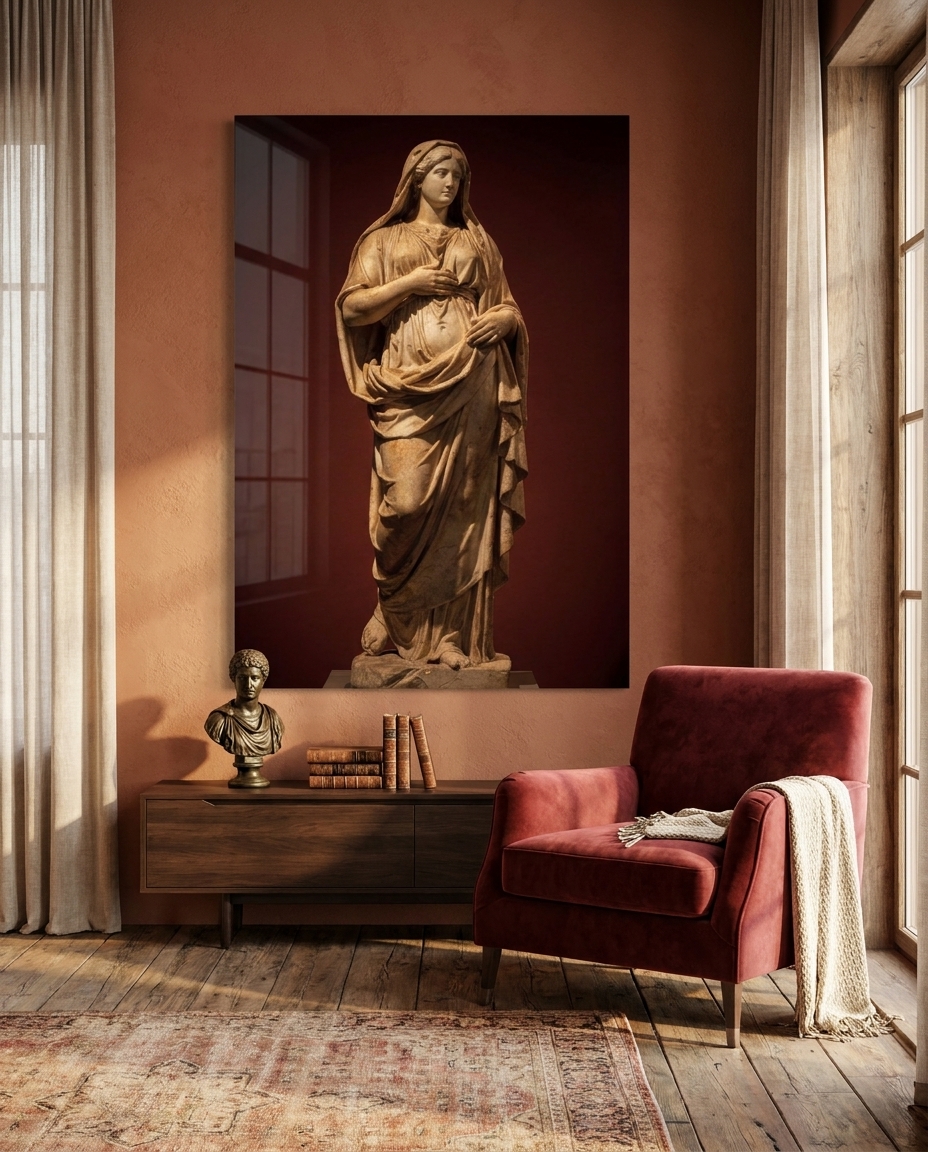
Eighth in our chronological journey through the history of art — a gallery survey unfolding from the first cave paintings toward the present day.
Rome conquered the Greek world and fell in love with its art — then bent that inheritance to its own, very Roman purposes. Where the Greeks had chased an ideal, Rome wanted something more useful and more durable: to record a face exactly, to commemorate a victory, to endure. Across a thousand years and three continents, Roman artists turned art into an instrument of memory and power, and in doing so invented ways of seeing the West would not fully recover for another millennium and a half.
The unflinching face
The most startling Roman contribution came first: portraiture that refused to flatter. In the severe workshops of the Republic, sculptors carved elder statesmen wrinkle for wrinkle — furrowed brows, hollow cheeks, the loose skin of a long life — because in Rome, age and service were the marks of authority. This “veristic” honesty had no Greek precedent. A marble head could now be a specific person rather than a perfect one, and the individual entered the history of art for good.
Walls that open onto gardens
Indoors, Roman painters performed a different kind of magic. On the plastered walls of villas they painted illusions so convincing that a windowless room seemed to open onto a living garden — laurel and roses, songbirds, a distant blue haze — or onto a shelf of glass and fruit rendered with a naturalism, right down to the fall of light through a glass bowl, that would astonish anyone who thinks such effects were invented in the Renaissance. Fresco made the Roman interior a stage for the eye.
Painting in stone
The Romans also raised the mosaic from mere flooring to a rival of painting. Cutting tesserae fine enough to shade a feather, they laid whole pictures into the ground: doves drinking at a bronze basin, the reflection caught in the water, everything built stone by patient stone. Colour that would fade in paint survives underfoot two thousand years later — craft as a form of permanence.
The architecture of empire
Above all, Rome built. The triumphal arch had no structural job at all; its only purpose was to be seen and remembered, coffered vault and winged victories turning engineering into rhetoric. The aqueduct did the opposite — pure function, tier upon tier of arches carrying water across a hundred kilometres of dry country — and became sublime by sheer conviction. And the empire’s cosmopolitan wealth flowed into its goldwork, chains of astonishing fineness set with garnet and emerald gathered from the edges of the known world. This collection draws these threads together as original works in the movement’s spirit, an homage rather than a copy of any single surviving piece.
For the collector, for the room
Roman art furnishes a room the way it furnished an empire: with weight, warmth and confidence. The veristic marbles bring the hush of a museum hall; the frescoes and the mosaic answer warm interiors with jewel-toned depth — oxblood, teal, gold and Pompeian red; the arch and the aqueduct are statement pieces that reward a tall wall. These are works for the entrance that should stop someone, the dining room that wants abundance on its walls, the study where the past is meant to feel close at hand — monumental, human, and entirely at ease beside both antiques and clean modern lines.