
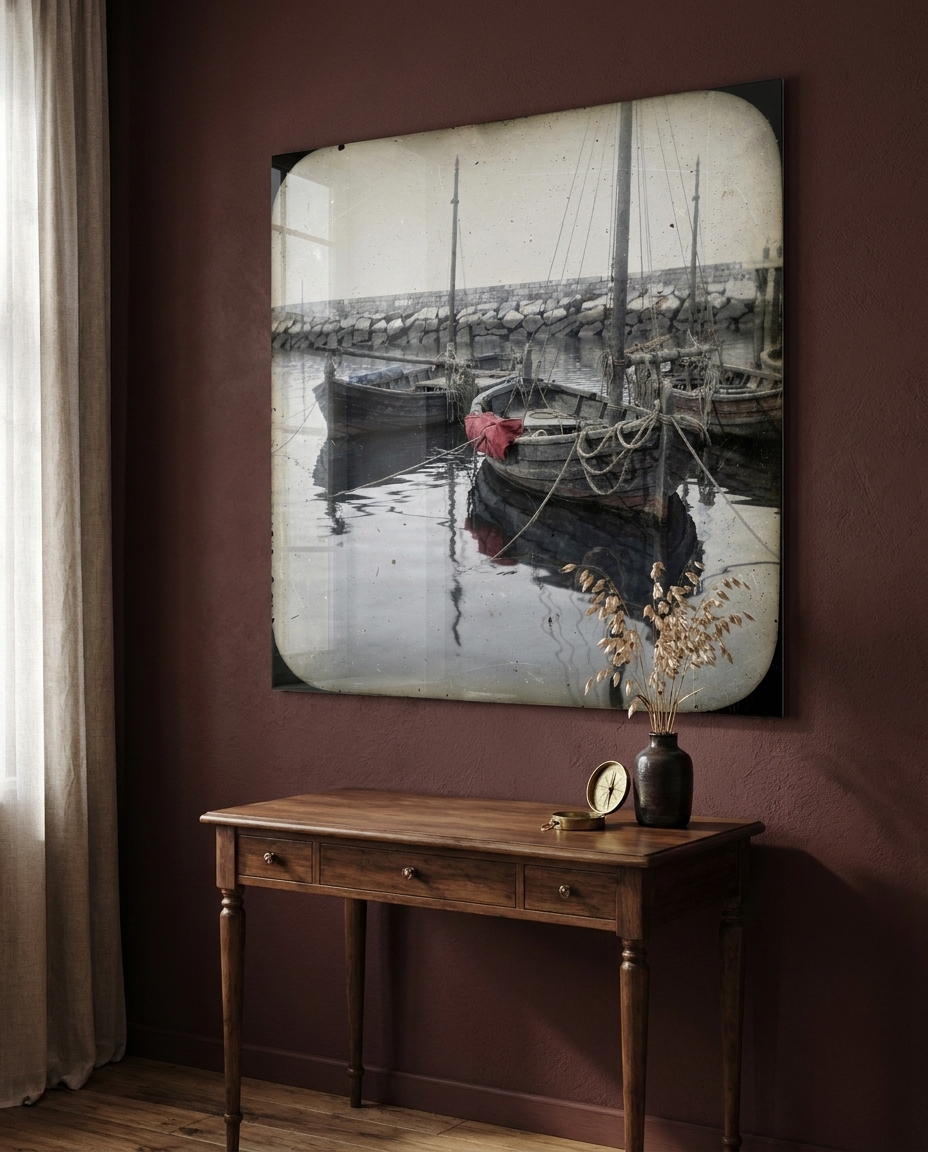
Photography turns two hundred this decade, and the first photographs were not paper at all. They were small mirrors of polished silver, held at an angle to catch the light, with fine dust on the surface, a darkened edge and a patient, almost unbearable sharpness in the centre. Some were touched by hand afterwards with a drop of colour: a red sail, a pink lip, a gold line along the horizon. Silver Plates is eight square images made in that spirit — the look of an old plate, with one small hand-painted accent in each.
They are images in the manner of early plates, made for today’s walls. There are no people, no animals, no lettering, and nothing copied from an existing photograph.
The need — the decorator’s eye
The walls of the season are deep and matte: a dark green, a blue-grey, a clay rose, a warm plaster. A silver-grey image with a single note of colour is made for them. It does not compete with the paint; it gives the eye one place to rest. On a clay-rose wall the red chimney of The Rooftops After Rain belongs there; on a deep green wall the pink lip of The Spiral Shell glows.
The format is square, as the plates were. At 50 × 50 to 80 × 80 cm a piece hangs above a console, a bed or a desk, or sits in a stairwell where you pass it every day. Four together make a small grid; eight make a whole hallway.
The production — the art director’s vision
Every plate follows the same rules. A mirror-silver surface, cold sepia-grey tones, deep blue-black shadows, fine scratches and dust, a soft vignette at the edge, and a sharp, detailed centre. Light is still and daylight-soft; water is flat; nothing moves. Then, exactly one touch of colour per plate — vermilion, dusty rose or old gold — small enough to be found rather than seen.
The subjects are quiet things that early photographers loved because they hold still: a shell on a sill, a bell jar over a fern, wet slate roofs, a stone staircase, a bare elm, an iron footbridge in mist, a shutter ajar, boats at slack tide.
The sale — the gallerist’s word
These are pictures for people who like to look closely. The Stone Stair and The Open Shutter suit a hall; The Glass Bell and The Spiral Shell a reading corner or a study; The Iron Footbridge a bedroom; The Elm in Winter and The Boats at Rest a dining room or an office.
Each work is printed on 4 mm acrylic glass, backed with 3 mm Dibond. The depth of the acrylic suits the silver and the blue-black: the dark parts stay dark, the highlights keep their sheen.
The eight works
- The Spiral Shell — a large spiral shell on a windowsill, its lip touched with dusty rose.
- The Rooftops After Rain — wet slate roofs and chimney pots, one chimney in vermilion.
- The Stone Stair — a stone spiral staircase seen from above, one step edged with old gold.
- The Glass Bell — a bell jar over a small fern, the pot touched with vermilion.
- The Elm in Winter — a single bare elm above a dry-stone wall, a thin line of gold at the horizon.
- The Iron Footbridge — a cast-iron footbridge in morning mist, its lantern in vermilion.
- The Open Shutter — a stone window with one shutter ajar onto a vine, the shutter edge in dusty rose.
- The Boats at Rest — small wooden boats moored at slack tide, one furled sail in vermilion.
See the whole collection: Silver Plates.