

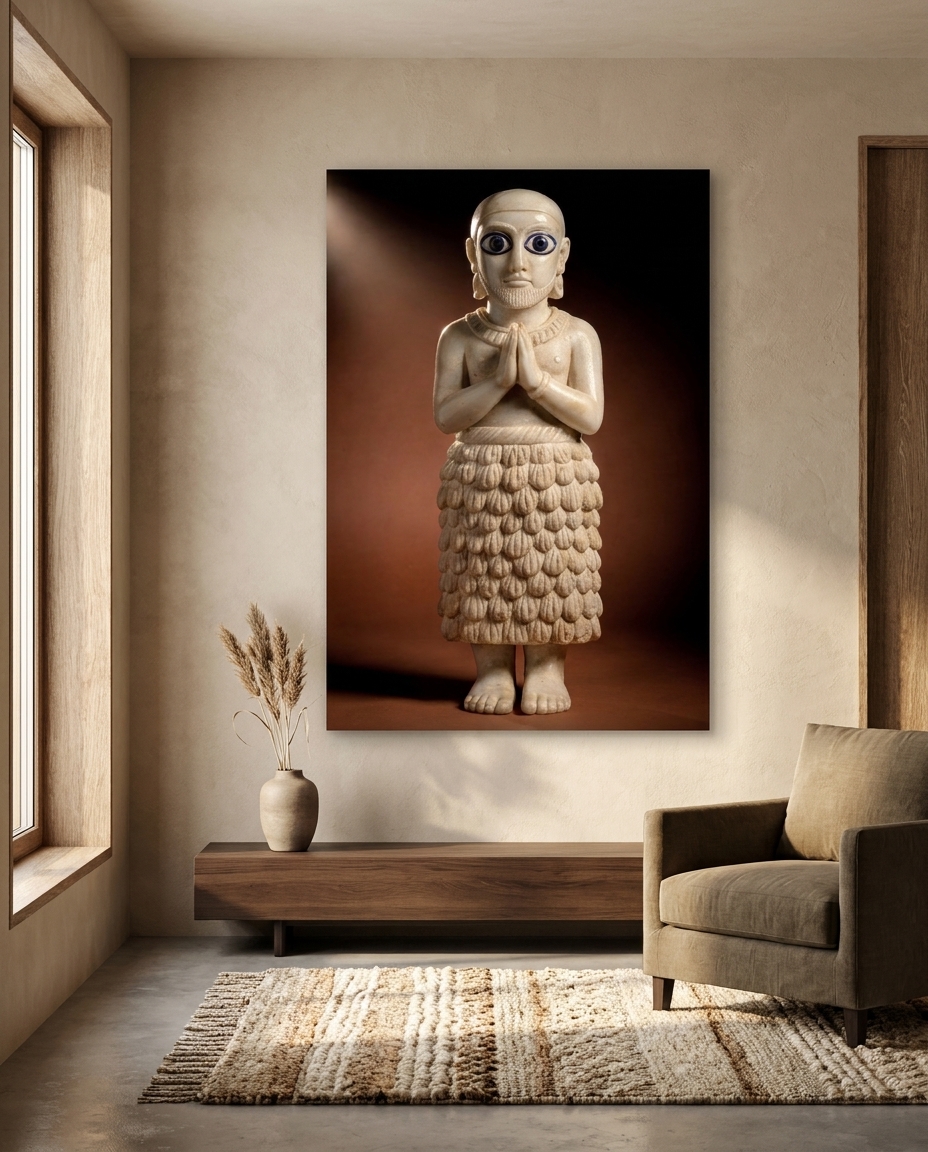
Between the Tigris and the Euphrates, more than five thousand years ago, humankind built its first cities, raised the first temples to touch the sky, and pressed the first written words into wet clay. The art of Sumer, Akkad, Babylon and Assyria is the art of that beginning — monumental, hieratic, and charged with devotion and power. It is where the image, as a vessel for belief and authority, truly begins.
Its visual language is unmistakable. Ziggurats climb in stepped terraces toward a summit shrine. Votive figures stand frozen in prayer, their enormous eyes inlaid with lapis-lazuli and shell, gazing with a reverence that still unsettles us. Cylinder seals unroll processions of offering-bearers and confronted beasts in strict horizontal registers. Winged, human-headed bulls — the lamassu — guard palace gates with a calm, colossal watchfulness. Lyres are crowned with golden bulls; walls glow with glazed brick in deep lapis blue. The palette is eternal: lapis, gold, terracotta, alabaster and bitumen black, lit by a warm desert light.
Three readings of the collection
The decorator’s eye. Grounding, architectural pieces — verticality, warm earth tones and a museal calm that anchors a refined interior without shouting.
The art director’s vision. Frontality, symmetry and the register — the oldest compositional grammar we have — rendered with the depth and materiality of true relief and stone.
The gallerist’s word. To live with a Mesopotamian image is to live with the origin of civilisation’s gaze: devotion made permanent, power made visible.
This collection gathers eight original homages to that founding age — not reproductions of any single artefact, but new works in the spirit and style of the first cities: the wide-eyed suppliant, the winged guardian of the gate, the ziggurat at dusk, the lyre of the bull, the procession of the seal, and the lions of the threshold.