

Last time we looked at Art Nouveau, where a living line ties everything together. Tonalism and the Aesthetic Movement take the opposite path: they lower the voice, narrow the palette and let atmosphere carry the picture.
Where the movement sits in the story of art
Between about 1870 and the first years of the twentieth century, painters in Britain and the United States turned away from loud stories and bright spectacle. In Britain, the Aesthetic Movement defended an idea often summed up as art for art’s sake: a work needs no moral and no plot, only beauty and harmony. James McNeill Whistler borrowed the vocabulary of music and called paintings nocturnes, harmonies and arrangements.
In the United States, painters such as George Inness and Dwight Tryon built landscapes around one dominant tone, soft edges and the light of dusk or early morning. This tendency is now called Tonalism. Both currents learned from Japanese art, with its open space, quiet asymmetry and refined objects.
The movement matters because it asked the viewer to enjoy colour and arrangement for themselves. That step prepared the ground for later modern painting.
What actually defines it
One dominant harmony. Each picture holds to a narrow family of colours: silver and blue, ivory and pearl, teal and muted gold.
Veiled light. Mist, dusk and moonlight soften edges and slow the eye.
Spare composition. Large quiet areas, a high or low horizon and a calm asymmetry leave room to breathe.
Refined things. Porcelain, feathers, a fan, blossom and a golden screen appear for their beauty alone.
The need
Our interior architect noted that these works suit rooms made for rest. The misty landscapes calm a bedroom or a study without leaving the wall empty. The still lifes give a dining room or an entrance a refined focal point, and each single harmony is easy to match with the colours already in a room.
The production
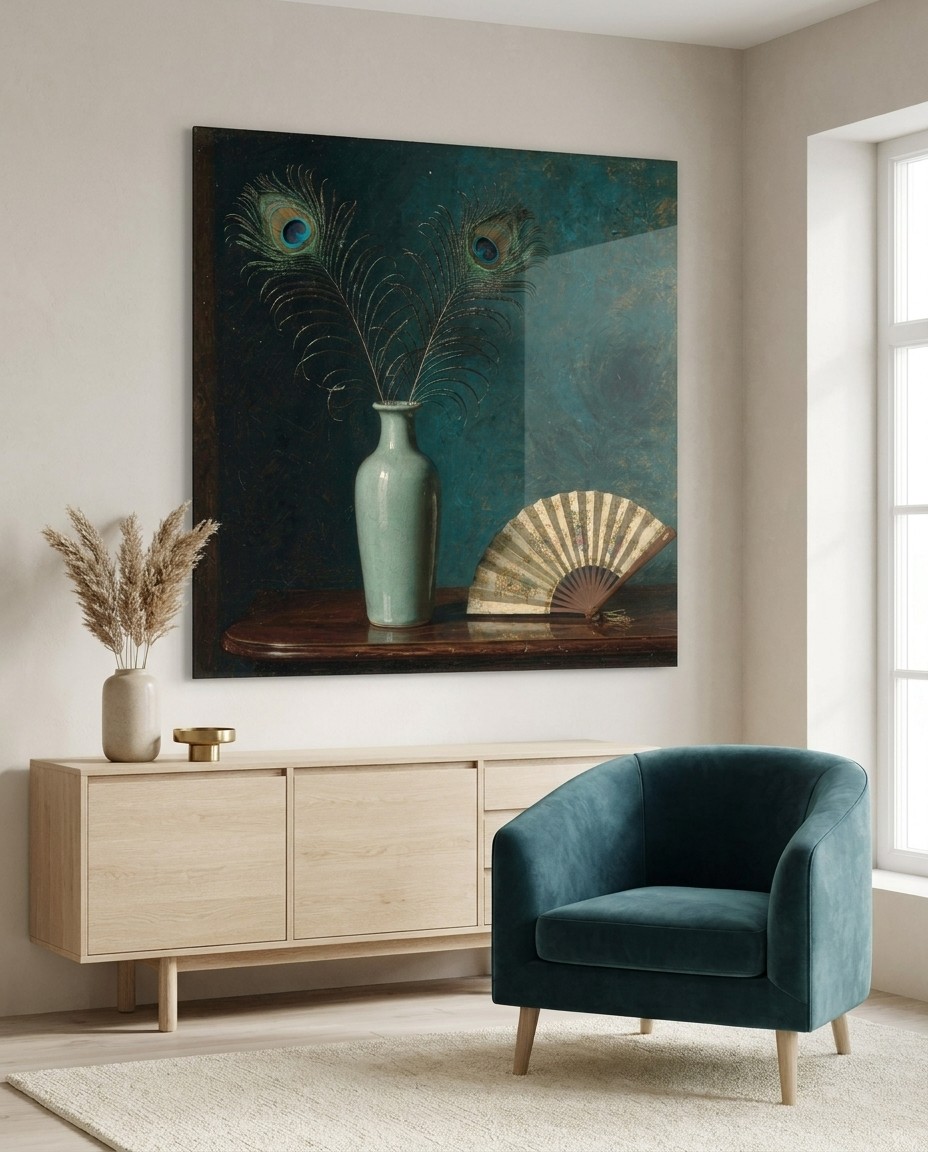
The art director composed eight original works in the spirit of the movement, without reproducing any known painting. Nocturne in Silver and Blue shows a bridge fading into night mist above a still river. Moonrise Over the Harbour raises thin masts and dark hulls under a pale moon. Twilight Over the Marsh follows a winding channel toward the last band of light. Birches in Morning Mist sets slender white trunks in a silver meadow. Harmony in Pearl and Ivory places a woman in an ivory gown, holding a fan, beside a pale curtain. The Blue and White Porcelain gives one blossoming branch to a blue and white jar. Arrangement in Teal and Gold pairs peacock feathers in a pale vase with an open golden fan. The Chrysanthemum Screen rests white chrysanthemums before panels of muted gold. Each work was checked for fidelity to the movement and cleared of anything that does not belong in the image.
The sale
Our gallerist sees a collection for patient eyes. These pictures change with the light of the day, which suits buyers who live with a work for a long time. Two nocturnes make a natural pair, and so do the porcelain jar and the golden screen. Acrylic glass adds depth to the dark blues and teals and lets the pale lights glow softly.
See the collection
The eight works are here: Tonalism and Aestheticism.
Next in the chronological walk through art history: Arts and Crafts, where the revival of handwork, plant patterns and honest materials takes the lead.