

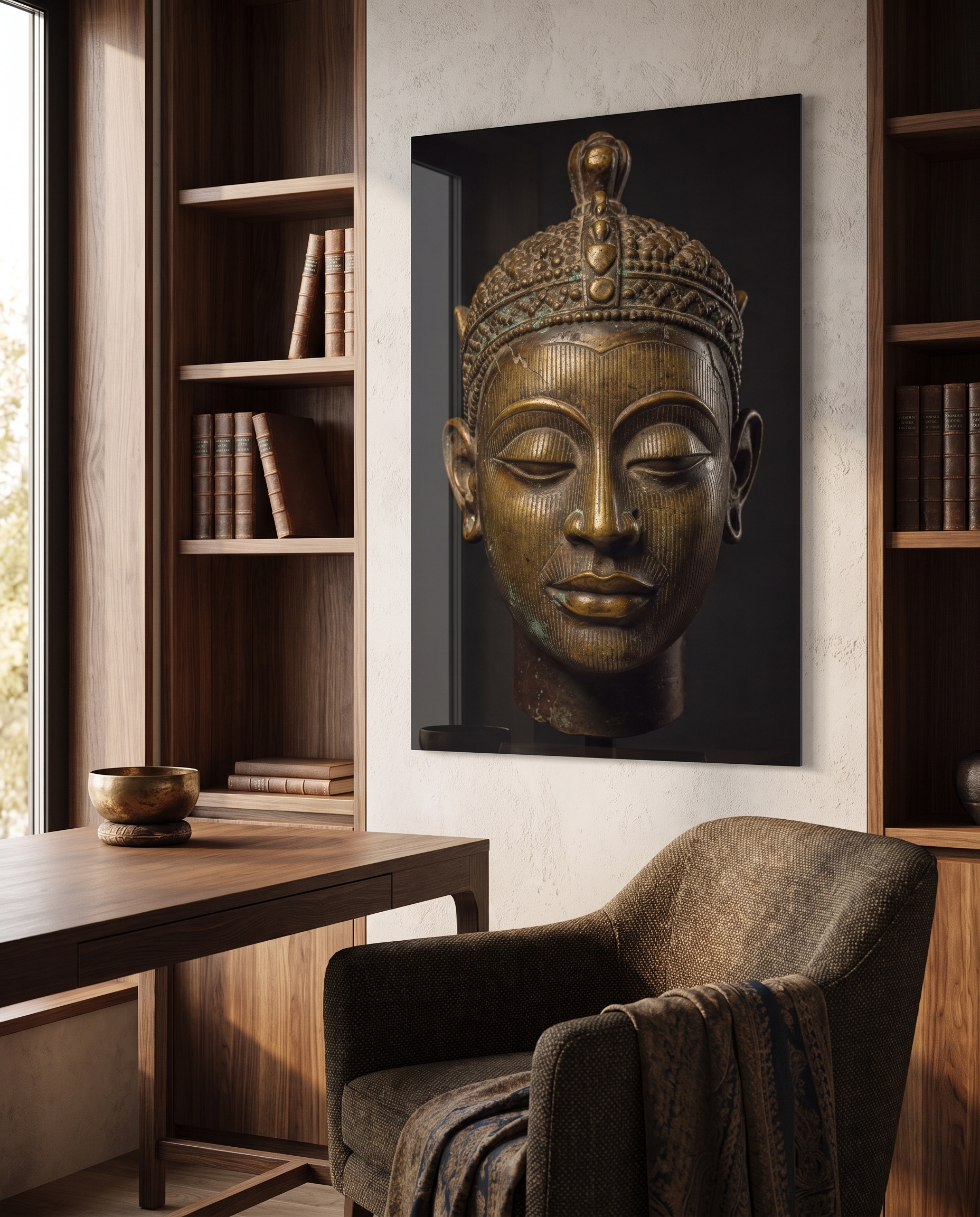
When Portuguese traders reached the court of Benin in the fifteenth century, they found bronze casting so refined that later European visitors simply refused to believe it was made in Africa — a prejudice that persisted, in one form or another, for four hundred years. Further east, in the Yoruba city of Ife, an even older tradition had already produced some of the most naturalistic portrait heads in world art, cast a full century before the Renaissance perfected the same ambition in bronze. This is the art of the West African courts: precise, idealised, made by and for kings who were also believed to be living links to the ancestors.
Lost wax, cast twice
Ife and Benin worked the same technique — a wax model built over a clay core, packed in a second clay mould, then melted out and replaced with molten alloy in a single irreversible pour. Get the wall thickness wrong and the casting fails; there is no correcting a bronze head after the metal has set. What survives from both traditions is astonishing precisely because the margin for error was zero: skin rendered in fine parallel striations, eyelids modelled with a jeweller’s patience, coronets and collars built up bead by cast bead.
Materials that carried rank
Nothing in these courts was decorative for its own sake. Coral, imported and restricted by sumptuary law, marked the wearer as royal the instant it was seen — a queen or an oba in full regalia could carry more coral than most households would see in a generation. Ivory, carved thin enough to glow when lit from behind, went to pendants and ceremonial masks. Brass and bronze, cast from metal obtained through trans-Saharan and later coastal trade, went to the ancestor heads and altar pieces that kept a dead king present at court. Terracotta, humbler and older, likely trained the hand that would later cast in metal.
What the courts made, and what was taken
In 1897, a British punitive expedition sacked Benin City and removed thousands of its bronzes and ivories, which were sold off to fund the expedition and now sit scattered across museums from London to Boston — a history of extraction that is inseparable from how this art reached the wider world, and that is still being actively addressed through restitution today. This collection does not depict, copy or stand in for any of those specific, named objects. It is a set of original studio compositions built in the spirit and craft-language of the courts — a homage to a visual tradition, not a claim on anyone’s heritage.
The collection
Eight original works: a cast bronze commemorative head in the Ife manner; a bronze altar head crowned in openwork coral; a fired terracotta head with the same serene naturalism in humbler clay; a cast bronze leopard, the animal reserved for kings across the Guinea Coast; a ceremonial mask in bronze and ivory with a coral-bead trim; a still life of coral, ivory and brass regalia; a ceremonial brass vessel banded in geometric relief; and a tall bronze pillar relief recording a court procession in shallow, patient carving. None reproduces a museum piece. Each carries the same conviction — that beauty and rank were, in these courts, the same material, worked by hand.
Living with it
These pieces want darkness around them — charcoal, ink blue, oxblood — so the bronze and coral read as lit from within rather than merely lit. A single warm, focused source per piece does more than an evenly bright room ever will; it is what separates a photograph of a treasury from a room that feels like one. Hang a head or a mask alone, at eye level, and give it space: this is art that asks to be approached, not glanced at in passing.