

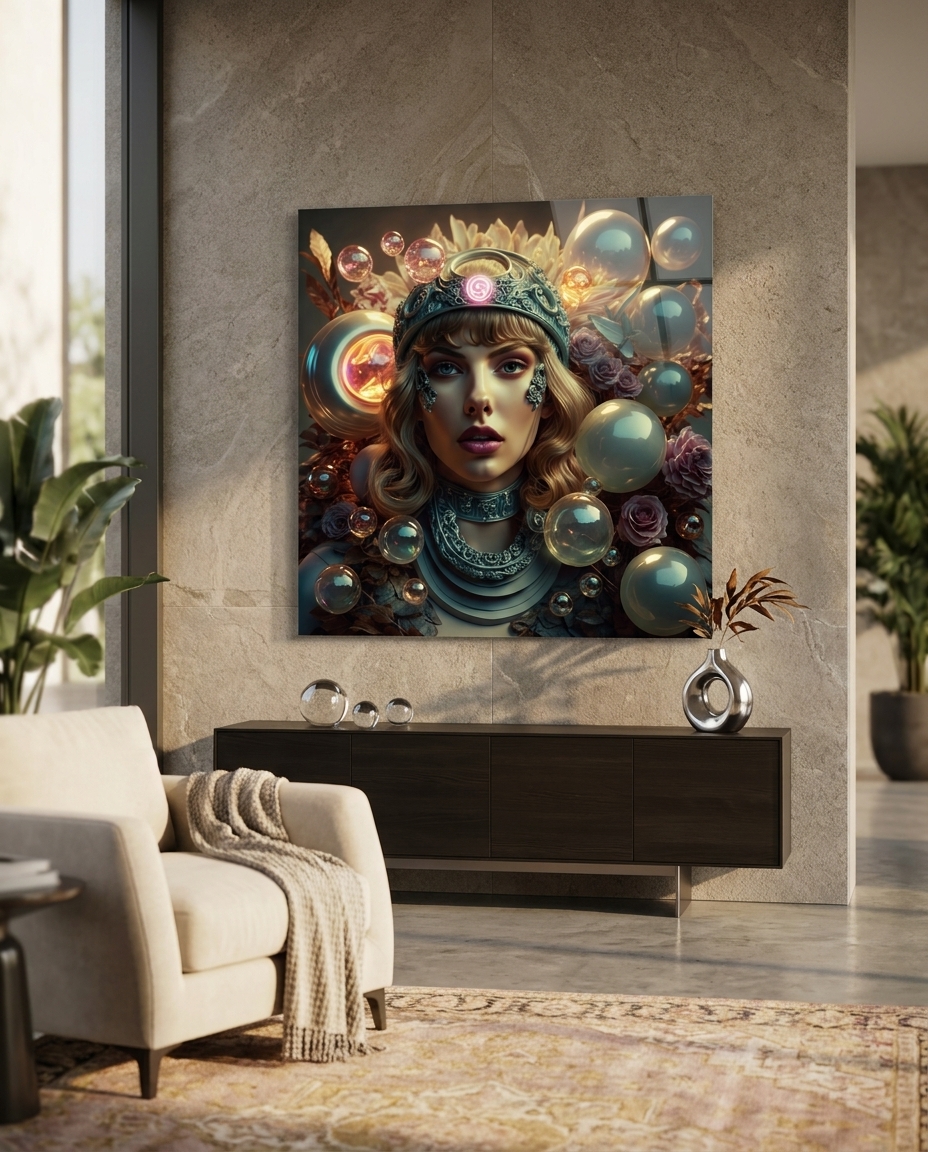
Digital Renaissance: A Tribute to Taylor Swift in the Modern Age is an independent, transformative homage — original works inspired by a contemporary cultural figure, created in the language of Renaissance portraiture. It is not affiliated with, endorsed by, or produced in partnership with the artist it honours. What follows is how the collection came to be, told by the three people who made it.
The need — why a room asks for a face
Most walls do not need another landscape. They need a gaze.
Interiors in 2026 have settled into what we call curated calm: warm, restrained, tactile, personal. Espresso browns, ochre, sage, honed surfaces that age rather than gleam. In that kind of room, abstraction can drift. A portrait does the opposite — it holds the space, gives it a centre of gravity, and turns a wall into a decision someone made.
What was missing from the catalogue was a portrait cycle with genuine emotional charge. Not a decorative face, but one a room could live with: a subject the eye returns to at breakfast and again at midnight. Formats here run to the single oversized statement — one work, generously scaled, anchoring a living room or a hallway. Hung as a pair, Modern Muse and Elegance Reimagined gain height on a narrow wall; hung alone, Digital Sovereignty simply owns the room.
The production — old light, new current
The brief was a collision: the compositional grammar of the Renaissance — three-quarter turn, controlled chiaroscuro, a sitter lit as if by a single high window — carrying a subject who belongs entirely to now.
That tension is the whole collection. Echoes of Renaissance and Illuminated Legacy lean into the historical register: deep grounds, jewel tones, fabric that reads as weight rather than pattern. Virtual Majesty and Infinite Renaissance push the other way, letting a cooler, more electric light break across the surface, as though a fifteenth-century panel had been touched by a screen’s glow.
Two rules governed every frame. First, distortion over resemblance — this is a muse, an archetype of modern fame, not a likeness for its own sake. Second, visible authorship: grain, atmosphere, imperfection, the sense of a hand rather than a machine. Timeless Luminescence is the clearest case, where the face emerges from a haze that refuses to fully resolve. The eye leans in. That leaning is the point.
The palette follows the year’s instincts — warm whites and deep earths, with saturated jewel accents doing the work that gold leaf once did.
The sale — meaning is the asset
Collectors in 2026 buy meaning before they buy price. The strongest signal in the market is identity: work that says something about who the owner is, what they came from, what they value. A portrait cycle built on modern iconography sits exactly there.
Younger collectors — now the majority of the high-net-worth field — discover work on a screen and commit without seeing it in person. That places the burden on depth. Every piece here is produced on acrylic glass, chosen for museum clarity and the way it carries luminosity into a warm room. We sell that depth, not the shine.
Where to begin: Digital Sovereignty is the collection’s anchor and its cover for good reason — the most composed, most frontal, most unflinching of the eight. The quieter register belongs to Echoes of Renaissance, more inward and low-contrast, which tends to be the piece people choose for a bedroom. Modern Muse is the one that photographs best above a console and starts the most conversations.
Eight works. One face, refracted eight ways. A room that has one of them is never neutral again.
→ Discover the Digital Renaissance: A Tribute to Taylor Swift in the Modern Age collection