

Some collections are made of moods. This one is made of places — eight of them, each carrying centuries, each photographed by the imagination at the exact hour when stone turns gold. Here is how Eastern Treasures: Heritage and Modernity came together.
The need — the wall that wants to travel
There is a particular request that comes up again and again in interiors work: give me somewhere to look. Not an escape exactly — something closer to breadth. A room with one good horizon in it breathes differently.
The 2026 interior is warm, restrained and tactile, built on espresso browns, ochre, sage and honed materials. What it lacks, often, is depth of field. A wide landscape supplies that instantly: it pushes the far wall further away and gives an enclosed room a sense of distance it does not physically have.
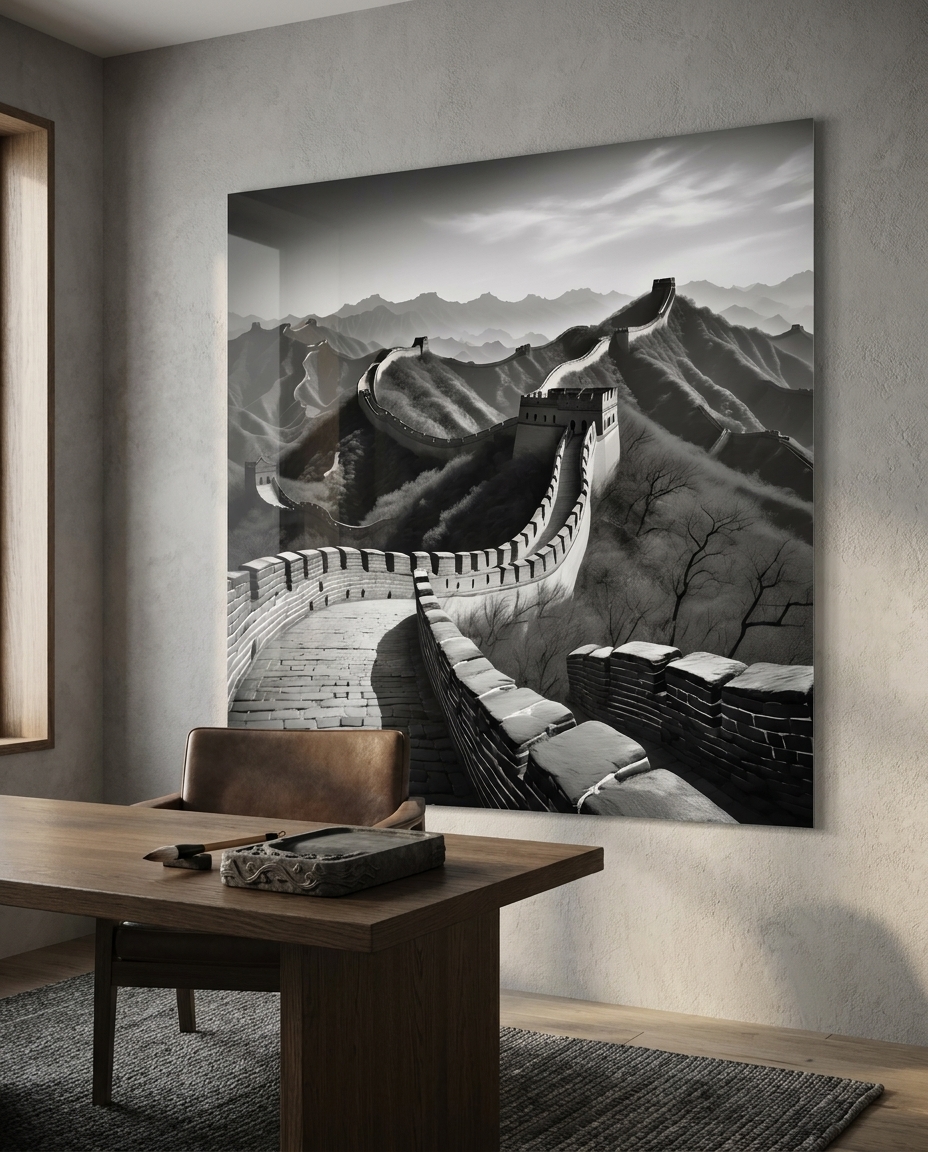
This collection was commissioned for exactly that job. The Himalayan Peaks and The Great Wall of China are horizontal anchors — the single oversized statement above a sofa or a long sideboard, where the eye can run the full width. Cherry Blossoms in Bloom and The Persian Garden work in softer rooms: bedrooms, spa spaces, anywhere the brief is restorative rather than dramatic. The Taj Mahal at Dawn is the hospitality piece — the lobby wall, the one that tells a guest where they have arrived.
The production — heritage without the postcard
The hard part of a landmark series is avoiding the postcard. These are among the most photographed places on earth. Reproducing them accurately would be pointless; the value lies in how they are felt.
So the direction was atmospheric rather than documentary. Every work is built on a single decisive light — dawn haze on marble in The Taj Mahal at Dawn, low sun raking the ridgeline in The Great Wall of China, dust and warm shadow in The Silk Road Caravan. Grain and diffusion are deliberate throughout: softness carries emotion where sharpness would only carry information.
The modernity in the title is not neon or chrome. It lives in the treatment — contemporary colour handling, saturated earths against warm negative space, and a compression of scale that makes an ancient site feel immediate rather than historical. The Forbidden City is the clearest example: the architecture is centuries old, the palette is entirely of this year.
The Russian Countryside sits slightly apart from the monuments — quieter, more human, a landscape rather than a landmark. It earns its place by giving the cycle a breath between grand statements.
The sale — provenance of feeling
Landmark work sells for reasons that are rarely about architecture. People buy the place they honeymooned, the country a grandparent left, the trip they intend to take. The subject is public; the meaning is entirely private. That is a strong position in a market where collectors increasingly buy for identity and significance rather than for price.
It also travels well commercially. Hospitality and office buyers want art that is grounded and crafted — work that suggests a place has been considered rather than decorated. A series like this can be bought as a set of two or three for a corridor, or as a single anchor.
All eight are produced on acrylic glass, and here the medium genuinely earns its keep: depth, museum-grade clarity, and the way a luminous dawn holds its light across a large surface. We sell the clarity and the depth — never the gloss.
If you buy one, buy The Taj Mahal at Dawn. If you buy two, add Cherry Blossoms in Bloom for the contrast of scale — monument against blossom, permanence against a season that lasts ten days.
→ Discover the Eastern Treasures: Heritage and Modernity collection