

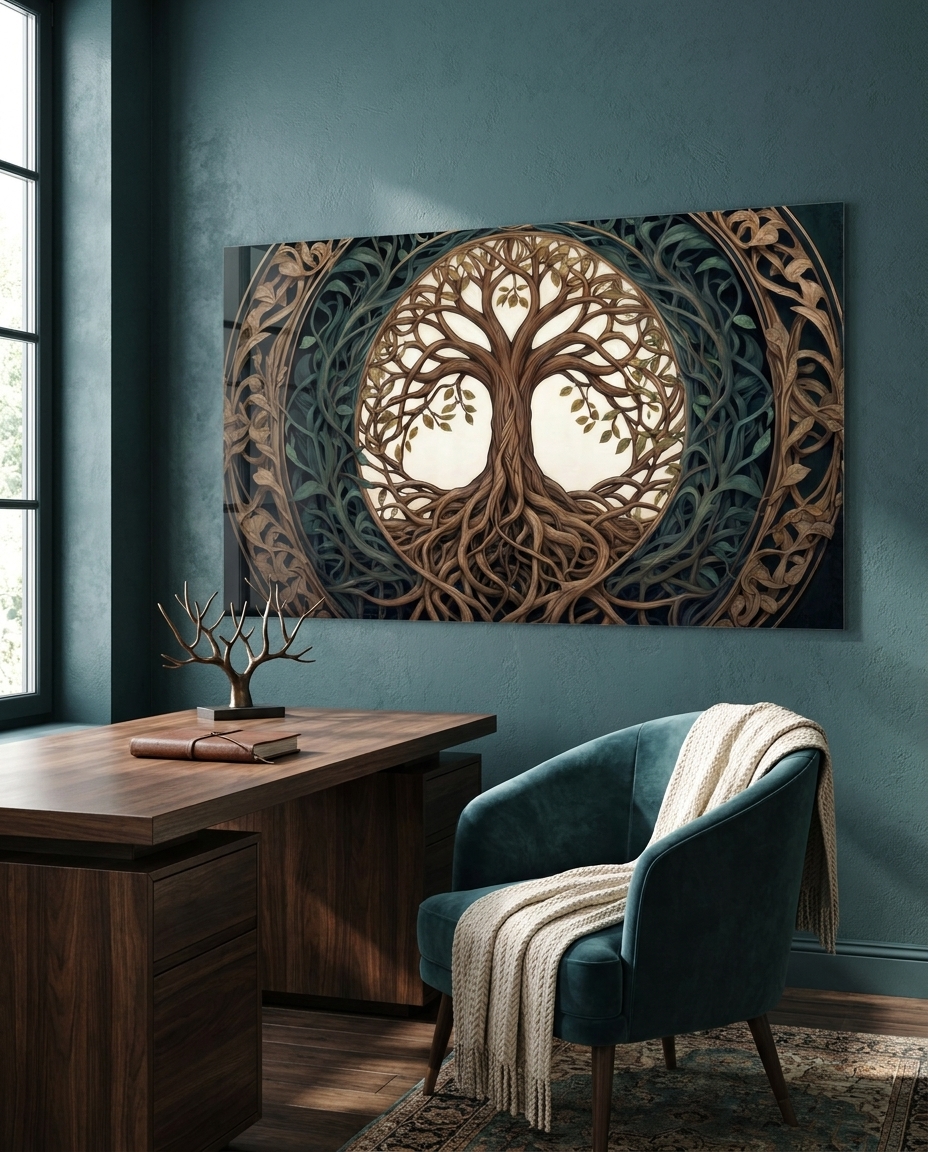
This is the collection in our catalogue that is most often bought for someone else — a wedding, a new home, a milestone. Echoes of Heritage: A Journey Through Jewish Identity and Legacy is eight works about memory and belonging, made to be lived with rather than looked at once.
The need — art that a family keeps
Interiors have turned personal. The dominant instinct of 2026 is warm, restrained and meaningful — rooms assembled slowly, from things that carry a story, rather than styled in a weekend. Under that instinct sits a request that decorating trends rarely name directly: people want work that says where they come from.
That need is badly served by most catalogues. Heritage art tends to arrive either as literal religious illustration or as generic symbolism with the warmth drained out. Neither hangs well in a contemporary home.
The brief here was a third path: art with genuine cultural depth that still functions as art in a calm, modern room. Shabbat Peace and Tree Of Life Mandala are the domestic heart of the collection — dining room, entry hall, the wall a family passes every day. Jerusalem Dreams and Homeland Reverie are the wider horizons, suited to a living room anchor at generous scale. Vows Beneath the Star is, unsurprisingly, the piece most often chosen as a wedding gift.
The production — symbol without illustration
The governing rule was restraint. Symbols carry enormous weight already; the work does not need to shout them.
So the visual language is luminous and low-contrast, built on warm whites, deep blues and a light that seems to come from within the surface rather than from a source outside it. Hebrew Reflections treats letterforms as texture and rhythm — legible as calligraphy, composed as abstraction. Tree Of Life Mandala takes the oldest of motifs and structures it with radial geometry, so it reads as pattern first and meaning second, which is the correct order for something you will see every day.
Two works carry the collection’s emotional range at its edges. Diaspora Blues is the darkest and most inward — dispersal, distance, a cooler palette held deliberately in check. Procession Toward the Sun answers it with movement and warmth. Between them the cycle covers what heritage actually feels like: loss and continuity in the same breath.
Throughout, grain and atmosphere do the work that hard rendering would ruin. Softness here is not decoration — it is how memory looks.
The sale — meaning over price
The clearest signal in the current market is that collectors buy identity. Work about roots, community and values outperforms work that is merely beautiful, and it does so at every price level — including the accessible end, which is the fastest-growing part of the market.
This collection also has an unusual sales pattern worth naming: it is bought as a gift far more often than our other cycles. That changes what matters. Presentation, legibility of the subject, and the sense of an object made with care count as much as the image itself. Each work is produced on acrylic glass for depth and museum clarity — a surface that reads as considered when it arrives, not merely printed.
Advice for a first purchase: Tree Of Life Mandala is the most universally welcome and the most forgiving of any room. Jerusalem Dreams is the one to choose for a large statement wall. Diaspora Blues is for the collector who wants the collection’s honest note rather than its warmest one — and it is, quietly, the strongest work of the eight.
→ Discover the Echoes of Heritage: A Journey Through Jewish Identity and Legacy collection