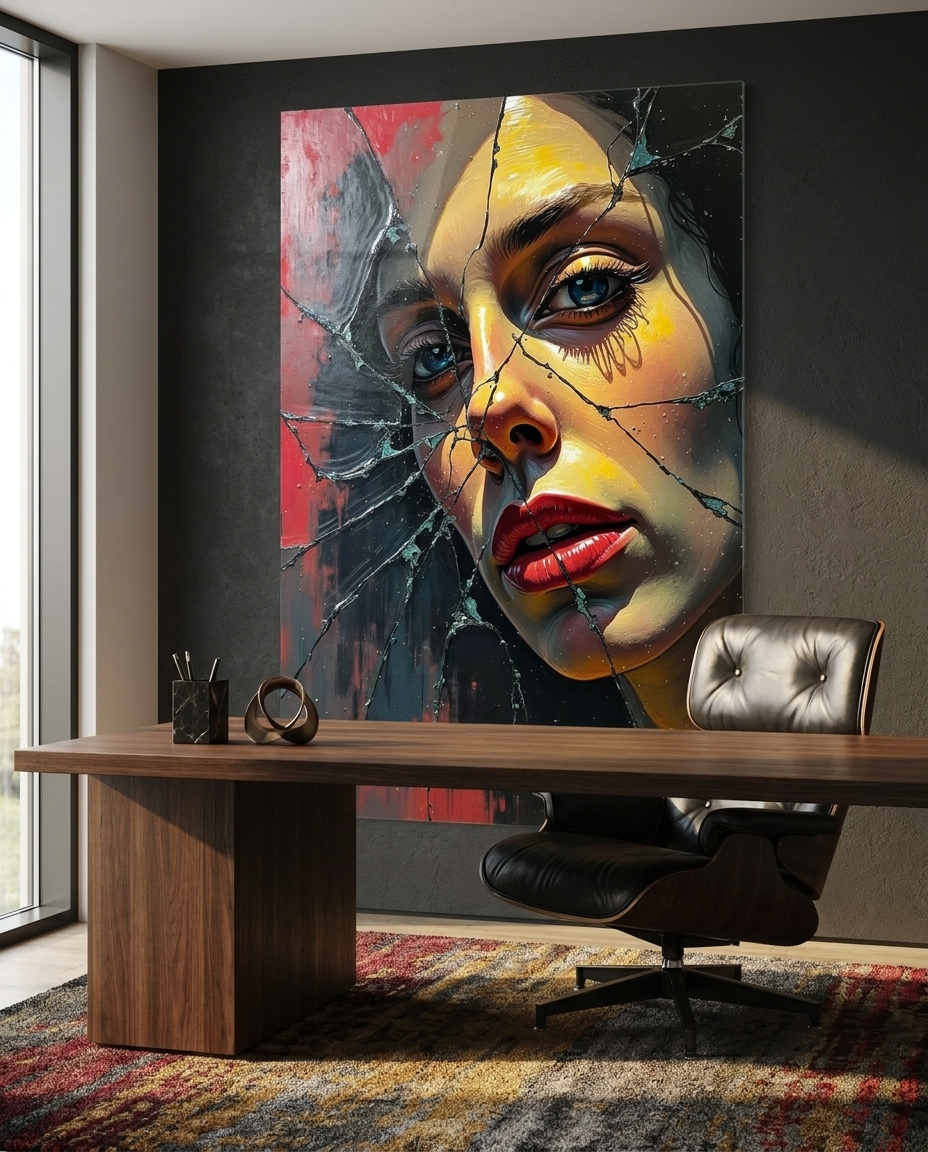
Not every room wants to be soothed. Echoes of Surreal Angst is the collection we made for the people who find calm art slightly dishonest — eight works that take anxiety, dream logic and distorted time and give them a form you can hang.
The need — the counterweight room
The prevailing interior of 2026 is warm, quiet and restrained. It is a genuinely good instinct, and it has one failure mode: a home that is entirely soothing becomes a home with nothing to say.
Almost every well-designed house has one room that can carry weight — a study, a den, a library corner, a teenager’s space, a hallway you pass through rather than sit in. That room is where this collection belongs. It is a counterweight, and it makes the calm rooms around it read as a choice rather than a default.
Practically: The Melting City and Architectural Scream are the large statement works, best given a full wall and no competition. Clock of Fractured Time is the study piece — dense, rewarding, the kind of image you keep finding new details in over a working day. Ghostly Ballroom has the most theatrical scale and does remarkable things in a dim hallway. Deep, warm-dark walls suit this collection far better than white ones.
The production — dream logic, held together
Surrealism is easy to do badly. Pile up enough impossible objects and you get noise, not unease. The discipline is that each work may break exactly one rule of reality — and must then obey every other rule with total conviction.
The Melting City softens architecture and keeps the light rigorously honest. Floating Hands suspends the body but preserves anatomy and weight. Clock of Fractured Time shatters chronology inside a space that is otherwise perfectly plausible. The single violation is what makes the image land; a second one would turn it into decoration.
Distortion over resemblance is the operating principle throughout. Weeping Figures and Distorted Reflection deliberately refuse a clean read of the face — the emotion is delivered by the deformation itself, not by an expression you can name. Nightmare Bloom takes the opposite route, using organic beauty as the carrier and letting the wrongness arrive a second later.
The palette is deliberately restricted — bruised blues, ash, sudden warm accents — and the surface carries visible grain and atmosphere. This is work that wants to look made, not rendered.
The sale — the piece that starts the argument
Psychological portraiture and personal-mythology surrealism are, right now, the freshest territory in the market. Collectors — especially younger ones, who now make up the majority of serious buyers — reward work with genuine emotional risk. Nothing sells more slowly than art that has been designed to offend no one.
This collection converts differently from our calmer cycles: fewer buyers, faster decisions, more single-piece purchases than sets. Someone either recognises themselves in Weeping Figures immediately, or they do not. That is fine. It is the work that gets photographed and sent to a friend, which is how most discovery happens now.
Each piece is produced on acrylic glass, which suits this imagery particularly well: the depth pulls the darker passages into genuine dimension instead of flattening them, and the museum-grade clarity keeps the fine grain intact at scale.
Where to start: The Melting City is the collection’s signature and its most immediately legible work. Clock of Fractured Time is the connoisseur’s pick — the one that keeps paying out. Architectural Scream is for the collector who actually meant it.