

Between roughly 1000 and 1150, Europe built more stone churches than in the previous five centuries combined — a construction boom driven by pilgrimage routes, monastic reform, and a genuine, well-documented relief that the turn of the millennium had not, after all, ended the world. A Burgundian monk named Raoul Glaber wrote that the earth had shaken off its old age and dressed itself everywhere in a “white robe of churches.” Round arches, thick load-bearing walls, small deep-set windows and heavy stone vaults gave the resulting style its name centuries later — nineteenth-century historians thought it looked like a rustic echo of Roman building, and the label “Romanesque” stuck. It undersells what actually happened: for the first time since antiquity, large-scale figurative sculpture returned to European architecture, carved directly into the fabric of the building itself.
The portal became a sermon
Pilgrims walking the roads to Santiago de Compostela, Rome or Jerusalem could not read Latin, and most could not read at all. So the church put its argument above the door, where everyone had to look up to enter. The tympanum — the semicircular stone field over a portal — became the single most important surface in Romanesque art: a hieratic Christ in Majesty, elongated apostles, the weighing of souls at the Last Judgment, all carved in a deliberately unnaturalistic style that traded anatomical accuracy for legibility and awe. Figures stretch or compress to fit their frame; drapery falls in rhythmic, almost musical folds that have nothing to do with how cloth actually hangs. This was not a failure of skill. It was a different aim entirely — carving theology, not the world.
Capitals, cloisters and controlled fantasy
Move inside, and the same masons who carved the portal turned playful. Column capitals — the carved blocks where a shaft meets its arch — became a private sketchbook in stone: confronted lions with knotted tails, a green man exhaling foliage from his mouth, biblical scenes compressed into a few square inches. Cloister capitals in particular escaped strict doctrinal oversight, and monks and masons filled them with a bestiary that ranges from solemn to genuinely strange. Bernard of Clairvaux famously complained about it — what, he asked, were these “filthy apes” and fighting knights doing in a monastery meant for reading, not looking? The complaint survives; so does the carving. The tension between discipline and invention is, in many ways, the whole style in miniature.
Color, gold and the objects that traveled
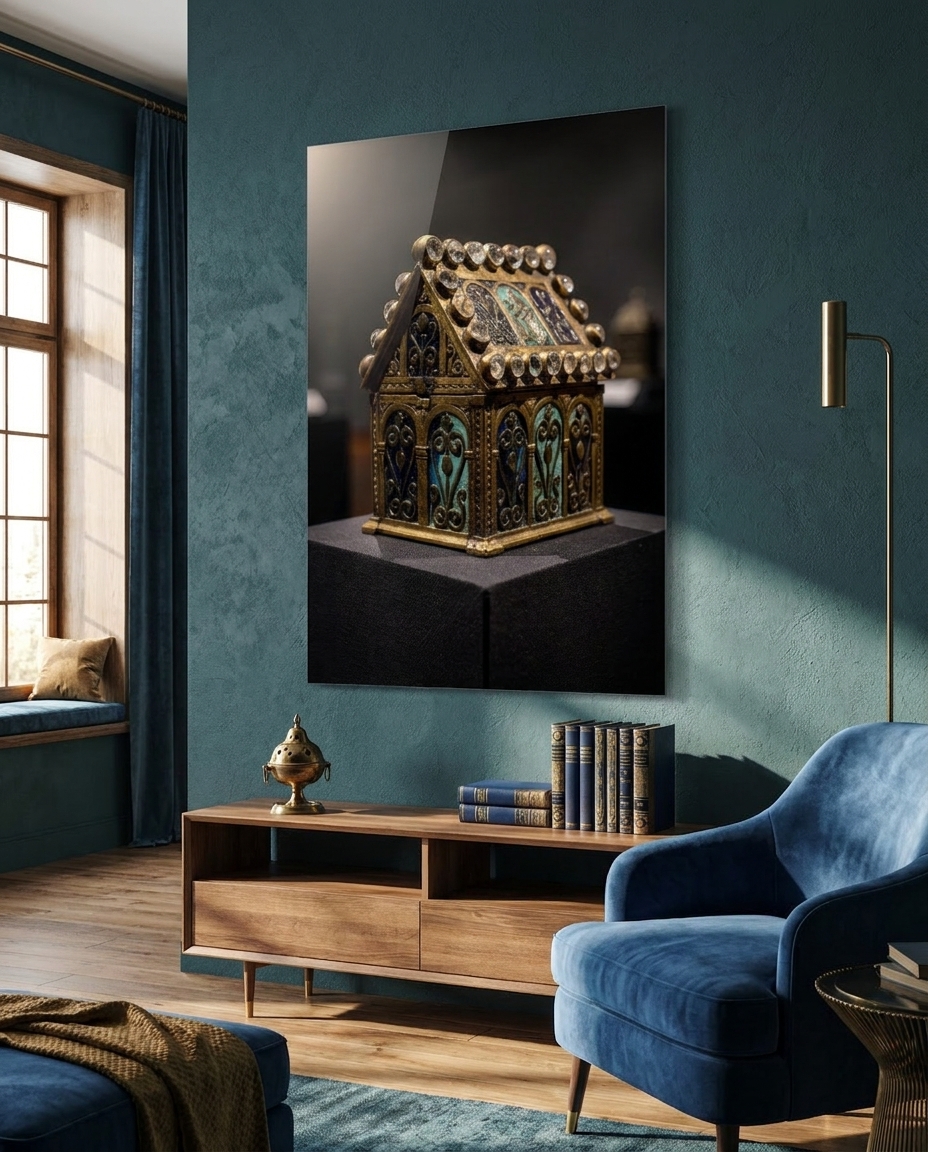
Stone was never the whole picture. Apse walls were painted in flat, bold fresco — ochre, terracotta red, lime white, built to be read from the length of a nave rather than admired up close. Scriptoria turned out manuscripts whose single opening initials could consume a monk’s attention for weeks, built from interlace, coiling beasts and gold leaf. And metalworkers cast reliquaries — gabled, house-shaped caskets in gilded copper and champlevé enamel — objects small enough to travel the pilgrim roads themselves, carrying relics from shrine to shrine and, with them, the visual vocabulary of one workshop to another. Romanesque art moved because the roads moved it.
The collection
Eight original works, none copying any specific portal, manuscript or reliquary: a hieratic Christ in Majesty carved above a pilgrimage-church door, ringed by the symbols of the four evangelists; a cloister capital of confronted lions with interlaced tails; a fresco fragment of seated robed elders in flat ochre and terracotta; a concentric archivolt of carved chevron, rosette and cord ornament; a gilded reliquary casket in blue champlevé enamel and rock crystal; an oversized illuminated manuscript initial in vermilion, ultramarine and gold leaf; a tympanum fragment of an angel weighing souls; and a foliate green-man capital, half face, half vegetation. Together they move between the monumental and the intimate — the same hand, in spirit, working at the scale of a church door and the scale of a page.
Living with it
This is art built for weight and shadow, not brightness. Hang it against warm stone tones, deep charcoal or oxblood walls, and light each piece with a single raking source rather than an even wash — raking light is what makes carved relief and gilded metal read as carved and gilded in the first place. A study, library or entrance hall suits the gravity of it best. Give each piece room to be looked up at, even slightly — that was always the point.