

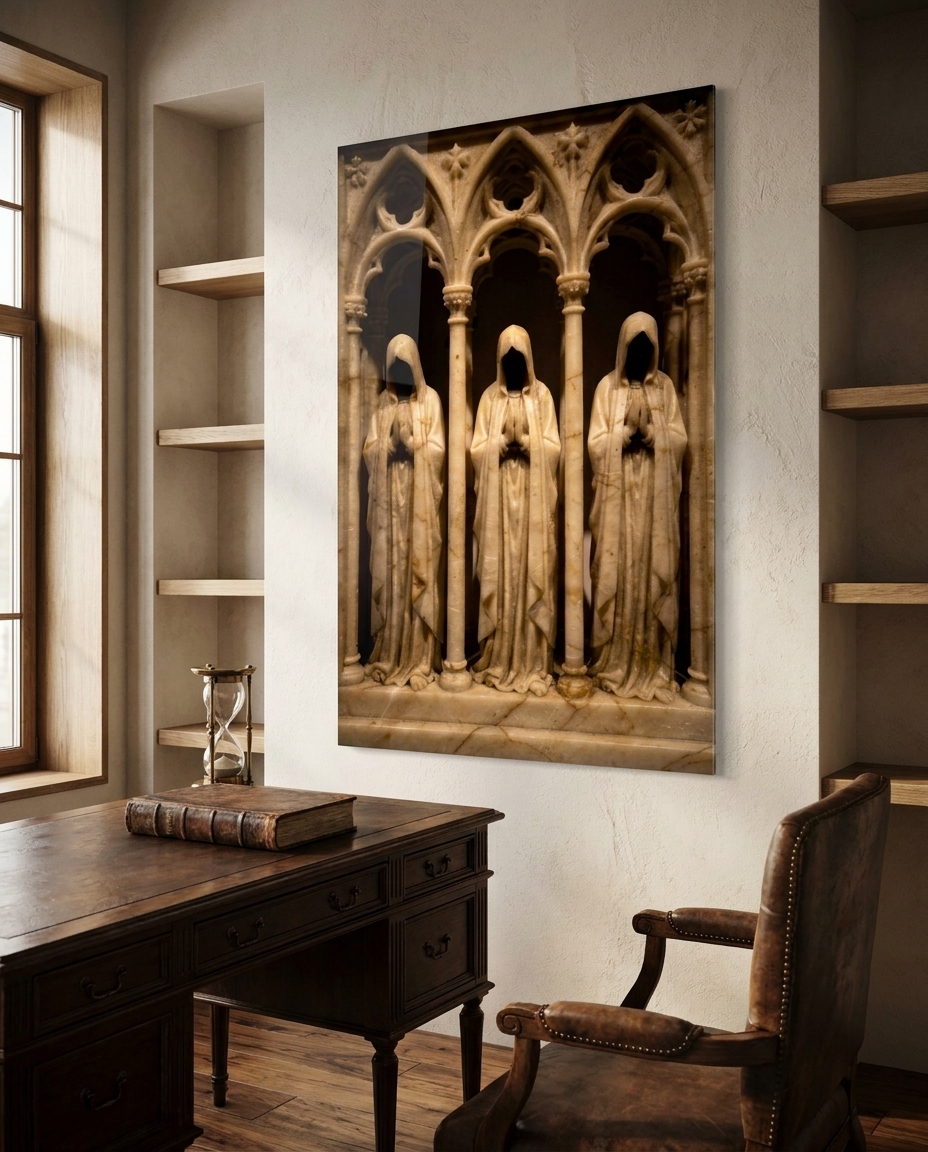
There is a moment, standing beneath a Gothic vault, when the stone above you stops behaving like stone. It thins, it branches, it lifts. Somewhere between 1140 and 1500, Europe worked out how to build that feeling on purpose — and then spent three and a half centuries refining it. This collection is our homage to that age.
Where Gothic sits in the story of art
Gothic art begins with a renovation. Around 1140, the choir of a royal abbey north of Paris was rebuilt with pointed arches, ribbed vaults and walls opened into coloured glass. The idea travelled fast. Within a century it had produced the great cathedral age across France, England, Germany, Spain and the Low Countries, and it did not exhaust itself until the Renaissance arrived with a different set of convictions.
It followed the Romanesque, and it is best understood as an argument with it. Romanesque building is massive, round-arched, thick-walled, and it keeps its figures stylised and grave. Gothic is the opposite instinct: take weight out, put height and light in, and let the figures soften into something recognisably human.
The name, incidentally, was an insult. Renaissance critics called it Gothic to mean barbarous — the work of northern tribes rather than civilised Rome. The label stuck long after the contempt wore off, which is a useful reminder that art history’s vocabulary is often written by the movement that came next.
What actually defines it
Three engineering ideas carry the whole style. The pointed arch directs thrust downward rather than outward, so it can be built tall and narrow. The rib vault concentrates the ceiling’s load onto slender points instead of spreading it along a wall. The flying buttress moves the remaining outward push to the building’s exterior, where it can be braced in open air.
Together they make the wall structurally optional. That is the whole revolution: once the wall is no longer holding the roof up, it can be replaced with glass. Hence the enormous windows, hence the tracery — stone reduced to a lace framework — and hence the ruby and lapis interior light that no earlier European building could produce.
The sculpture changed with the architecture. Gothic figures grow tall and slightly sinuous, wrapped in long tubular drapery, and their faces relax. A Gothic saint looks at you; a Romanesque one looks through you. The same warming happens in manuscripts, where burnished gold grounds and ivy-leaf borders fill with tiny marginal creatures that have nothing to do with the sacred text beside them and everything to do with a scribe enjoying himself.
The need
Our interior decorator asked for one thing from this movement: verticality that a modern room can actually use. Tall, narrow, upward-pulling images are unusually good at solving real problems — a stairwell wall, a narrow hall, a high-ceilinged room where everything else sits low. And the Gothic palette of pale limestone, weathered grey-gold and deep shadow lands squarely in the warm, tactile, patinated register that interiors have moved toward.
The production
Our art director set a firm rule: eight original compositions, no reproduction of any identifiable cathedral, window, tomb or manuscript. Everything here is invented in the period’s manner rather than copied from it. The brief called for the visible mark of the hand — chisel tooth, tool marks, weathered grain, patinated oak, craquelure on vellum — because Gothic work was made by hand and the surface should say so.
The set deliberately spans the movement’s full range of media rather than resting on stained glass alone: architecture inside and out, stone and alabaster sculpture, carved oak, illumination, and ivory. Only one work is a window — and it is figurative and leaded, not an abstraction of coloured light.
- The Ascending Vault — looking straight up into a rib vault, ribs springing to a carved boss.
- Buttress and Sky — a tier of flying buttresses and crocketed pinnacles in low raking sun.
- The Portal Saints — elongated jamb figures in long tubular drapery beneath their canopies.
- Alabaster Mourners — hooded tomb figures gathered under a cusped arcade, translucent and grave.
- Lancet of Ruby and Lapis — a leaded figurative window burning through from behind.
- The Carved Choir — linenfold panelling, pierced tracery cresting, warm patinated oak.
- Hours of the Ivy Margin — a gilded initial on a burnished ground, with drolleries in the border.
- The Ivory Gable — a devotional diptych built as miniature Gothic architecture.
The sale
Our gallerist’s argument is simple. Gothic is one of the few historical styles that reads instantly to almost everyone and still rewards close looking for years. A single tall piece will structure a wall on its own — the most reliable decorating move of the moment — and the deep blacks and luminous stone in these images are exactly what an acrylic face-mount is good at carrying, since the material conducts light into the image and gives it depth without any light source of its own.
Each work is produced as a museum-quality print under acrylic glass, in the sizes and formats listed on its product page.
See the collection
This is the seventeenth movement in our chronological journey through the history of art, which began with Paleolithic cave painting and continues, one movement at a time, toward the art of 2026.