
Between Rooms is our new collection of eight works, and it began with an awkward question: which wall in your home do you look at most often, and least deliberately?
The answer, almost always, is a stairwell. It is the tallest surface a house owns, the one every resident passes several times a day — and the one that stays empty for years because nobody quite knows what belongs there. That gap is where this collection started.
The need — a room you pass through, never furnish
Our interior decorator made the case first. Transitional spaces — stairwells, landings, entrance halls, the wall a window sits beside — are the least-decorated surfaces in a home, and they are also the most vertical. They ask for a tall piece, hung alone, doing the whole job by itself. That is exactly the direction the market has moved this year: a single oversized work that structures a room and reduces the amount of decoration everything else needs.
There was a second argument, subtler and more useful. A window painted on a wall gives a flat surface somewhere to go. Depth is the one thing a small or interior room cannot buy, and a threshold motif hands it over free. Hung well, Rain on the North Window does not read as a picture of a window; it reads as a window, in a wall that never had one.
The production — light as the only visitor
The art director set one rule for all eight: no people. The subject is the space itself, and the light that crosses it — a slab of dawn coming in sideways, a single shaft falling down a spiral stair, an amber trapezoid climbing a landing wall at the end of the day.
Everything else followed from that. The register is atmospheric rather than sharp: airborne dust made visible, faint haze, edges dissolving where the light is strongest, a fine grain across the whole surface. These are dark works — the shadow occupies most of the frame, so that the light can be a small, precious event inside it. Where a cleaner treatment would have given us an architectural rendering, this one gives a painting of light, closer to the Tonalists and to Hammershøi’s empty Copenhagen rooms than to any photograph of a building.
The surfaces matter as much as the light. Hand-troweled plaster, flaking limewash, worn timber, cracked paint, stone hollowed by use: the texture is not decoration here, it is the record of everything that has already passed through. Two palette families run across the set — deep jewel tones of merlot, oxblood, plum and teal on one side; terracotta, caramel, ochre and olive-grey on the other. Two ways of being dark, one warm and one cold.
The sale — eight thresholds, one light
The gallerist’s contribution was the discipline of the series. Four windows, four staircases, one consistent logic of light: this is a collection meant to be recognisable as a body of work, not eight pieces that happen to share a folder. Coherence of series is what builds credibility for a young name — more than any claim of rarity.
The works divide cleanly by mood. Morning Enters Sideways, Landing, Late Afternoon and Merlot Curtain carry the warm end of the register and belong in a bedroom, a living room, a landing that catches afternoon sun. The Blue Hour Pane, Rain on the North Window, The Turning Stair, Descent in Prune and Twelve Steps Down hold the dark end — a study, an entrance hall, a room that is already low-lit and would rather stay that way.
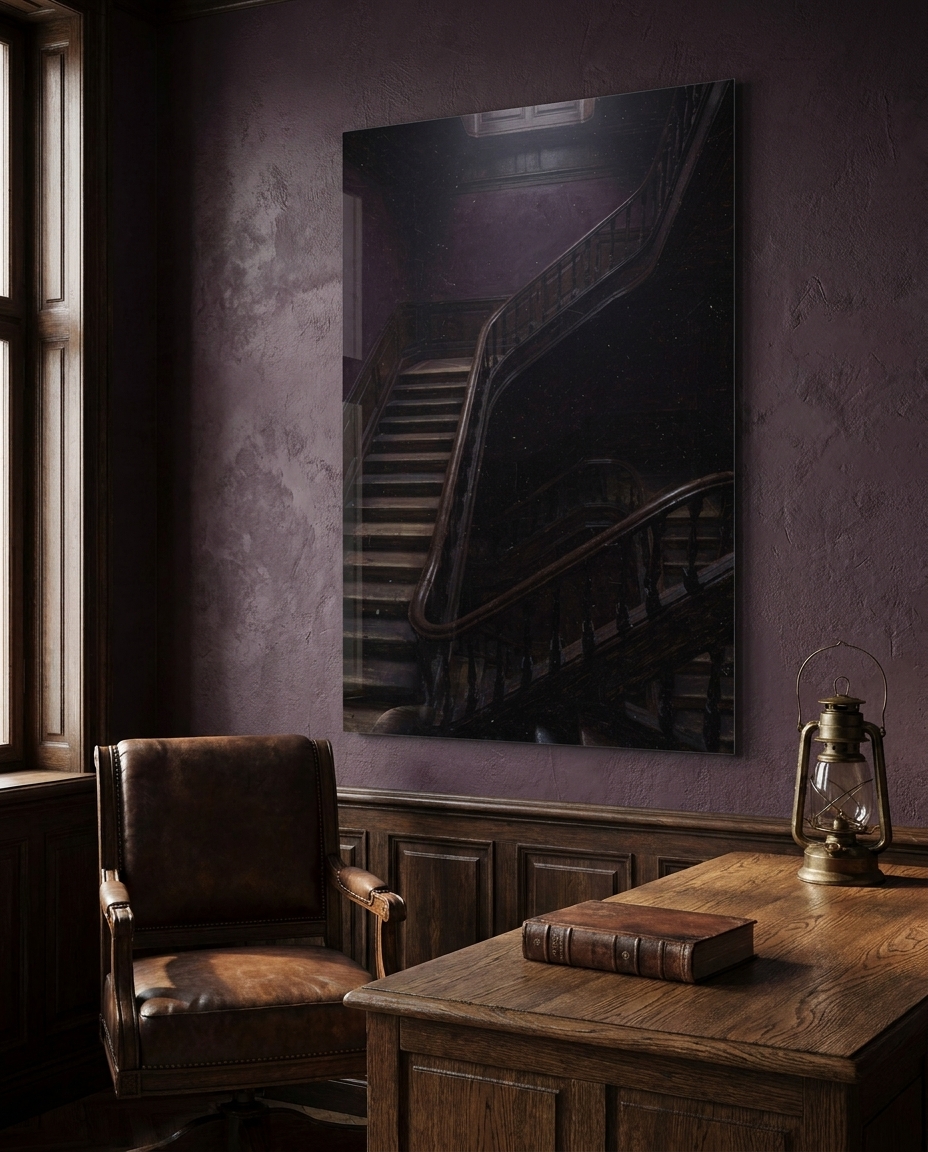
Our advice is the same for all eight: hang one, large, alone. These works do not want company on the wall. Light them indirectly, so the grain and the deep shadow stay tender instead of glaring, and give the piece the tall empty surface it was made for.
The eight works
- Morning Enters Sideways — dawn through a tall casement, a solid slab of dusty light landing on a worn floorboard.
- The Blue Hour Pane — deep teal twilight beyond a small multi-pane window, against a nearly black room.
- Merlot Curtain — heavy velvet half-drawn across a tall window, backlit until the fabric glows like held wine.
- Rain on the North Window — the world beyond dissolved into a soft grey-green blur, every drop a small lens.
- The Turning Stair — a worn stone spiral seen from below, one shaft of pale light entering high above.
- Descent in Prune — a dark timber banister sweeping down into plum-coloured gloom.
- Landing, Late Afternoon — a long amber trapezoid of light crossing the steps and climbing the wall.
- Twelve Steps Down — a narrow service stair descending into warm dark, oxblood risers, one bulb at the bottom.
Each work is produced as a high-definition Lambda print, face-mounted under acrylic glass on an aluminium composite panel — a support that carries light into the image and gives these deep shadows the depth they were made for.