
Loom and Clay is our new collection of eight works, and it began with a filter that returned nothing.
Type the word into the search of almost any online gallery and hundreds of results come back: woven fibre, terracotta, dried grasses, hand-drawn pattern. Type it into ours and you found an empty shelf. We are strong on historical and painterly styles, and entirely absent from the decorative language that people actually furnish their homes with. This collection is the answer to that gap — and, as it turned out, the answer to the direction our own experts had been pushing all month.
The need — the style our catalogue could not serve
Our interior decorator put it plainly. The warm, craft-led, layered interior is not a niche; it is the default of the moment. Terracotta, burnt sienna, caramel, ochre, olive-grey and clay have replaced the cool greys, and the materials that go with them are honed rather than polished, woven rather than moulded, chosen because they will age well rather than because they look new.
What that interior asks of a wall is very specific. Not a small decorative accent, but one large piece that carries the warmth of the whole room and lets everything else stay quiet. The oversized single work has become the reflex of the season precisely because it reduces the amount of decorating everything else has to do. Eight vertical pieces, hung alone above a bench or a bed, or stacked as a coordinated pair — that was the brief handed to production.
The production — the hand has to be visible
The art director set one governing rule: every image must carry the trace of the person who made the thing in it.
That rule did most of the work. It ruled out the flat, tidy, vector-clean version of this style immediately — the one that reads as decoration rather than as an object. What we wanted instead was evidence: individual fibres and slubs in the yarn, the exact turn of a knot in the cord, a thumbprint dragged through wet clay, one crooked row in an otherwise even weave, a frayed selvedge, an over-inked corner where the block was pressed down too hard. The imperfection is the subject. A surface with no accident in it now reads as generic, and the market has noticed.
The light is the second thread that ties the set together. All eight are lit by the same low, warm, raking afternoon sun coming in from one side, grazing across the surface so that the texture casts its own small shadows, with deep warm shade on the other side and a faint haze of dust in the air. Nothing is clinically sharp. There is a fine grain across every frame. Where a cleaner treatment would have produced a product photograph, this one produces something closer to a still life — the tradition of the bodegón, where humble domestic objects are given the light usually reserved for grand subjects.
The palette is shared and deliberate: terracotta, burnt sienna, rust, caramel, ochre, olive-grey and unglazed clay, with a single cool note — deep indigo — allowed to appear as an accent and never as a theme. The ground behind every subject is warm cream or sun-washed plaster. Eight subjects, one afternoon, one workshop.
The sale — coherence is the argument
The gallerist’s contribution was discipline. Eight pieces that share a light, a palette and a grain read as a body of work; eight pieces that merely share a folder do not. For a young name, that coherence is what builds credibility — more than any claim of rarity, and more than any single strong image.
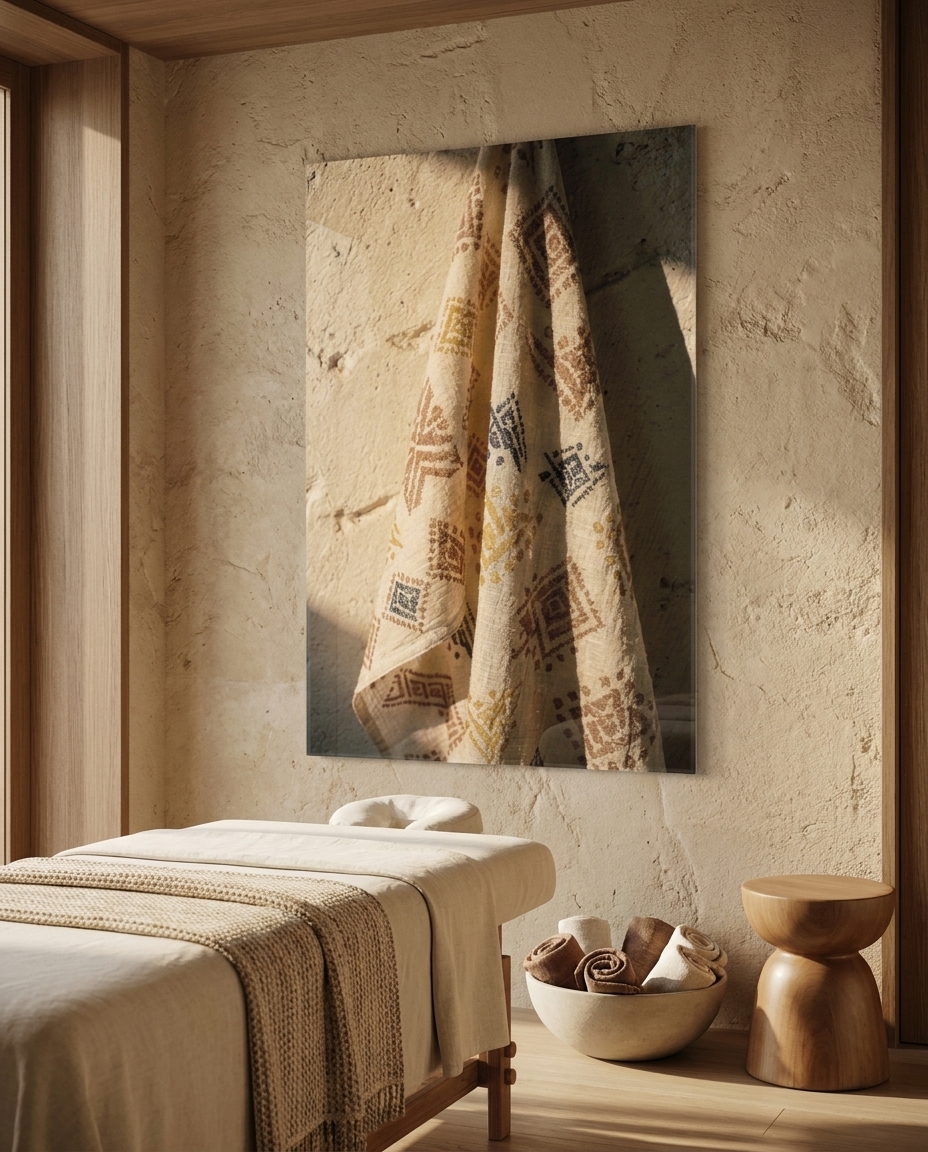
The set divides naturally by room. The Loom at Four, Folded Warmth and Fringe and Tassel carry the most colour and the most pattern, and belong where people gather: a living room, a lounge, a wide entrance wall. Knots in Sunlight and Block-Printed Cotton are softer and paler, and suit a bedroom or a treatment room. Clay and Grasses, Bowls in a Row and Cane and Light hold the quietest register — a dining room, a kitchen, a study.
Our advice is the same for all eight: hang one, large, alone, on a warm off-white or plaster wall, and let it be the reason the room feels warm. Light it from the side rather than head-on, so the grain and the raking shadow survive. Pair it with what it is already made of — linen, wood, jute, unglazed ceramic — and the piece stops looking like a picture of craft and starts behaving like part of it.
The eight works
- The Loom at Four — a weaving still bound to its loom, rust and ochre rows crossing an unfinished warp.
- Knots in Sunlight — a hand-knotted hanging on sun-warmed plaster, its own shadow doubling the pattern.
- Folded Warmth — a stack of folded flatweave rugs, diamonds and chevrons compressed into stripes of colour.
- Clay and Grasses — three thrown vessels holding dried grasses, throwing a long late shadow up the wall.
- Cane and Light — a panel of woven cane webbing, every hexagon lit from behind and fraying at the edge.
- Fringe and Tassel — a curtain of hand-spun tassels in terracotta and cream, one indigo among them.
- Block-Printed Cotton — a length of hand-printed cotton draped and falling, the ink heavier where the block pressed hardest.
- Bowls in a Row — a stack of thrown bowls, kiln blush and grit, each rim slightly out of true.
Each work is produced as a high-definition Lambda print, face-mounted under acrylic glass on an aluminium composite panel — a support that carries light into the image and gives these warm, textured surfaces a depth that a matte print cannot reach.