

For roughly a thousand years, European painting had no interest in weight. Figures floated on gold, flat and frontal, because they were signs rather than bodies. Then, within about two generations around 1300, painters in Florence, Siena and Assisi began to put a real body under the cloth, a real floor under the feet, and a real feeling on the face. This collection is our homage to that shift.
Where the Early Italian Renaissance sits in the story of art
The Trecento — the Italian 1300s, also called the Proto-Renaissance — is the hinge between the medieval and the modern eye. Behind it stands the Byzantine tradition, magnificent and deliberately unearthly, and the Gothic north with its soaring stone and coloured glass. Ahead of it lie the confident perspective, anatomy and idealised beauty of the High Renaissance, still a century away.
What happens in between is not a revolution in subject — the commissions are still overwhelmingly religious — but a revolution in credibility. Giotto and his contemporaries kept the sacred story and changed the way it occupied space. A mourner acquires shoulders. A cloak falls the way cloth actually falls. Two figures stand at different distances from us. A building is drawn as a box you could walk into, even if its lines do not yet quite agree with one another.
That imperfection matters, and it is one of the pleasures of the period. The Trecento painter is working out perspective by eye, in public, without the mathematics that Brunelleschi and Alberti would supply a hundred years later. The result is a space that is generous rather than exact: rooms slightly too small for the people in them, floors that tilt a little too steeply, mountains built like stairs. Painting is visibly thinking.
What actually defines it
Weight. The single greatest break with the preceding centuries. Bodies have mass and stand on the ground, and the drapery obeys gravity, gathering and hanging in deep sculptural folds. You can feel a torso under the wool.
Restrained feeling. Faces become grave, inward and individual. Sorrow, attention and tenderness are held quietly rather than performed. This is the first Western painting that assumes the viewer will read an expression.
The stage box. Architecture is painted as a shallow, doll’s-house room opened toward us, side walls and roof cut away. It is the ancestor of every framed interior in Western art.
Two surfaces, two techniques. Buon fresco — pigment brushed into wet lime plaster, which then chemically binds it into the wall — had to be painted in daily patches called giornate, whose overlapping seams remain visible forever. Egg tempera on gessoed poplar, by contrast, is built from thousands of fine hatched strokes over burnished gold leaf, tooled with punches and incised with a stylus.
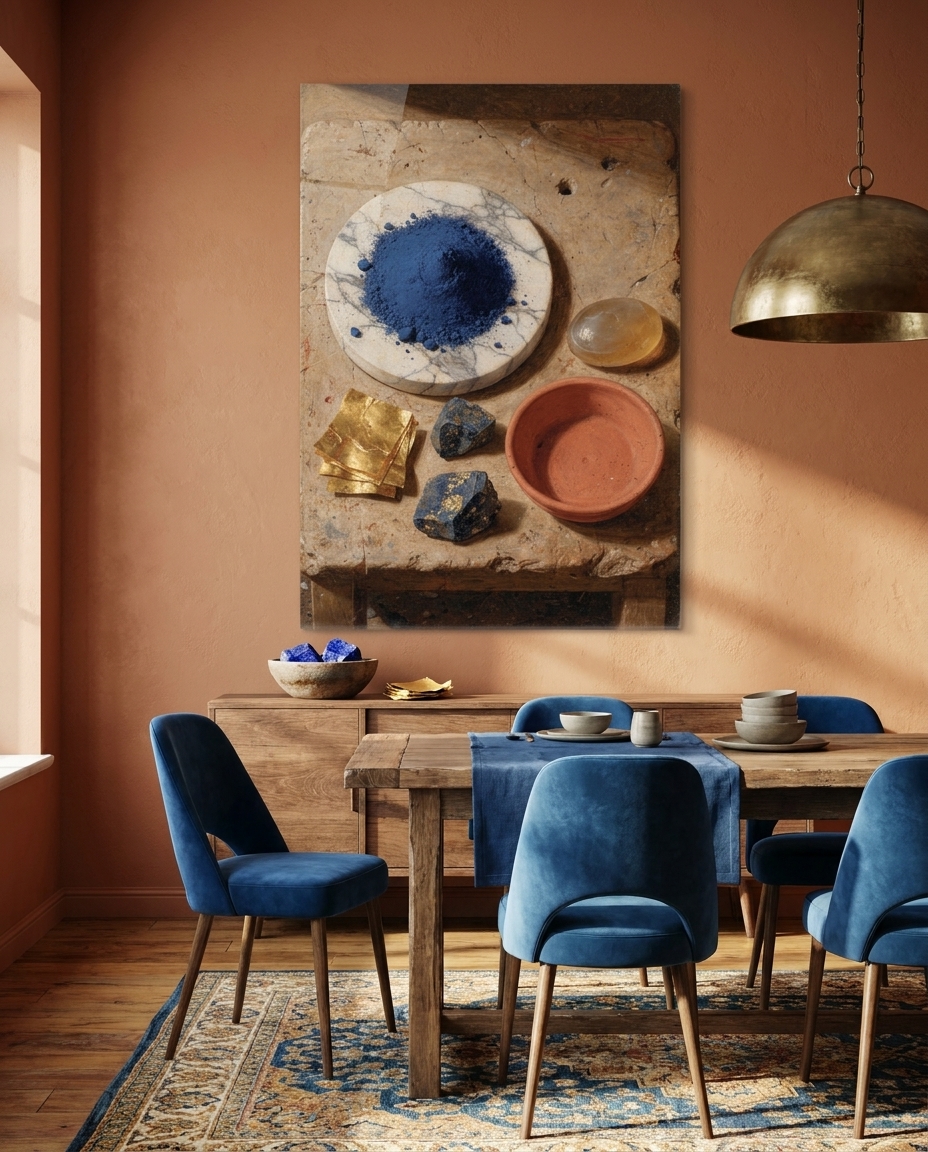
And, unavoidably, colour as expense: ultramarine, the deep blue reserved for the most important figure in a painting, was ground from lapis lazuli carried overland from what is now Afghanistan, and cost more by weight than gold. Contracts specified it. A patron who paid for that blue expected people to know.
The need
Our interior decorator made the case on temperature and texture. The Trecento palette — lapis blue, burnished gold, vermilion, iron-oxide red, ochre and warm chalky white — sits precisely in the layered, earthy, jewel-toned register interiors have moved toward, and it is the opposite of a cold minimal scheme. Just as importantly, these are surfaces with a grain: plaster, gesso, craquelure, gold-leaf seams and honest small losses. In a year when a visible hand reads as authenticity, work that carries its own making is doing something no smooth image can.
The production
Our art director set the rule at the outset: eight original compositions, and no reproduction of any identifiable chapel, fresco cycle, altarpiece or panel. Everything here is invented in the period’s manner rather than copied from it. Two further constraints shaped the set. The perspective had to stay honestly imperfect — correcting it into a modern vanishing point would erase the very thing the century discovered. And the surface had to stay material: chalky, cracked, abraded, unmistakably made.
The eight works deliberately range across the whole practice rather than resting on figures alone: fresco, gold-ground panel, painted architecture, landscape, the workshop itself, and pure surface.
The production, seen work by work
- The First Weight — three robed figures on a bare rocky ledge under lapis, standing with the new gravity that gives the century its name.
- Gold Ground, Blue Robe — a seated figure on burnished, punch-tooled gold, still and frontal, wrapped in the costly blue.
- The Painted Room — the stage box: a loggia with its front wall removed, its lines nearly but never quite converging.
- Ledges of the Wilderness — the schematic landscape of the period, rock stacked like steps, one tree, one small robed figure.
- Blue Made from Stone — the workshop table: raw lapis, ground ultramarine, gold leaf and a burnishing stone.
- The Day’s Joint — a near-abstract fresco wall, plaster patches meeting at their day-joints, red underdrawing showing through a loss.
- Procession Under the Loggia — robed citizens walking beneath round arches, a town rendered flat, generous and believable at once.
- The Punched Halo — a close view of a panel’s corner: gold, rosette punchwork, incised rays and a fine net of craquelure.
The sale
Our gallerist’s case rests on two things. First, familiarity without specificity: this visual language is instantly recognisable as the beginning of Western painting, yet none of these images is a picture anyone has seen before, so the work reads as a discovery rather than a reproduction. Second, material fit. Gold, deep ultramarine and warm earth red are exactly what an acrylic face-mount carries best — the acrylic conducts light into the image and gives the gold a depth it cannot have on paper, without any light source of its own.
Each work is produced as a museum-quality print under acrylic glass, in the sizes and formats listed on its product page.
See the collection
This is the nineteenth movement in our chronological journey through the history of art, which began with Paleolithic cave painting and continues, one movement at a time, toward the art of 2026. The previous stop was Yamato-e and Heian art in Japan — painted, remarkably, while Europe was still building Romanesque abbeys.