Most of what the world recognises as “Japanese art” — the flat colour, the diagonal composition, the season standing in for a feeling — was invented by a small aristocracy in a single city, about a thousand years ago, largely to decorate their own private lives. This collection is our homage to that moment.
Where Yamato-e and Heian art sit in the story of art
In 794 the Japanese court moved to a new capital, Heian-kyo, and stayed there for nearly four hundred years. The Heian period (794–1185) began as an enthusiastic borrower: its painting, like its poetry and its government, followed Chinese models, a manner later called kara-e, “Chinese pictures”. Then, around the tenth century, official contact with the mainland lapsed. Left to itself, the court did something unusual. Instead of stagnating, it turned inward and invented a native manner: yamato-e, “Japanese pictures”.
The subject changed first. Chinese painting offered towering mountains and moral exemplars; yamato-e offered a garden in the rain, a woman’s sleeve, the fifteenth night of the eighth month. Then the form followed. Painters abandoned depth, modelling and drama in favour of flat colour, elegant contour and an oblique view from above. The result is one of the very few major traditions in world art that is neither trying to imitate appearances nor trying to abstract away from them. It is simply designing.
This happened while Europe was building Romanesque abbeys and had not yet arrived at the Gothic pointed arch. Six centuries would pass before Japanese woodblock prints reached Paris and changed European painting a second time — and those prints owe their flatness, their cropping and their love of the everyday moment to what the Heian court worked out first.
What actually defines it
A handful of conventions carry the whole style, and they are worth knowing because they are the opposite of the ones Western painting settled on.
Fukinuki-yatai, the “blown-off roof”: to show an interior, the painter simply removes the roof and looks down at a slant. Floors and verandas become long parallel diagonals, and the viewer is placed nowhere a body could stand — hovering, discreet, slightly above the life being depicted.
Suyari-gasumi, bands of stylised mist: horizontal ribbons of gold or pale cloud slide across the picture, dividing one episode from the next and hiding whatever does not need to be shown. They are simultaneously weather, punctuation and tact.
Tsukuri-e, “built-up painting”: thick opaque mineral pigment is laid on in layers until the underdrawing disappears, then the fine ink line is drawn back over the top. The surface stays matte, chalky and slightly granular — nothing about it is smooth.
Hikime-kagibana, “line eyes, hook nose”: a single fine stroke for each eye, a small hook for the nose, a dot of colour for the mouth. Faces are deliberately not portraits. Emotion is carried by posture, by the arrangement of robes, and above all by the season outside.
To which one should add the materials, because in Heian art the material is the beauty: gold and silver leaf, sprinkled gold dust in lacquer, mica, dyed papers torn and re-pasted into collage, and the twelve graded layers of a court lady’s silk, whose colour combinations had names and seasons of their own.
The need
Our interior decorator argued for this movement on two grounds. The first is format: yamato-e was largely made for the handscroll and the folding screen, which means it composes naturally wide — and a wide, calm horizontal panel is the single most useful shape for the wall above a sofa, a console or a bed. The second is temperature. Gold grounds, warm ivory, ink black and mineral green sit exactly in the layered, warm-neutral register interiors have moved toward, and they carry a room without shouting at it.
The production
Our art director set the rule at the outset: eight original compositions, no reproduction of any identifiable scroll, screen, temple or manuscript. Everything here is invented in the period’s manner rather than copied from it. Two further constraints shaped the set. No Western perspective and no cast shadows — the flatness is not a stylisation, it is the grammar. And no woodblock printing: Edo-period prints come six hundred years later, and Heian painting is painted, brush over built-up pigment.
The eight works deliberately span the movement’s full range rather than resting on courtly figures alone: interiors, a screen, a landscape handscroll, decorated paper, lacquer, and a devotional image.
The production, seen work by work
- The Roof Removed — a palace interior seen from above with its roof lifted away, floors running as long diagonals under gold mist.
- Twelve Layers of Silk — a court lady in the junihitoe, the cascade of graded sleeve edges becoming the whole composition.
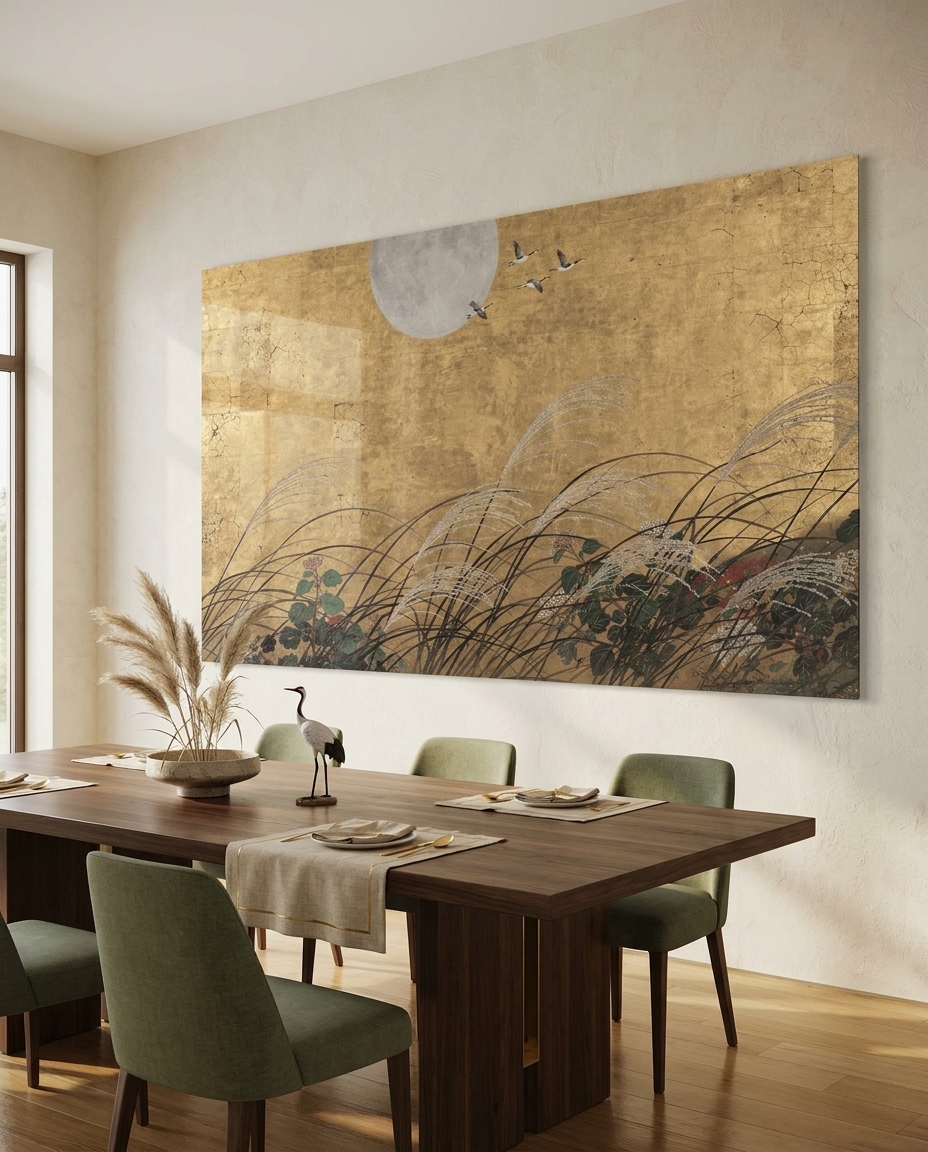
- Autumn Grasses on Gold — a screen panel of pampas grass and bush clover bent by wind, under a silver moon on beaten gold.
- Scattered Ink, Scattered Gold — decorated poem-paper: torn coloured sheets, gold and silver flecks, columns of flowing brushwork.
- The Gold-Dust Box — a maki-e lacquer box, black ground sprinkled with gold, autumn grasses running into a silver stream.
- The Scroll Unrolls — a section of narrative handscroll: raked sand, a pond, a bridge, a pine, a veranda of robed figures.
- Seated in Gilded Cypress — a devotional image painted flat, gilded and serene, before an openwork halo of scrolling cloud.
- Snow on the Bamboo Blind — a veranda at night in falling snow, a paper lamp, an abandoned fan, a plum branch under white.
The sale
Our gallerist’s case is straightforward. This is a visual language almost everyone finds immediately calming and almost no one can date — it reads as timeless rather than as a period. The wide format makes it the most placeable set we have produced in this series, and the combination of burnished gold, deep ink black and chalky mineral colour is precisely what an acrylic face-mount carries best: the material conducts light into the image and gives the gold a depth it cannot have on paper, without any light source of its own.
Each work is produced as a museum-quality print under acrylic glass, in the sizes and formats listed on its product page.
See the collection
This is the eighteenth movement in our chronological journey through the history of art, which began with Paleolithic cave painting and continues, one movement at a time, toward the art of 2026.