

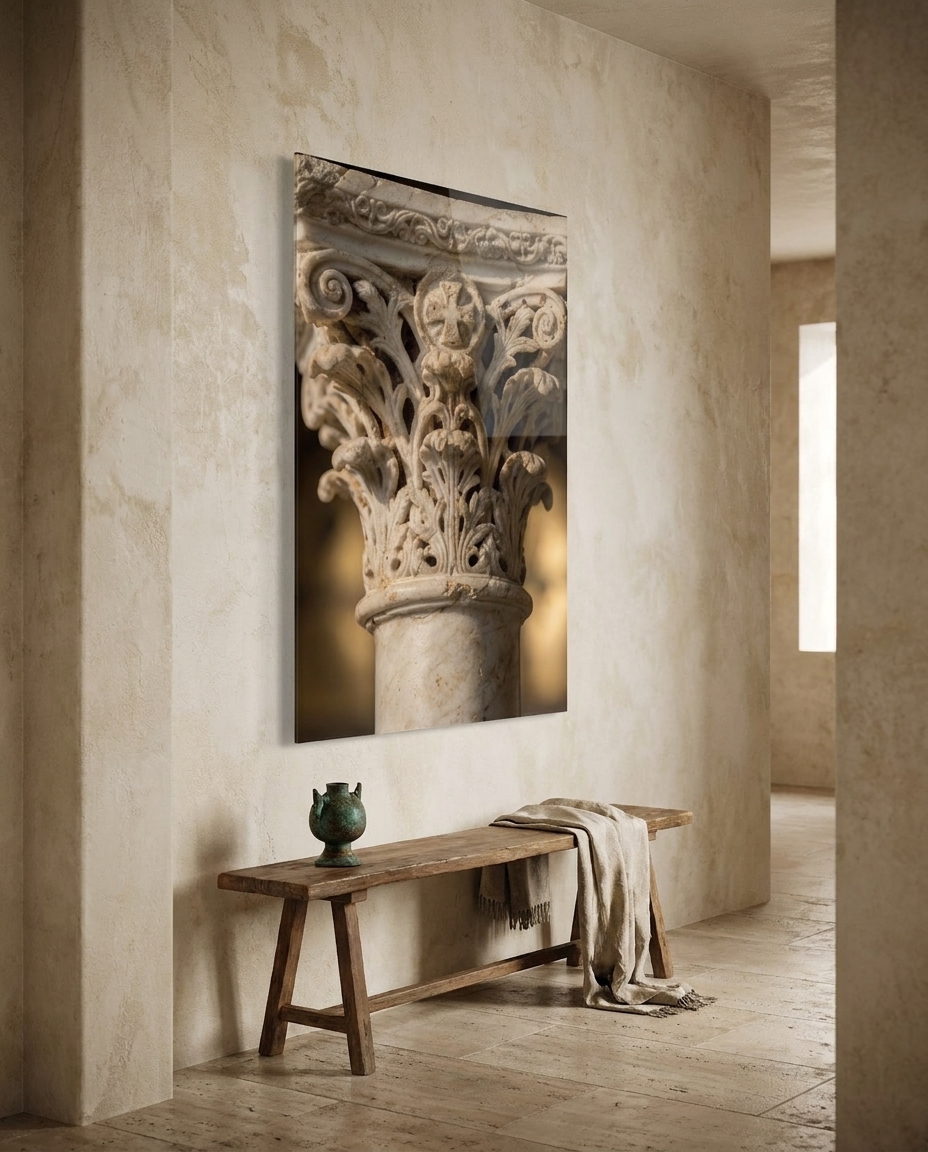
In 330 CE the capital of the Roman Empire moved east, and with it the centre of gravity of European art. What emerged over the following thousand years in Constantinople, Ravenna and the monasteries of the eastern Mediterranean was not a decline from classical naturalism, as generations of Western critics insisted. It was a deliberate refusal of it.
Against the illusion of depth
Classical art had spent centuries learning to fake three dimensions on a flat surface. Byzantine art threw that away on purpose. Figures face us frontally, weightless, feet barely touching ground. Perspective flattens. Behind everything lies gold — not a sky, not a wall, but a field of gold leaf that abolishes space entirely.
This was theology made visible. An icon was not meant to be a window onto a scene happening elsewhere; it was meant to be a presence, here, meeting your eyes. The gold is not background. It is eternity, which has no depth because it has no distance.
The discipline of the gold ground
Gold ground is technically merciless. Thousands of tesserae, each set at a slightly different angle so the surface shimmers as the viewer moves; or gold leaf laid over red bole on a panel, burnished until it burns. Against it, the artists deployed a narrow, ferocious palette: lapis blue, porphyry purple, imperial crimson. Nothing muddy, nothing tentative.
The faces are where the style concentrates. Elongated, grave, dominated by enormous eyes. They do not smile, they do not turn away, they do not perform emotion. They simply hold the gaze — which is a far harder thing to draw than a smile.
The collection
Eight original works in the movement’s manner — never a copy of any surviving icon or mosaic. A blue-robed saint against cracked gold. A vaulted apse of tesserae. An enthroned figure in imperial purple. A jewelled processional cross. A carved capital where acanthus meets the cross. An illuminated initial. A mosaic peacock among vines, the old symbol of incorruptibility. And a basilica interior where light travels down the arcades toward a distant lit apse.
Living with it
Gold-ground work does something specific to a room: it throws light back. These pieces come alive under warm lamplight and at the end of the day, when low sun rakes across the surface. They hold their own against strong colour — deep green, oxblood, ink blue — and they suit rooms with a certain formality: an entrance hall, a dining room, a study. Give them a wall to themselves. They were never designed to compete.