

Somewhere in the first century of our era, in the mountain valleys of what is now northern Pakistan and eastern Afghanistan, two of the ancient world’s great visual languages met and produced something neither could have made alone. Greek sculptors — heirs to the workshops Alexander had left behind — found themselves carving an Indian teacher who had, until then, never been given a face.
The moment a symbol became a face
For roughly five centuries after his death, the Buddha was not depicted as a man. He was an empty throne, a parasol, a pair of footprints, a wheel. The Gandhara workshops changed that. Drawing on Hellenistic conventions of drapery, proportion and wavy hair, they gave the Buddha a body — and in doing so created an image that would travel the Silk Road to China, Korea and Japan, and shape the religious art of half a continent.
What makes Gandhara extraordinary is that the borrowing runs both ways. The robes fall in the deep, weighted folds of a Roman toga, but the gesture of the hands is pure Indian codified symbolism. The face has classical proportion, but the eyes are lowered in a state no Greek sculptor had ever tried to carve: not heroism, not grief, but withdrawal from wanting.
Grey stone, gold light
The material matters. Gandharan sculptors worked mostly in grey-blue schist, a stone that takes a fine edge and holds shadow in a way marble does not. Traces of gilding survive on many pieces — the figures were never meant to be the austere grey we see today, but luminous, catching lamplight in shrine and monastery. This collection works with that duality: cool stone and warm gold, matter and radiance.
The collection
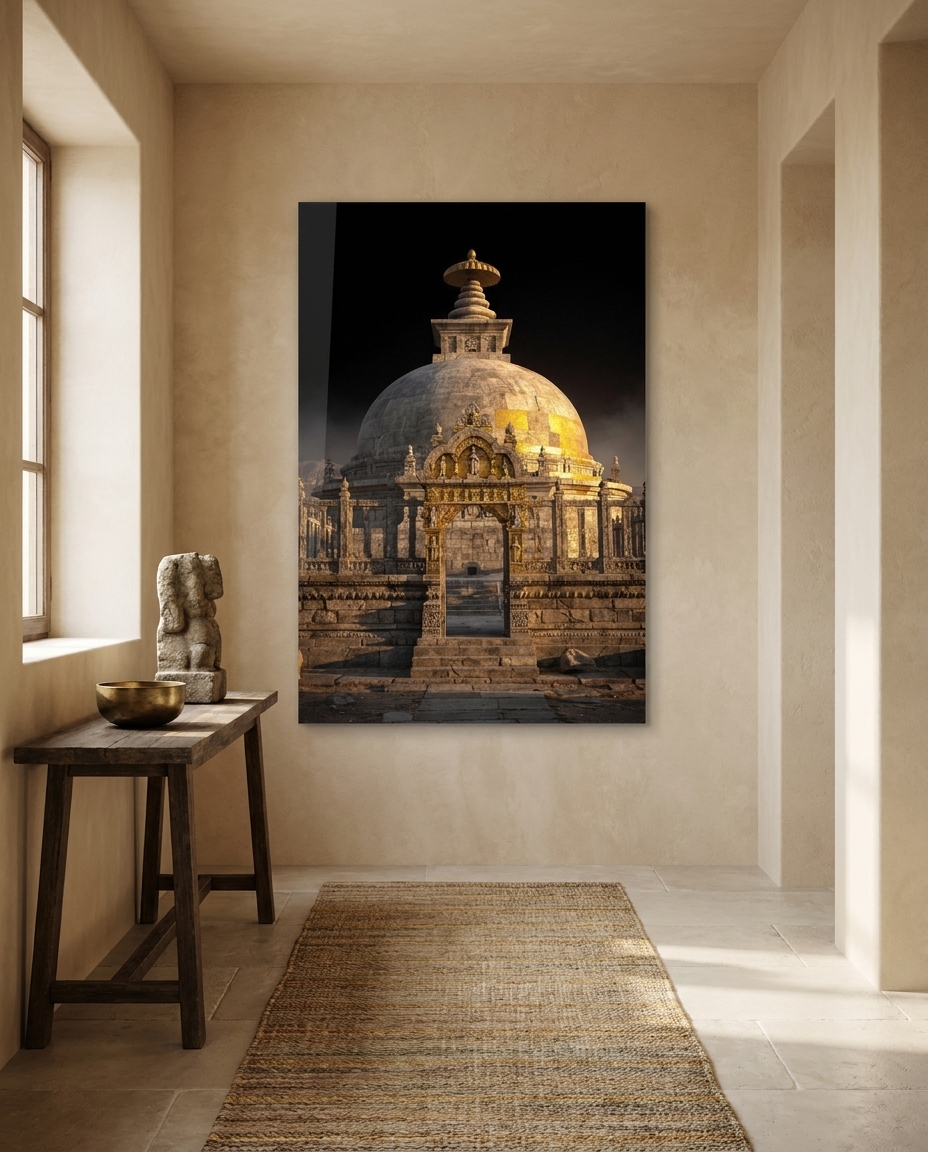
Eight original works, conceived as an homage to the movement rather than a reproduction of any single surviving object. A meditating head in half-light. A standing figure whose robes seem carved by wind. A crowned bodhisattva heavy with ornament — the prince the Buddha renounced. A single hand, holding a gesture. The great dome of a stupa. A frieze where Greek acanthus curls into Indian lotus. A gilded reliquary. A weathered pillar against open sky.
Together they trace the movement’s real subject: stillness, given form.
Living with it
These are quiet works, and they reward quiet places. The stone studies belong where the light changes slowly — a bedroom, a reading corner, a hallway that is passed through rather than occupied. Their palette of grey, ochre and gold sits naturally against warm neutrals, unpolished wood and linen. In a room that is already busy, a single one of these will do more than three of anything else.