

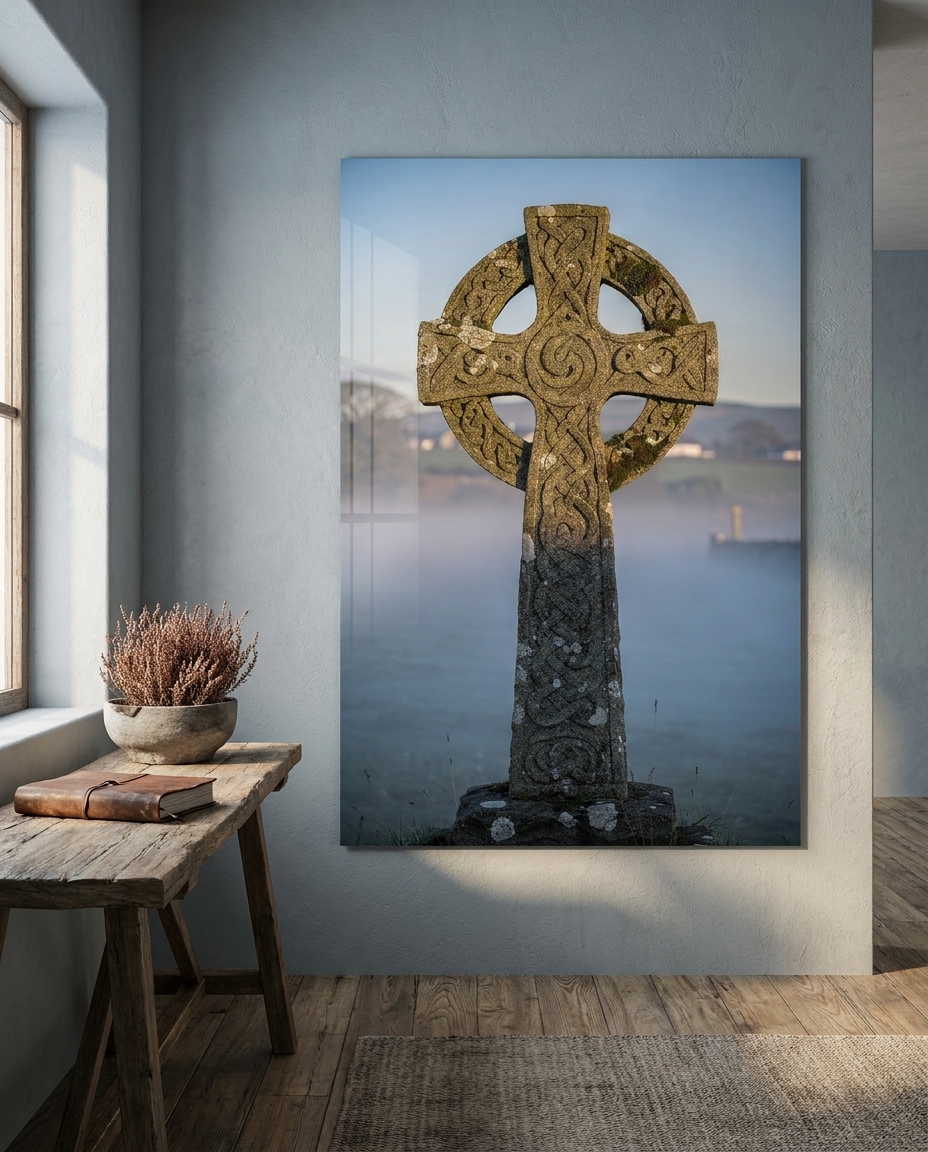
When Rome withdrew from Britain and the western empire came apart, art in the far north-west of Europe did something unexpected. It did not become cruder. It became almost impossibly intricate — an art of monastic patience, worked at the scale of a fingernail, in monasteries on the edge of the Atlantic.
The horror of the empty surface
Insular art is governed by a principle art historians call horror vacui: the dread of blank space. Every surface is filled, and filled again, with interlace so dense the eye cannot follow a single ribbon from beginning to end. This was not decoration for its own sake. Following the pattern was a discipline — the visual equivalent of copying scripture, an act of devotion measured in months.
The vocabulary came from two directions. From the pre-Christian Celtic La Tene tradition came spirals, trumpet curves and triskelions. From Germanic and Anglo-Saxon metalwork came the zoomorph: the elongated beast whose jaws, limbs and tail dissolve into ribbon and rejoin the knot. Monastic scribes fused the two into something neither had been.
Vellum, granite, gold
The tradition worked in three registers at once. On vellum, with iron-gall ink and pigments traded across half the known world — orpiment yellow, verdigris green, woad blue, red lead. In metal, with gold filigree fine as thread and garnets cut to sit in cloisonne cells. And in granite, on high crosses that stood in the weather for twelve centuries and are still legible.
The collection
Eight original works in the Insular manner, none a copy of any surviving manuscript or cross. A carpet page of pure interlace. An initial letterform swallowed by its own ornament. A ringed high cross in low mist. A filigree brooch set with garnet and amber. A bronze reliquary with enamel bosses. A carved slab of triskelion spirals. Two beasts entwined beyond untangling. And a chased silver chalice with blue enamel studs.
Living with it
These are works that reward proximity. Hung where people pass close — a corridor, a stairwell turn, above a desk — they keep giving up detail for years. Their palette of ochre, verdigris and oxblood sits well against lime plaster, unfinished oak and wool. Pattern this dense needs calm around it: give the neighbouring wall nothing to say.