
Last time we stayed in eighteenth-century Paris, among powder pastels and gilded salons. Now we travel to the other side of the world, to a city of a million people where painting was not hung in palaces but sold for the price of a bowl of noodles. In Edo, today’s Tokyo, artists, carvers and printers turned the passing pleasures of an ordinary day — a rain shower, a blossoming branch, a walk by the river — into some of the most graphic and modern images ever made.
Where Ukiyo-e sits in the story of art
Ukiyo-e flourishes in Japan from the late seventeenth century to the middle of the nineteenth, during the long Edo period. The name means “pictures of the floating world”: a Buddhist word for the transience of life, reclaimed by the city’s merchants as an invitation to enjoy it while it lasts. While Europe moved from the Rococo towards Neoclassicism, Japanese studios were perfecting an entirely different way of making a picture: not one painting for one patron, but a design cut into blocks of cherry wood and printed by hand, one colour at a time, for a wide public.
Its subjects follow the life of the city and the seasons. Beautiful women in layered kimono, theatre and street life, then — in its last great flowering — landscapes, famous views, weather, birds and flowers. Each print was a collaboration between a designer, a carver, a printer and a publisher, and the best of them reached a precision of line and a purity of colour that no brush could match.
When Japan opened its ports in the 1850s, these prints reached Europe, sometimes as wrapping paper for porcelain. Artists in Paris were stunned: the flat colour, the bold cropping, the high viewpoints and the empty space changed Impressionism, poster design and, in the end, the whole of modern graphic art. Few movements have travelled so far, or lasted so well.
What actually defines it
A print, not a painting. A crisp black keyline of even weight, carved in wood, holds every shape. Inside it, colour is laid flat, edge to edge, with no shading and no cast shadow.
Bokashi. The printer wiped the block by hand to create soft gradations: a sky deepening to blue at the top of the sheet, water darkening towards the horizon, a flush of pink at dawn.
A clear, graphic palette. Prussian blue and indigo, vermilion and safflower pink, sage and pine green, soot black, and the warm off-white of the paper itself, left bare as a colour in its own right.
Weather as drawing. Rain becomes fine parallel diagonal lines, snow becomes round white dots, foam becomes curling claws, wind bends every reed in the same direction.
Daring composition. Steep diagonals, views from above, a branch or a tree trunk cropped hard by the edge of the frame in front of a deep distance — the very devices that would later feel so new in the West.
The need
Our decorator sees a lasting appetite for calm, natural interiors: light oak, linen, stone, paper lamps, a few objects chosen with care. Those rooms need art that is quiet without being empty, and graphic enough to hold a wall on its own. Ukiyo-e does exactly that. Its flat colour reads clearly from across a room, its subjects — water, seasons, a single bird — never tire the eye, and its blues and warm whites sit naturally with wood and textile. It brings serenity to a bedroom, a reading corner, a hallway or a bathroom.
The production
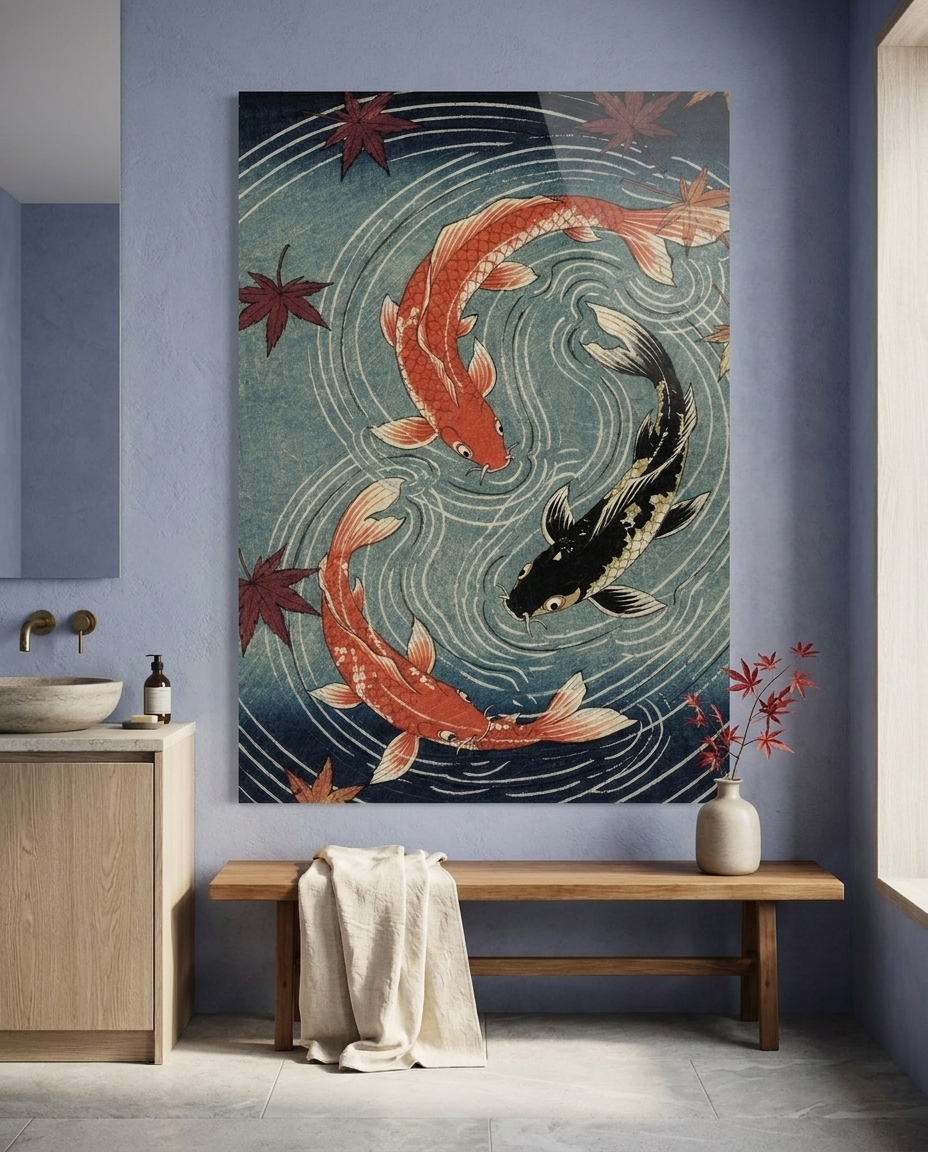
The art director built the eight works around the real repertoire of the movement rather than around any single print, and kept them all in its gentlest register: landscape, weather, birds and flowers, and one figure of daily life. Willow Rain on the River lets a great willow frame a misty river at dusk, with two travellers sharing one umbrella in a moored boat. Surge on the Pine Headland throws a curling blue wave against a rocky point crowned with pines. Dawn Over the Silent Lake places a distant snow-capped cone above a still lake and golden reeds. Twilight Crossing at the Iris Marsh follows a lone walker along a zigzag boardwalk through purple irises. In the bird-and-flower tradition, Solitary Crane on Winter Pine stands in falling snow, Night Song of the Plum Blossom sets a small warbler against a rising full moon, and Autumn Ripples and Floating Gold looks down on three carp among red maple leaves. Summer Reverie on the Veranda answers the portraits of beautiful women, with a woman in indigo kimono and a round paper fan. One keyline, one paper texture and one palette hold the eight together.
The sale
Our gallerist sees in Ukiyo-e one of the most universal collections in the series: instantly recognisable, deeply rooted in art history, and at home in almost any contemporary interior. On acrylic glass, the flat colour fields gain a lacquer-like depth, the Prussian blues turn luminous and the paper grain stays subtly visible. The crane and the plum blossom make a natural pair for a hallway or a bedroom; the wave and the lake give a study or a living room a sense of space; the carp are made for a bathroom. Pair them with pale wood, linen, ceramics and plenty of empty wall, and let each print breathe.
See the collection
The eight works are here: Ukiyo-e.
Next in the chronological walk through art history: Neoclassicism, when Europe turned back to antiquity for order, clean lines and civic virtue.