

Last time we stood in the grave silence of seventeenth-century Spain, where painting said as little as possible and meant every word. Move forward a few decades, cross into France, and the curtains open. The heavy dark lifts, the palette turns to powder and pearl, and painting learns to smile. The Rococo is the moment European art decided that grace, wit and pleasure were worthy subjects in their own right.
Where the Rococo sits in the story of art
The Rococo runs roughly from 1720 to 1775. It is born in Paris after the death of Louis XIV, when the aristocracy leaves the formal ceremony of Versailles for smaller, more intimate town houses, and it spreads to the courts and churches of Central Europe. It grows directly out of the Baroque — the same love of movement and ornament — but it trades Baroque drama for lightness, and grand public statements for private rooms. Where the Spanish Golden Age painted a cloister, the Rococo paints a boudoir.
The word itself comes from rocaille, the shell-and-pebble work of garden grottoes, and that tells you where its heart is: in decoration, in curving asymmetrical ornament, in the total design of a room where panelling, mirrors, porcelain, furniture and painting all speak the same language. Painters invented the fête galante, elegant figures at leisure in dreamy parkland, and gave new dignity to pastel portraiture, still life and the intimate scene of daily life.
By the 1770s, a new taste for moral seriousness and the rediscovery of antiquity swept it aside in favour of Neoclassicism. But the Rococo never really left: it shaped French decorative arts for good, and its palette of rose, celadon and pale blue is still, today, the grammar of a certain idea of elegance.
What actually defines it
Light instead of dark. High-key, diffused daylight fills the whole canvas. Shadows are soft and coloured, never black.
A powder palette. Rose, celadon, powder blue, ivory and cream, set off by touches of antique gold. Colours are mixed with white until they glow.
The S-curve. Asymmetrical scrolls, shells and flowing lines replace the straight axis. Compositions move diagonally and leave room to breathe.
Feathery brushwork. Quick, light, visible strokes that make silk shimmer and foliage tremble, rather than a polished, hidden surface.
Intimacy and play. Conversations in a park, a letter read in private, a swing, a tea table: human-scale pleasures, painted with affection and a hint of wit.
The need
Our decorator sees the pastel interior returning everywhere: pale pink and sage walls, bouclé and velvet, curved furniture, fluted glass, a little gilding used with restraint. Those rooms ask for art with softness and warmth that still has presence, and most contemporary work is either too cold or too loud for them. The Rococo was literally designed for such rooms. A bedroom, a dressing room, a salon or a breakfast room gains an immediate sense of occasion without losing its calm.
The production
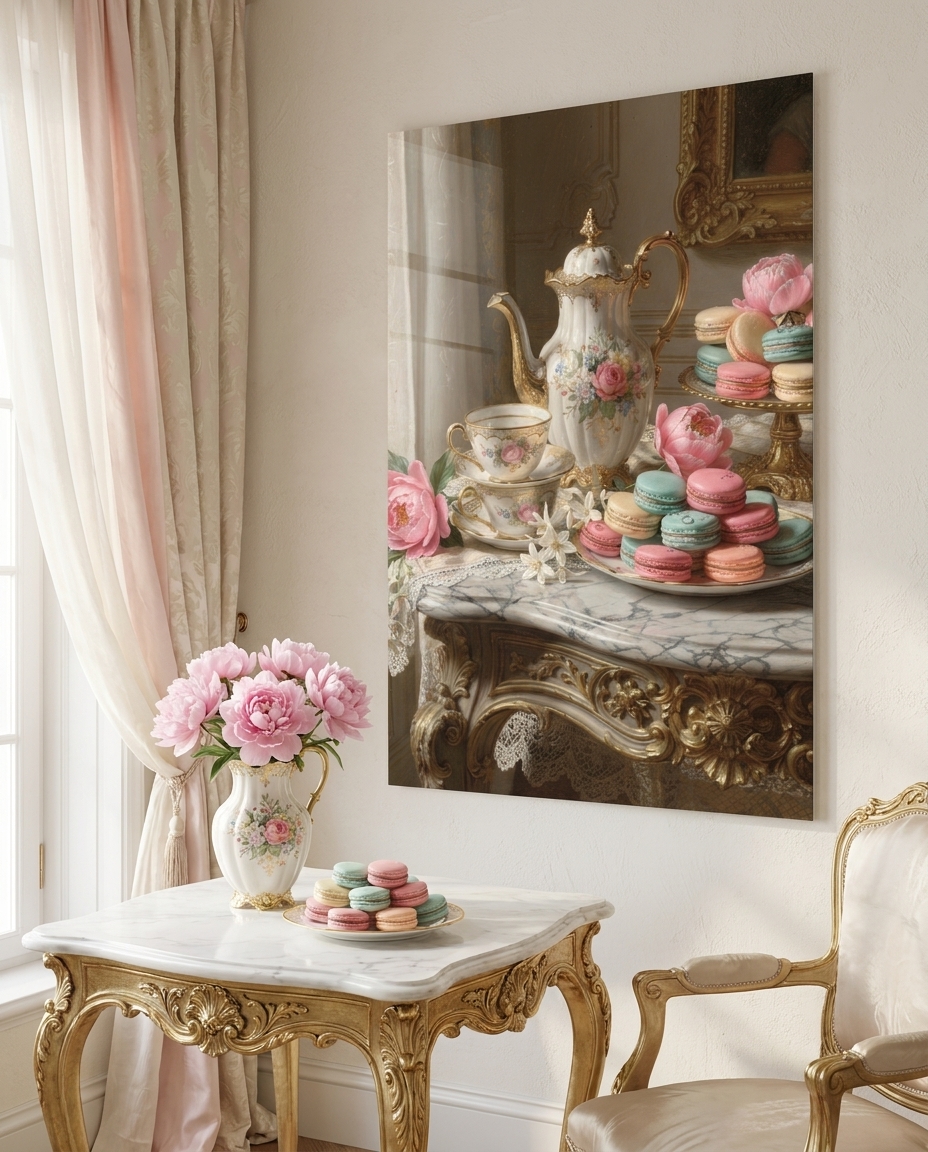
The art director built the eight works around the real repertoire of the movement rather than around any single painting. Three are about people, all in full eighteenth-century dress: The Willow Swing, a young woman in rose silk flying above a garden; The Whispering Glade, a fête galante of courtiers beside a dolphin fountain; and The Sealed Letter, a private moment at a gilded writing desk. Lady with Pearl Ribbons answers the great pastel portraits of the age. The other four are about the decorative world the Rococo invented: Confections and Peonies, a porcelain tea still life; The Gilded Salon, a mirrored white-and-gold interior; The Celadon Pavilion, the period’s dream of the Far East; and The Shell Grotto, the rocaille ornament that gave the movement its name. One shared palette and one feathery painterly finish hold the eight together.
The sale
Our gallerist sees this as one of the most giftable and most livable collections in the series: joyful, never kitsch, and deeply rooted in art history. On acrylic glass, the pale tones gain real luminosity and the gold catches the light as it moves through the day. The portraits hang beautifully as a pair; the tea still life and the salon bring charm to a dining or breakfast room; the swing and the glade open up a living room like a window on a garden. Pair them with pale woods, linen, velvet, marble and fresh flowers, and let them breathe on a softly coloured wall.
See the collection
The eight works are here: Rococo.
Next in the chronological walk through art history: Ukiyo-e, the Japanese woodblock prints of the “floating world”, with their flat colour, great waves and glowing lanterns.