
Most pictures of the night sky are made to impress: a blazing galaxy, a colour that no eye has ever seen. Slow Sky goes the other way. It is eight quiet astrophotographic works built around two simple things standing under the stars — an old pine on a granite ridge, and a rock pillar in the sea — each seen at four moments of a single night, from the first stars at dusk to the last ones before dawn.
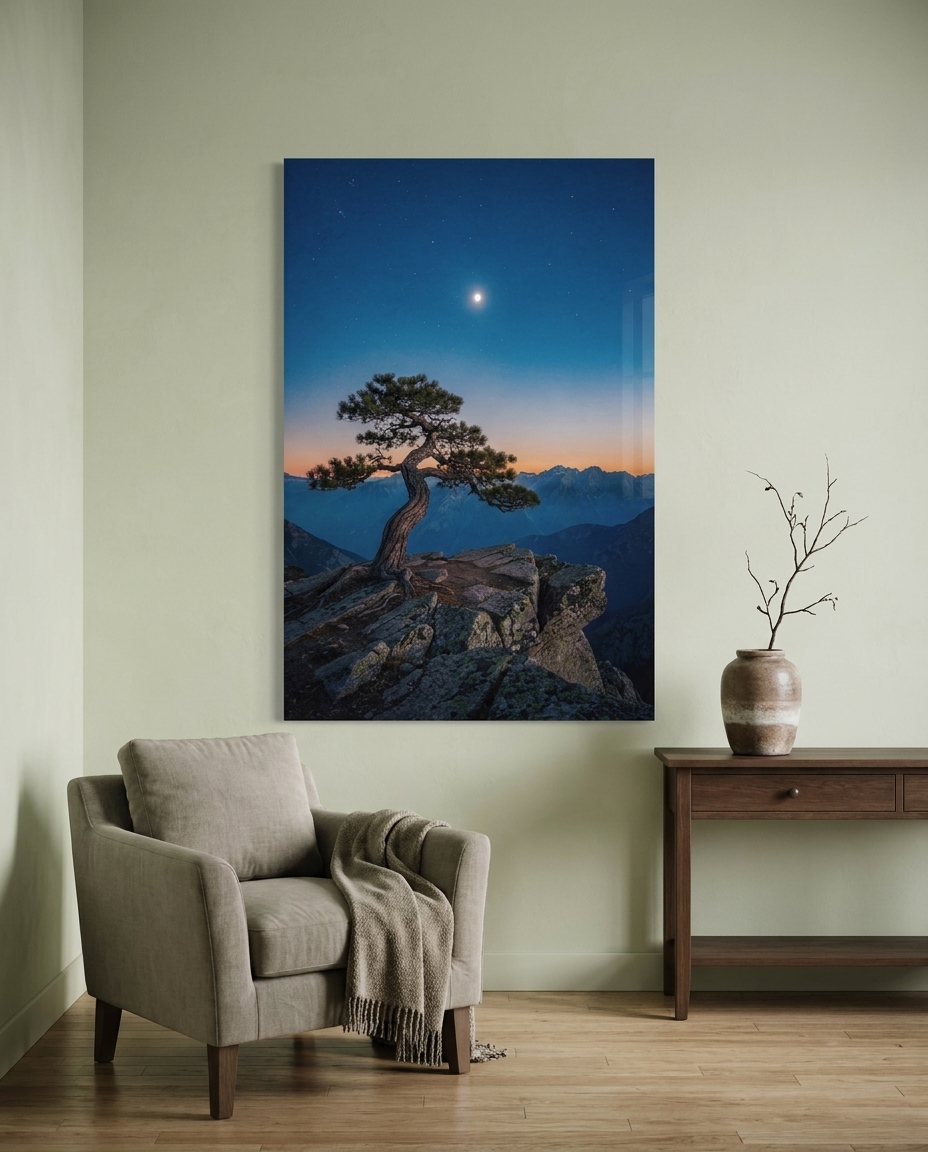
The sky is a deep, luminous cobalt, never black. In every image there is one warm note — a band of rust on the horizon, amber light on wet pebbles, a terracotta glow before sunrise — so that the night feels inhabited rather than cold.
The need — the decorator’s eye
Two things shaped this collection. The first is a gap in our own catalogue: astrophotography, one of the most searched-for styles in wall art, was barely represented in the gallery. The second is what we see on walls this autumn. Paint charts have moved to pale greens — sage, celery, soft mineral tones — and those walls ask for art that warms them without fighting them. A cobalt night with a single rust or amber accent does exactly that: the blue sits calmly against green, and the warm note answers the wood and wool of the room.
We also wanted pieces that work when they are not hung. A tall night sky leaning on an oak console or a low sideboard, lit by a table lamp, is one of the simplest ways to change the mood of a hallway or a reading corner, and the vertical format of the series was chosen with that in mind.
The production — the art director’s vision
The series follows one rule: two places, four hours. The ridge pine is seen at blue hour with a single evening planet; then with the Milky Way rising straight up behind it; then under a long exposure, where the stars become hundreds of perfect circles turning around the pole; and finally at first light, with mist filling the valley below. The sea stack goes through the same night: dusk with a ribbon of afterglow, the core of the galaxy arching over the water, a full moon lighting the rock from the side, and the last hour of darkness with the faint cone of zodiacal light rising from the horizon.
The language is that of contemporary landscape astrophotography: a wide lens, stars kept small and sharp, natural star colours, a fine grain, the sea smoothed into silk by a long exposure. No fantasy nebula, no oversized moon, no neon. Each frame keeps the earth in the lower third and gives the upper two thirds to the sky, so that the eight read as one family on a wall.
The sale — the gallerist’s word
This is a collection made to be lived with at night as much as in daylight. One work alone above a bed or a sofa is a quiet window onto a dark sky. Two works make a natural pair — dusk and dawn of the same subject, or the pine and the stack at the same hour. Four works of one place, hung in a row, tell the whole night from left to right along a corridor or above a long sideboard.
Each work is printed on 4 mm acrylic glass, backed with Dibond. The lacquered face gives the cobalt real depth and keeps the stars crisp; in a room with matte walls and soft lamplight, it is the one glossy surface, and it should be.
The eight works
- First Stars over the Ridge — a windswept pine against a band of rust-orange dusk, the first stars and one bright evening planet above.
- The Arch Rises — the Milky Way climbing straight up behind the lone pine on its granite crest.
- The Turning Sky — star trails wheeling in concentric circles around the pole above the still tree.
- Last Stars over the Ridge — pre-dawn: a thin crescent moon, a soft apricot horizon and a valley full of mist.
- The Stack at Dusk — a rock pillar in a silky sea under a cobalt sky and a low ribbon of amber afterglow.
- The Stack and the Core — the galactic core arching over the water beside the dark silhouette of the stack.
- Moonrise at the Stack — a full moon lights the rock and the wet pebbles in warm silver-amber.
- The Stack before Dawn — the last hour of night, a terracotta glow on the sea and a faint pillar of zodiacal light.
See the whole series here: Slow Sky.