

Last time we followed the European imagination south and east into the bright, dreamed light of Orientalism. At the very same moment, another group of painters turned their backs on distance altogether. They looked at what was in front of them — a field, a forge, a riverbank, a kitchen table — and decided it was enough. Realism is the art of the ordinary taken seriously.
Where Realism sits in the story of art
Realism runs roughly from 1840 to 1880 and was born largely in France. It reacts against both the polished myths of the Academy and the storms of Romanticism. Instead of gods, heroes and ruins, its painters chose peasants, labourers, washerwomen, fishermen and the plain landscapes they worked in — and they painted them at a scale once reserved for history painting. Courbet declared that he could only paint what he could see; Millet gave rural work a quiet, almost sacred weight; Daumier and Bonheur brought the same honesty to city streets and to animals.
It was a radical idea in its day. Showing ordinary people with dignity and without sentiment was read as a social statement, and many of these canvases were refused or mocked before they were admired. Its legacy is enormous: the open-air painters, the Impressionists and, much later, documentary photography all inherit Realism’s conviction that everyday life deserves our full attention.
What actually defines it
The everyday as subject. Work in the fields, at the forge, by the river or at the table — shown as it is, without idealisation and without drama.
An earth palette. Umber, ochre, raw sienna, olive and slate greens, chalky whites, heavy dark grounds lit by warm, natural light.
Solid form and honest light. Weighty bodies and objects, broad confident brushwork, sometimes a palette-knife texture you can almost feel.
The land itself. Flat horizons, ploughed earth, wet shores, dark forests and wide overcast skies.
The need
Our interior architect sees a growing taste for honest materials: limewashed walls, oak and walnut, linen, leather, wrought iron, wool underfoot. Those rooms reject anything glossy or showy, and they ask for pictures with the same integrity. Realism answers them directly. A hay wagon gives an entrance hall a sense of season and arrival, a peasant still life belongs above a farmhouse dining table, and a shepherdess at dusk brings a reading corner its calm. These are grounded paintings for rooms that feel lived in.
The production
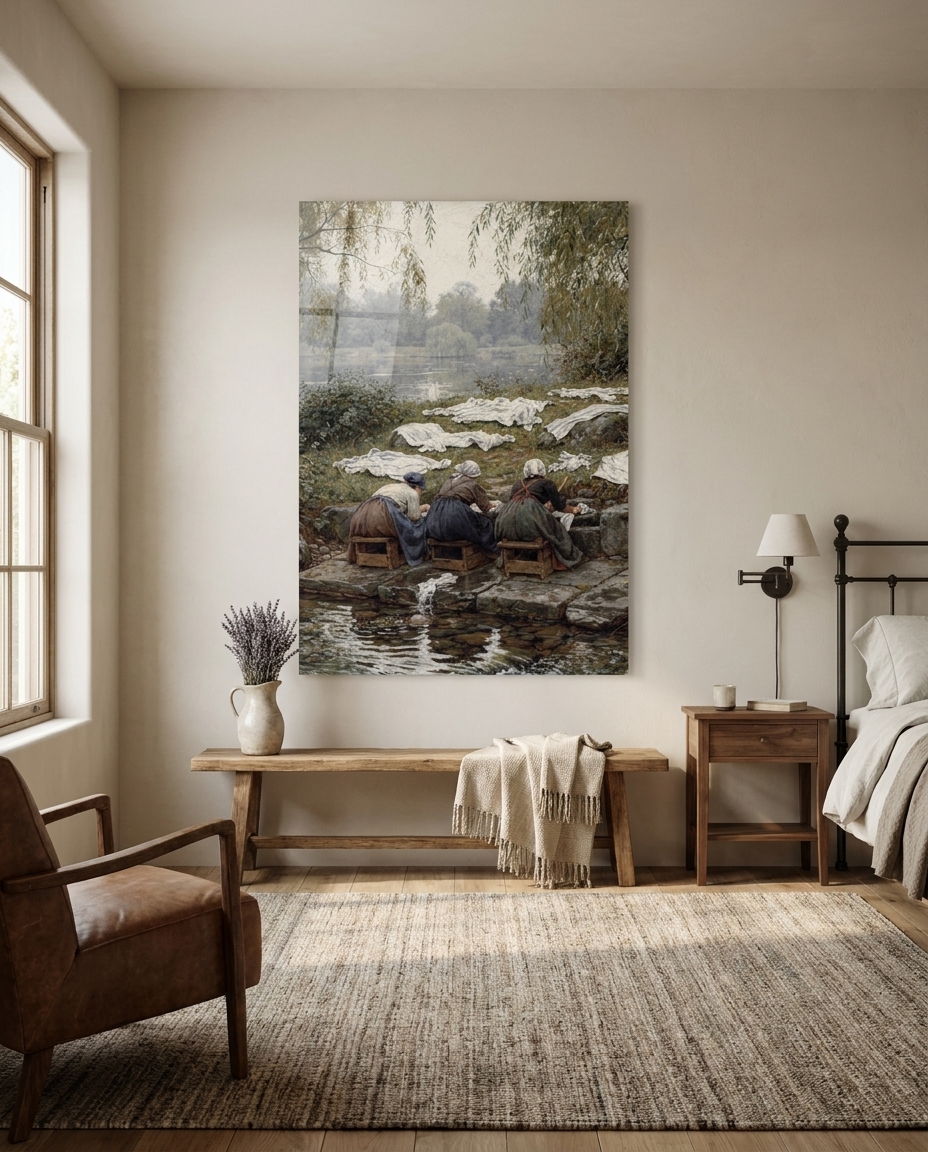
The art director built eight original works from the movement’s own repertoire of labour, landscape, animals and still life, without copying any known painting. The Hay Wagon at Midday stands two farmhands and their draught horses in a summer lane below a far village spire, while The Village Forge catches a blacksmith mid-swing in orange firelight, a horse waiting at the open door. Laundresses by the River kneel at a stone washing place among white linen and willows, and The Plough at Dawn follows a pair of oxen across dark earth, rooks in the furrow. The Peasant Table gathers bread, cheese, onions and a copper pot in a single window light. The Forest Stream lets a roe deer drink among mossy boulders, The Shepherdess at Dusk stands knitting among her flock as the sun sets over the heath, and The Boats at Low Tide closes the set with fishermen hauling their boat up a wet grey shore.
The sale
Our gallerist sees in Realism a collection that speaks to almost everyone: instantly readable, rooted in art history and quietly warm. On acrylic glass the earth colours gain depth, the firelight of the forge glows and the wet sand of the shore mirrors the sky. The hay wagon and the plough make a natural pair for a hallway or a country-style living room; the forge and the boats suit a study or a home office; the still life belongs in the dining room; the laundresses and the shepherdess bring their calm to a bedroom or a reading room. Hang them at eye level, alone or in pairs, where daylight can move across the surface.
See the collection
The eight works are here: Realism.
Next in the chronological walk through art history: the Hudson River School and Luminism, when American painters filled vast landscapes with a transcendent light.