

Last time we followed the storm and the sublime into the heart of Romanticism. In the decades that followed, the European imagination turned south and east. Railways, steamships and military expeditions had opened the shores of the Mediterranean, and with them came sketchbooks, bright skies and a hunger for light that no northern studio could supply. Orientalism is the painting of that journey — a world seen through the eyes of travellers, and just as often dreamed from a studio in Paris, London or Vienna.
Where Orientalism sits in the story of art
Orientalism runs roughly from 1820 to 1900. It grows out of Romanticism’s appetite for distance and drama, and it sits beside the new Realism and the first open-air painters. Its masters ranged from the polished academic finish of Gérôme and Lewis to the sun-struck sketches of Fromentin and Roberts. It was, above all, a school of colour and of light: the white-gold sun of North Africa, the Nile at dawn, the blue shadow of a tiled courtyard.
It is also a movement that is better understood today with open eyes. These pictures are European views of places and peoples, and they often shaped an imagined East rather than recording a real one. That is part of their interest as art history. What remains most durable in them is the craft: architecture, textiles, ceramics, light and landscape observed with extraordinary patience.
Its legacy runs straight into Impressionism and Post-Impressionism — Delacroix, Renoir, Klee and Matisse all travelled south in search of colour and came home changed.
What actually defines it
Light and heat. A hard white sun, whitewashed walls blazing against a turquoise sky, deep cobalt shadows and the shimmer of the noon desert.
Colour and pattern. Saturated vermilion, lapis, emerald and saffron; glazed tile, carved stucco, lattice screens, woven carpets and brass lamps.
Academic finish or sun-struck touch. Either a meticulous, glazed surface where every tile is counted, or loose luminous brushwork that dissolves the dust and the heat.
The journey. Caravans, minarets on a skyline, palm oases, river barges and covered markets — the traveller’s romance of distance.
The need
Our interior architect sees a steady demand for warm rooms: sand, terracotta, plaster, linen and wood, with a rug underfoot and golden light at the window. Those interiors ask for a picture with an inner glow. Orientalism supplies exactly that. A tiled courtyard brings depth to a living room, a spice bazaar gives an entrance hall its sense of arrival, and a river at sunrise settles a bedroom without shouting. These are warm paintings for rooms people want to stay in.
The production
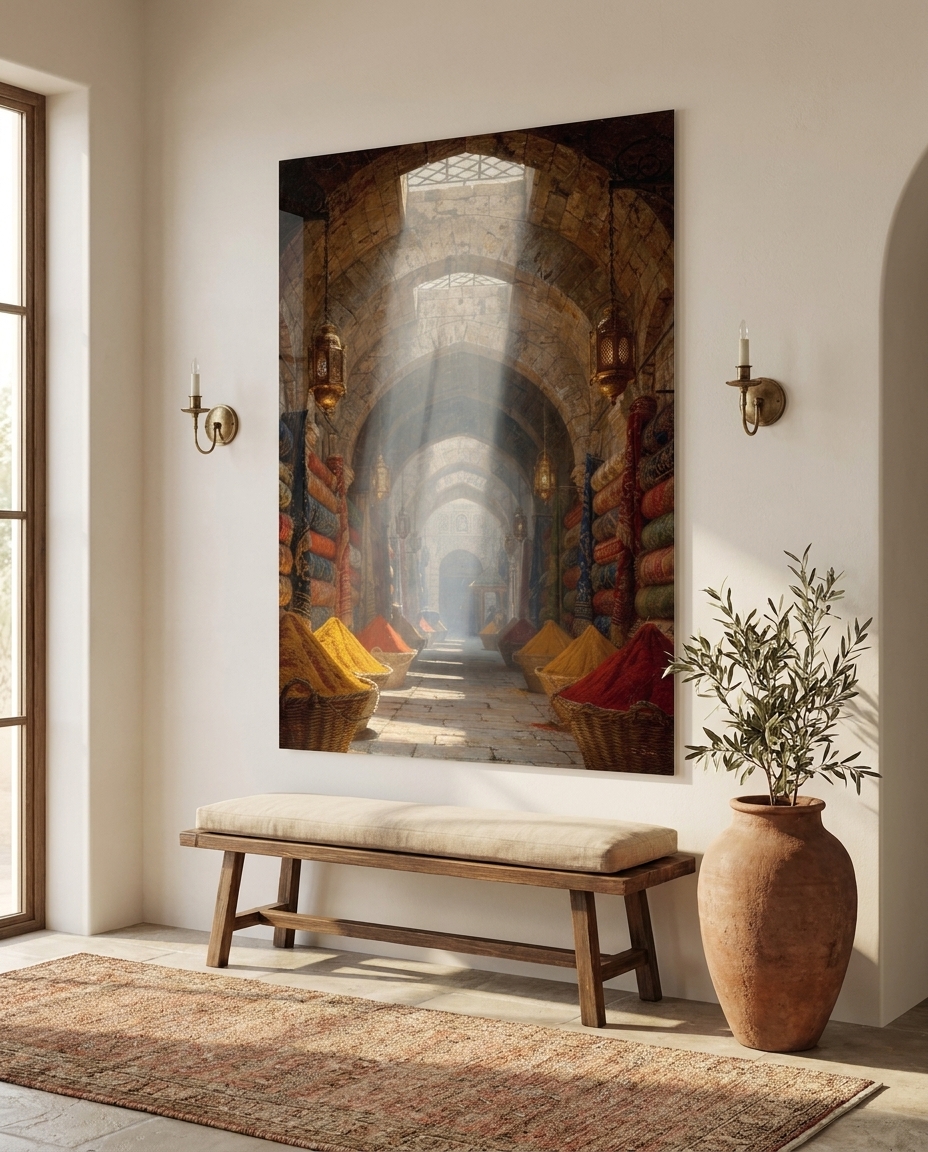
The art director built the eight works from the movement’s architecture, landscape, still-life and animal repertoire, without copying any known painting and without any portrait. Sanctuary of Glazed Tile opens a sunlit courtyard around an octagonal fountain. Arcades of Saffron sends shafts of dusty light down a vaulted bazaar, and The Amber Horizon lets a distant caravan cross the dunes at sunset. The Steed of the Citadel frames a white Arabian horse in a stone gateway, Still Life with Pomegranates gathers brass, ceramic and silk in patterned window light, and The White City Above looks across whitewashed roofs and rising doves to a river and far hills. Dawn on the Great River and Sanctuary of the Palms close the set with a sail on glassy water and a quiet spring under the date palms.
The sale
Our gallerist sees in Orientalism a collection that is instantly recognisable as art history, rich without being loud, and at home in the places where people gather — entrance halls, dining rooms, studies, hotel lounges, bedrooms. On acrylic glass the lapis, brass and saffron take on depth, the whitewashed walls glow and the river mirrors the sky. The courtyard and the oasis make a natural pair for a living room; the bazaar and the horse suit a hallway or study; the still life belongs above a dining table. Hang them at eye level, in pairs or alone, where daylight can move across the surface.
See the collection
The eight works are here: Orientalism.
Next in the chronological walk through art history: Realism, when painters turned to the everyday and to the dignity of work.