

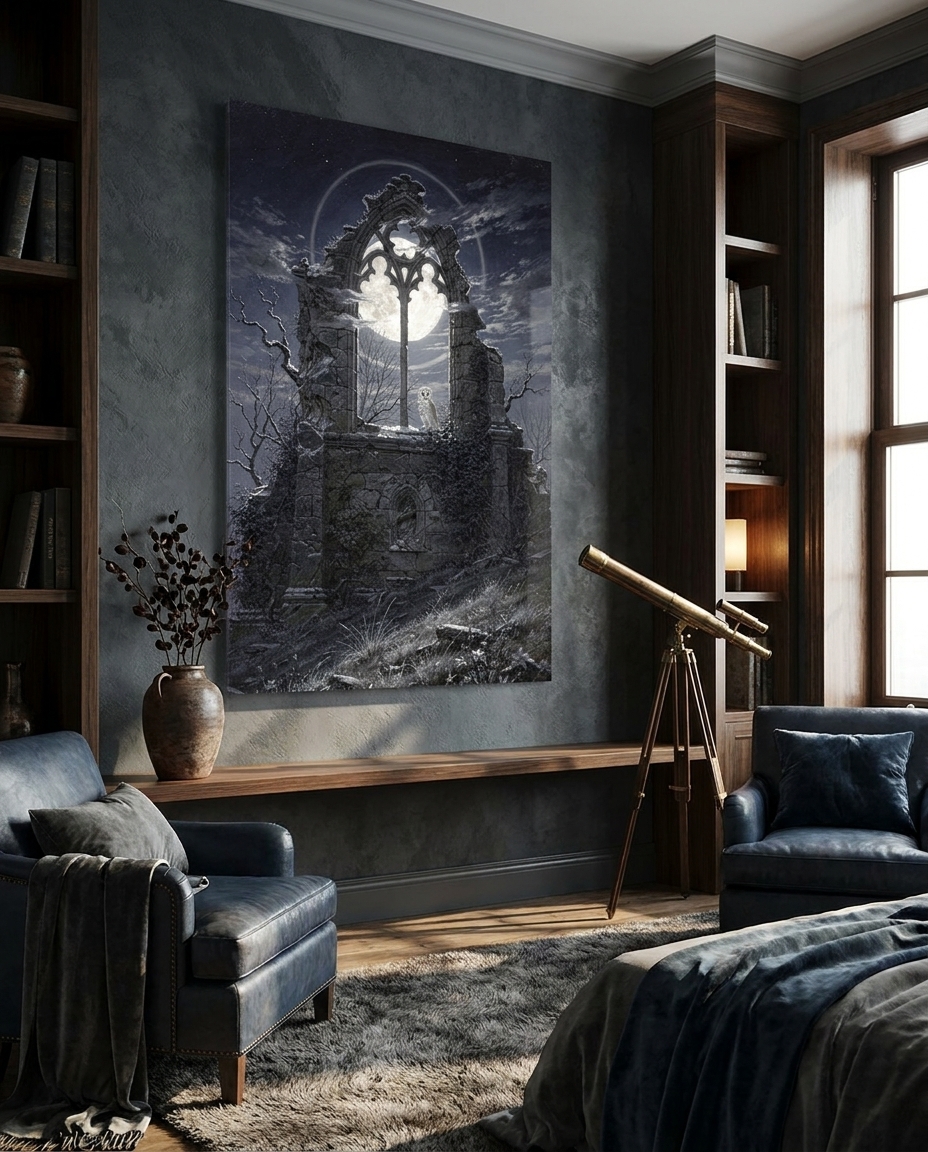
Last time we stood in the calm of the classical order, with its marble, its columns and its clean line. Around 1790 a new generation walked out of that perfectly arranged room and into the weather. Romanticism did not want to be convinced; it wanted to be moved — by a storm at sea, a ruined abbey under the moon, a gorge so deep that no person could measure it.
Where Romanticism sits in the story of art
Romanticism runs roughly from 1790 to 1850. It follows Neoclassicism and defines itself against it: where the earlier age asked for reason, symmetry and civic virtue, the Romantics put feeling, imagination and the individual first. The years of upheaval gave it its tone — revolutions, wars, the first factories, a world that suddenly seemed both larger and more fragile. Poets, composers and painters across Europe began to say the same thing: nature is not a tidy backdrop, it is a power, and the human soul is as vast as any landscape.
Its key word is the sublime: that mixture of awe and fear we feel before something far greater than ourselves. A waterfall, a volcano, a wave taller than a ship. Romantic painters also looked back, to the Middle Ages, to Gothic ruins and to folk tales, and they looked inward, to solitude, longing and dreams.
The movement changed everything that came after it. By freeing colour and brushwork from the contour, it opened the road to Impressionism and to modern painting, and its idea of the artist as a free, feeling individual is still ours.
What actually defines it
Nature as a force. Cliffs, storms, mountains, oceans and night skies fill the picture, and the human figure, when it appears, is small.
Drama of light. A single burst — the moon, a lightning bolt, a low sun, a glowing crater — against deep shadow, in diagonal and swirling compositions instead of calm symmetry.
Expressive paint. Visible brushwork, glazes, mist and spray dissolving the forms, a colour that carries the mood rather than describing the object.
Melancholy and the past. Ivy-covered ruins, bare lightning-struck trees, winter twilight, the passing of time.
The individual. Portraits that look away, into the distance, at something we cannot see.
The need
Our interior architect sees a clear appetite for rooms with atmosphere: deep wall colours, warm lamps, leather, wool, wood. Those spaces ask for a picture that deepens them rather than brightens them. Romanticism answers that need directly. A moonlit nocturne gives a library its silence, a stormy sea gives a study its energy, and a golden estuary lifts a bedroom without making it loud. These are paintings to live with in the evening.
The production
The art director built the eight works from the great Romantic repertoire of landscape, seascape, ruin, animal and portrait, without copying any known painting. The Emerald Surge sends a small boat up a translucent green wave beneath a lighthouse beam. Nocturne at the Ruined Chancel frames a full moon in the empty window of an invented Gothic chapel. Chasm of the Alpine Torrent drops a fragile footbridge across a thundering gorge, and Wild Spirit in Thunder lets a white horse rear under a fork of lightning. Solitude of the Blasted Oak sets a shattered tree and a flight of crows against a winter sunset, Portrait in the Sea Wind turns a young woman in a crimson cloak toward a stormy coast, and The Fire Across the Bay lights a volcanic night over a quiet harbour. The Golden Dissolve closes the set in a haze of morning light where a bridge and its masts almost vanish. One dark, rich, expressive manner holds the eight together.
The sale
Our gallerist sees in Romanticism a collection with real presence: instantly recognisable as art history, dramatic without being loud, and strong in the spaces where people linger — libraries, studios, dining rooms, hotel lounges, bedrooms. On acrylic glass the lightning and the lava take on depth, the night skies turn velvety and the golden estuary glows. The moonlit chapel and the blasted oak make a natural pair for a quiet wall; the wave and the volcano give an office or a lounge a sense of energy; the portrait works alone, at eye level, as the focal point of a room. Hang them at a common height, with generous space around each, and let the weather do the talking.
See the collection
The eight works are here: Romanticism.
Next in the chronological walk through art history: Orientalism, when the nineteenth century dreamed of distant lands in light and colour.