

Last time we crossed the world to Edo, where rain, blossom and river walks became flat, luminous prints. Now we come back to Europe in the second half of the eighteenth century, at the very moment it grew tired of its own gilded curls. Under the ash of two buried Roman towns, excavators were bringing whole streets, frescoes and household objects back into daylight — and a whole continent decided that the future of art lay in the past.
Where Neoclassicism sits in the story of art
Neoclassicism runs roughly from 1760 to 1830. It follows the Rococo, and it is in many ways its answer: after pastel boudoirs, playful asymmetry and pleasure for its own sake, artists, architects and patrons asked art to be clear, calm, rational and serious again. The excavations of Herculaneum and Pompeii, the engravings of Roman ruins that circulated across Europe and the young travellers of the Grand Tour all fed the same enthusiasm. The scholar Johann Joachim Winckelmann gave it its motto when he praised the “noble simplicity and calm grandeur” of Greek art.
The movement touched everything at once. Painting turned to clean contours and frieze-like compositions; sculpture rediscovered white marble and the idealised face; architecture covered Europe and the young United States with porticoes, domes and colonnades; furniture, silver, ceramics and fashion followed, down to the high-waisted white muslin gowns of the Empire years. It was also the art of an age of revolutions, which borrowed the language of ancient republics to speak about virtue, duty and the citizen.
Neoclassicism never really disappeared. Its order and its clarity still shape our banks, museums and town halls, and the generation that followed — the Romantics — defined itself precisely by rebelling against it.
What actually defines it
The line first. Contours are crisp and continuous, figures and objects are drawn as if they were carved in relief, and the paint surface is smooth, with no showy brushwork.
Order and symmetry. A shallow, stage-like space, a plain wall or a clear horizon behind, the verticals of columns and pilasters, a composition you can read at a glance.
The vocabulary of antiquity. Doric and Ionic columns, coffered domes, pediments, laurel and acanthus, the Greek key, urns, tripods and lyres, and above all marble, white or softly veined.
A sober palette. Marble white, stone grey, slate blue and sage, with a single accent of deep Pompeian red or burnished gold, and a cool, even daylight that models every form.
Dignity before charm. Faces are calm, poses composed, emotions held in reserve. The beauty of Neoclassicism is the beauty of restraint.
The need
Our interior architect sees a strong return of quiet, structured interiors: pale walls, stone and marble, symmetry, a few classical pieces mixed with contemporary furniture. Those rooms ask for art that brings order rather than noise, and a sense of permanence rather than a passing trend. Neoclassicism answers that need perfectly. Its architecture gives depth to a hallway or a study, its marble faces bring serenity to a living room or a bedroom, and its warm red accent lifts a dining room without ever disturbing it.
The production
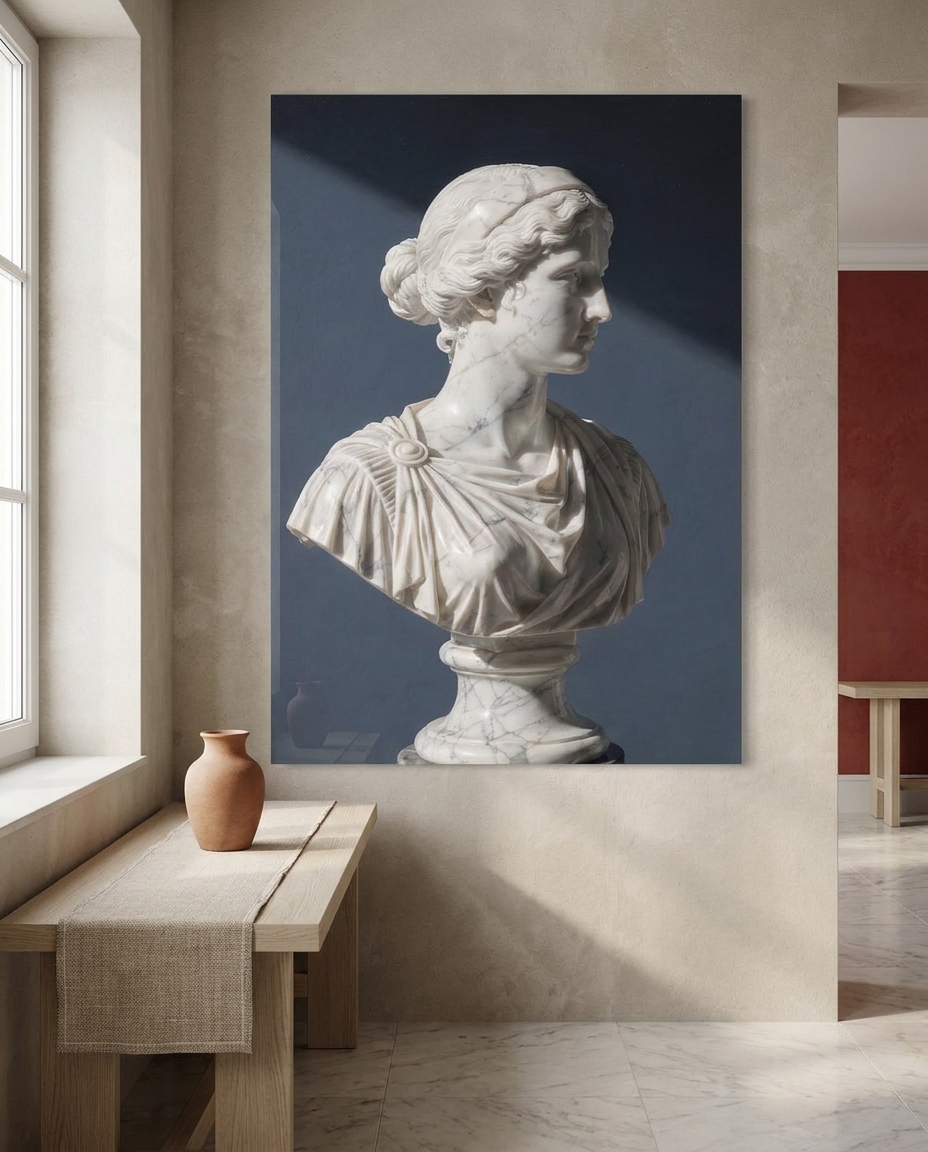
The art director built the eight works from the real repertoire of the period, without copying any known painting, statue or building, and kept every figure in its most dignified register. The Muse at the Harp seats a young woman in white muslin beside a gilded harp, a red shawl over the chair. Portrait in White Marble lets an idealised bust emerge from slate-blue shadow, and The Muse in the Niche stands a draped marble figure holding a laurel branch in a stone niche. Architecture carries half the collection: The Rotunda Library lets a shaft of light fall from the oculus of a coffered dome, The Palladian Portico sets a villa’s temple front square across a mown lawn, The Temple across the Water reflects a round garden temple in a still lake, and Ruins at Dawn raises a broken Corinthian colonnade against a rose and silver sky. The Urn and the Laurel closes the set with a still life of an urn, a laurel wreath and architectural drawings against a Pompeian red wall. One smooth surface, one cool light and one palette hold the eight together.
The sale
Our gallerist sees in Neoclassicism one of the most versatile collections of the series: rooted in art history, instantly elegant, and at ease in classic and contemporary homes alike, as well as in offices and hospitality spaces. On acrylic glass, the marble gains a soft, almost tactile glow, the skies turn luminous and the deep red of the still life takes on the depth of lacquer. The two marble pieces make a natural pair for a hallway or a living room; the rotunda and the portico give a study or an executive office a sense of measure; the temple and the ruins open up a dining room or a lounge. Hang them with generous space around them, at a strict common height, and let the symmetry do the rest.
See the collection
The eight works are here: Neoclassicism.
Next in the chronological walk through art history: Romanticism, when emotion, wild nature and the sublime broke through the calm of the classical order.