

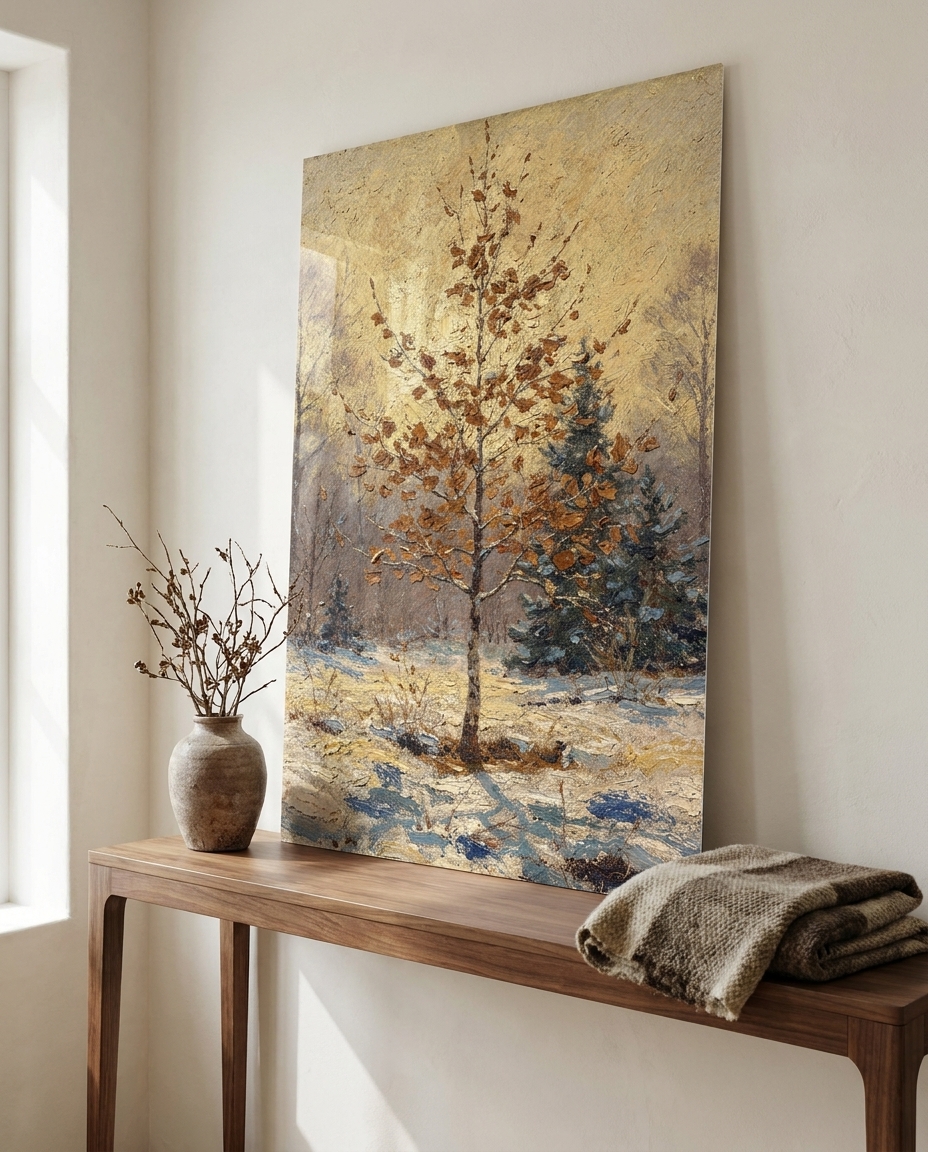
Snow is never white. Look at it on a clear winter morning and it is gold where the sun touches it and blue everywhere else. Snow Light is eight vertical oil paintings of one winter in the countryside, painted the way open-air painters learned to paint snow at the end of the nineteenth century: in broken touches of colour, chalk and ecru and pale gold in the light, cobalt and lapis in every shadow.
Each painting keeps one warm note, and only one: the rust of a beech that has kept its leaves, the orange of persimmons still on the branch, an amber window at dusk, the faded red of a barn door, the ochre of split logs. There are no people, no animals, no signs, and not a single letter anywhere in the paint. What is left is the quiet of a morning after snowfall.
The need — the decorator’s eye
The walls of this season have turned pale green — sage, celery, soft mineral tones in matte limewash and clay paint — and warm white. A green wall does not want more green. It wants a clear blue to give it depth and one warm colour to heat it. That is the whole logic of these eight: blue shadows, one note of rust or orange, and green kept to a few dark conifers at most.
The format is vertical, on purpose. A tall painting fits the places a wide one cannot: the narrow wall beside a fireplace, the space between two doors in a hall, the end of a corridor. At 60 × 90 or 80 × 120 cm it can simply lean on a console, a sideboard or a low bench and move from room to room as the season goes on; larger, it holds the wall above a sofa or a bed. Three of the eight are shown that way, resting on furniture rather than hung.
The production — the art director’s vision
Painters who worked outdoors in winter discovered something the studio had hidden: in sunlight, snow takes the colour of the sky in its shadows and the colour of the sun on its crests. They stopped painting it white and started building it from small strokes of pure colour set side by side. This collection is a tribute to that way of seeing — nothing is copied from any existing painting, no famous motif is repeated. What it borrows is a method and a light.
The handling is the same across the eight: matte oil paint, thick in the lit snow, thinner in the shadows, short commas and dabs you can follow with the eye up close. The light is always low — early morning, late afternoon, the last minutes of dusk — so that every tree, wall and drift throws a long blue shadow across the white. From across a room the eight read as calm and bright. Close up, the snow is full of colour.
The sale — the gallerist’s word
These are paintings bought for the pleasure of looking at them every day. One alone brings the stillness of a winter morning into a warm room. Two make a natural pair: The Orchard Wall and Beech Leaves in Snow share the same golden morning; The Lane at Dusk and The Red Door share the blue of the late afternoon. Three or four in a row along a hall make a quiet winter walk.
Each work is printed on 4 mm acrylic glass, backed with 3 mm Dibond. The lacquered face gives the blue shadows real depth and makes the lit snow glow. In a room of matte walls, wool, linen and wood, it is the one glossy surface, and it should be. As a gift for the end of the year, a season that comes back every winter.
The eight works
- The Orchard Wall — an old terracotta stone wall capped with snow, a bare apple tree behind it, long blue shadows in a golden morning.
- Beech Leaves in Snow — a young beech still holding its copper leaves in a snowy clearing, under a pale gold sky.
- The Mill Stream — a dark stream winding between deep snowbanks toward the corner of an old stone mill.
- The Lane at Dusk — a snowy village lane between low stone walls, one window glowing amber in the blue evening.
- The Woodpile — a tall stack of split logs in ochre and sienna, crowned with snow against a plank wall.
- Persimmons in Snow — bright orange fruits still on the bare branches, each one capped with snow, seen from below.
- The Poplars by the River — a row of tall bare poplars along a snowy bank, slow blue water, a low gold sky.
- The Red Door — the faded rust-red door of an old stone barn, snow drifted against it, a wedge of blue shadow from the eave.
See the whole collection: Snow Light.