

Last time we stood in front of Impressionism and its quick, broken strokes of colour, laid down to catch one fleeting hour. A younger generation looked at those same strokes and asked a different question: what if the instant could be built, patiently and almost scientifically, out of colour itself?
Where the movement sits in the story of art
Neo-Impressionism appeared in Paris in the mid-1880s. Its founder, Georges Seurat, showed A Sunday on La Grande Jatte at the eighth and last Impressionist exhibition in 1886, and the critic Félix Fénéon gave the new approach its name. Paul Signac became its tireless spokesman, Camille Pissarro adopted it for several years, and Henri-Edmond Cross, Maximilien Luce and Théo van Rysselberghe carried it into the 1890s and beyond. Seurat himself died in 1891, aged only thirty-one.
The movement leans on the colour research of its time. Michel-Eugène Chevreul had described simultaneous contrast in 1839, and the American physicist Ogden Rood published his optical studies in 1879. The painters took from them a simple idea: two colours placed side by side, and not mixed on the palette, mix in the eye of the viewer and shine more brightly than any pigment blended in advance. The word “Pointillism” started life as a mocking label. Seurat himself preferred to speak of a method, and Signac later summed it up in the book From Delacroix to Neo-Impressionism.
The movement matters because it turned painting into a deliberate system. It opened the way to Post-Impressionism, to Fauvism’s pure colour, and to the idea that a picture can be constructed rather than merely observed.
What actually defines it
Divided colour. The surface is built from small, separate touches of pure colour — dots, flecks or short dabs — set next to each other so that the eye assembles them at a distance.
Complementary contrast. Orange against blue, yellow against violet, red against green. Shadows are never black: they are made of the complementary colour of the light that casts them.
Calm, constructed compositions. Where Impressionism hurries, Neo-Impressionism holds still. Horizons are steady, forms are simplified, and a quiet geometry holds the scene together.
Light as the subject. Harbours, beaches, gardens, riverbanks and rooftops, seen at noon, in the late afternoon or at dusk, with the air itself made visible.
The need
Our interior architect noted that this is the most “architectural” of the colourful movements. Because the touch is so even and the compositions so calm, these pictures sit comfortably in rooms that already have a quiet order: pale plaster, light wood, linen. They bring luminous colour without noise, and they reward a second look, since the surface seems to shimmer a little differently as you walk across the room.
The production
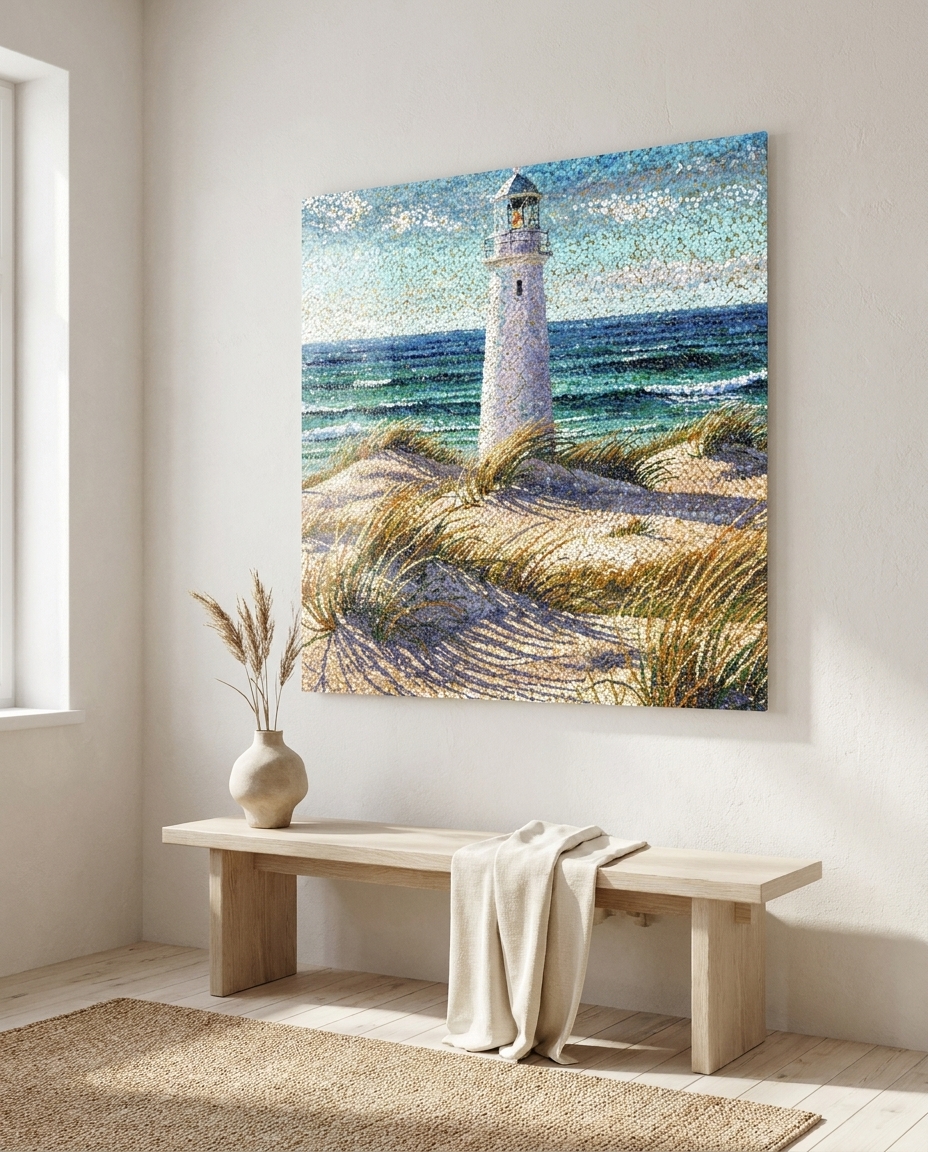
The art director composed eight original works in the language of the movement, without copying any known painting. The Radiant Basin gathers wooden sailing boats in a golden harbour, their masts trembling in the water. Breeze Across the Seine sets a stone bridge and tall poplars above a river broken into flecks of blue and green. The Shaded Promenade follows a sea-front garden path where small parasols drift under the trees. Beacon on the Dunes raises a white lighthouse over wind-combed sand and a teal sea. The Awakening Orchard opens a spring orchard in pale blossom. Rooftops at Twilight turns terracotta tiles into a field of orange and brick-red dots under a darkening sky. Harmony of the Table sets a cobalt pitcher, lemons and figs on white linen. Morning on the Shallows rests empty rowboats on a bay of pearl and lilac. Every work was checked for fidelity to the movement and cleared of anything that does not belong in the image.
The sale
Our gallerist sees in this set a collection for people who love colour but dislike clutter. Acrylic glass is a natural partner for divided colour: its depth makes every dot read as a small jewel, and the surface keeps the glow of the light it captures. The harbour and the promenade suit a bright living room, the orchard a country kitchen, the still life a dining room, the dunes a seaside home, the rooftops a study, and the quiet shallows a reading corner or a bedroom.
See the collection
The eight works are here: Neo-Impressionism and Pointillism.
Next in the chronological walk through art history: Post-Impressionism, when Cezanne, Van Gogh and Gauguin took colour and structure in three very different directions.