Last time we looked at Post-Impressionism, where colour and brushwork were bent to carry feeling. Symbolism takes the next step: it asks a picture to stop describing the world at all, and to suggest what lies behind it.
Where the movement sits in the story of art
Symbolism began in literature. In 1886 the poet Jean Moréas published a manifesto in Paris, and the idea quickly crossed into painting. Its roots lie in a reaction against both realism and the optical experiments of Impressionism. For these artists, the visible world was only a door; what mattered was the dream, the myth, the anxiety or the prayer that stood on the other side.
Gustave Moreau painted jewelled, hushed mythological scenes that seemed to glow from within. Odilon Redon moved from black charcoal visions to luminous flowers and floating heads. Pierre Puvis de Chavannes gave calm, frieze-like compositions a quiet, almost sacred stillness. Arnold Böcklin’s silent islands and dark cypresses became a symbol of the whole movement, and Fernand Khnopff painted veiled, motionless figures in empty rooms. Across Europe, from Belgium to Vienna and Scandinavia, the style took many local forms.
The movement matters because it defended the inner life as a subject. Its taste for ambiguity and mood prepared the ground for Expressionism, and later for Surrealism.
What actually defines it
Suggestion over description. A Symbolist picture gives clues, not explanations. A mask, a doorway or a bird carries an idea that the viewer completes.
Hieratic stillness. Figures are often frontal, silent and motionless, as if in a ritual. Nothing hurries.
A hushed, dreamlike light. Moonlight, twilight and candle glow dominate, in muted palettes of indigo, violet, moss green, ivory and tarnished gold.
Mythic and spiritual themes. Water, night, flowers, chalices and enigmatic architecture recur as symbols of memory, silence and the passage between worlds.
The need
Our interior architect noted that Symbolism is the movement for a room that needs calm. Its dark, velvety surfaces suit a study, a library corner or a bedroom, where a picture is looked at slowly and at close range. The ivory moons and pale blossoms bring a cool light to a deep wall colour, while the golden accents warm a neutral space.
The production
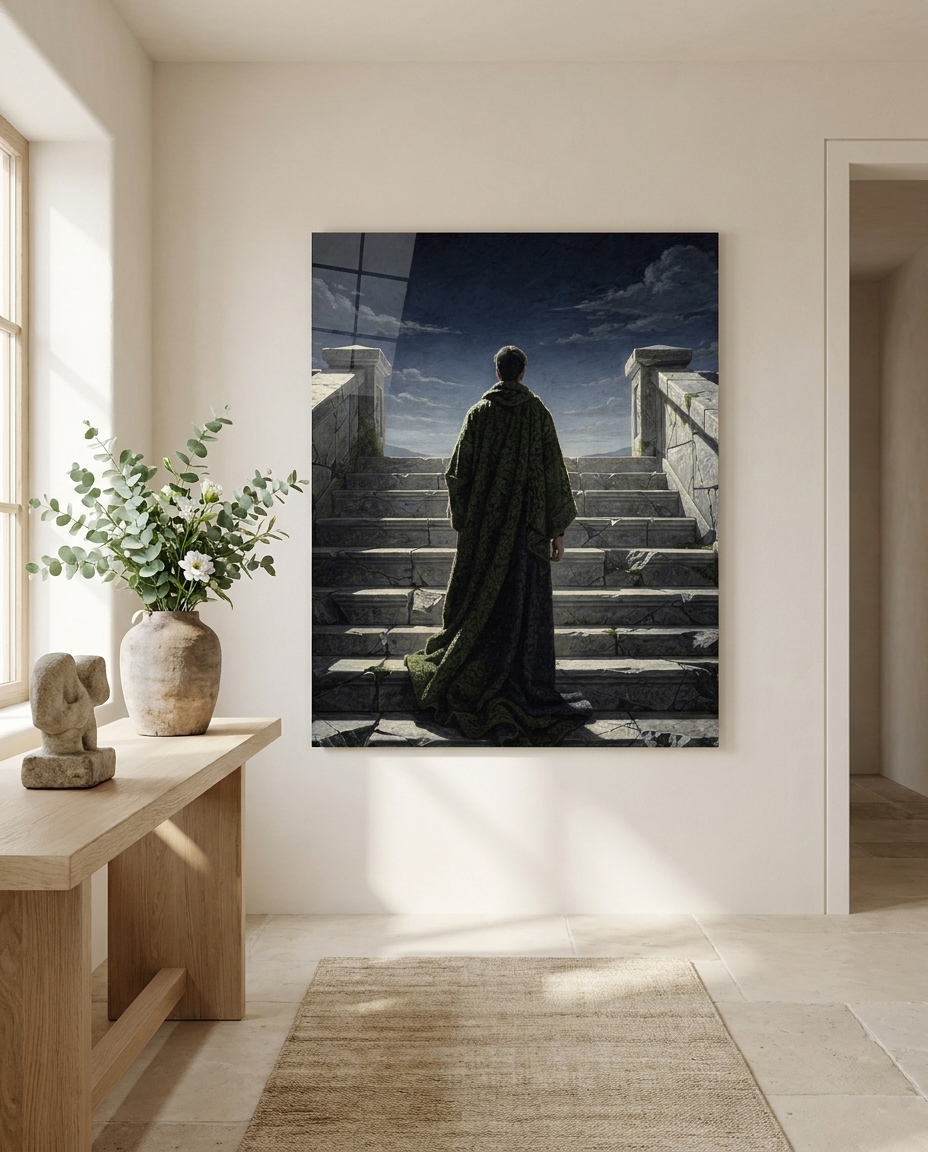
The art director composed eight original works in the spirit of the movement, without reproducing any known painting. The Veiled Presence stands a robed, veiled figure motionless between two candles. Nocturne on the Stone Stair follows a cloaked traveller up a moonlit flight of steps. The Water Mask rests a pale marble head half-submerged among closed water lilies. Solitary Drift glides a white swan across a black lake beneath a crescent moon. Sanctuary of the Chalice sets a golden cup on folded linen in a dim stone alcove. The Verdant Gate opens an ivy-covered arch onto a misty path and a pale moon. Twilight Blossoms raises a tree of silver flowers against a violet dusk. The Moonlit Sentinel perches an owl on a bare branch before an enormous moon. Each work was checked for fidelity to the movement and cleared of anything that does not belong in the image.
The sale
Our gallerist sees a collection for people who prefer atmosphere to spectacle. Acrylic glass suits these deep tones very well: it adds depth to the darkest indigos and blacks and lets the pale moons and gold accents glow. The veiled figure and the water mask suit a study, the stair an entrance hall, the swan a bedroom, the chalice a dining room, the gate a bright living room, the blossoming tree a seaside home and the owl a library nook.
See the collection
The eight works are here: Symbolism.
Next in the chronological walk through art history: Art Nouveau, where the line turns organic and flowers climb through every surface.