

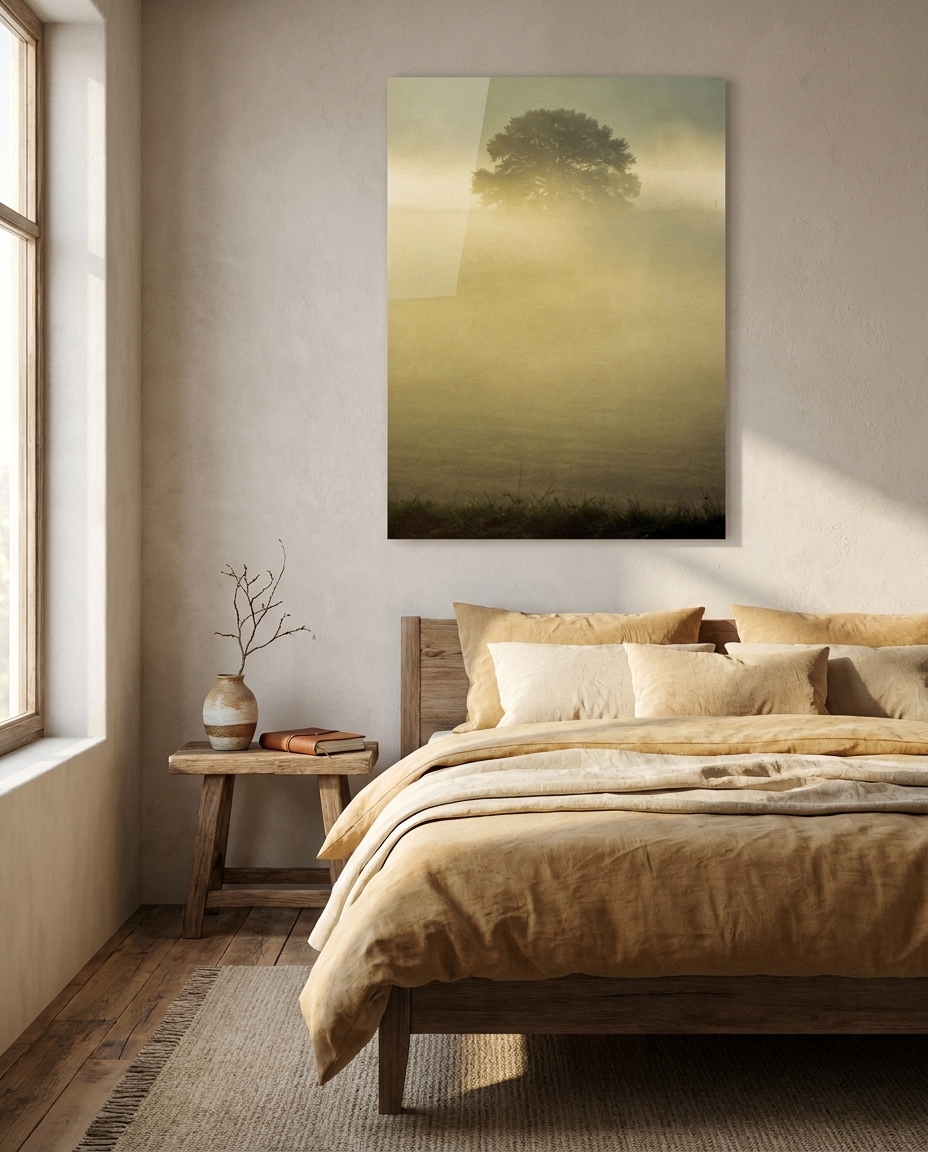
Most images try to tell you everything. This collection does the opposite: it withholds. Contours dissolve, distance swallows detail, and what remains is not a subject but a condition — weather, hour, temperature, the feeling of a place rather than its description.
The refusal of sharpness
There is a long tradition behind this. The Pictorialists of the 1890s deliberately softened their lenses; the Tonalists painted landscapes in which nothing is quite in focus and everything is unmistakably felt. Both understood something the sharp image forgets: that an unfinished picture recruits the viewer. Given a legible tree in fog, the eye supplies the forest. Given three tonal bands of haze, the mind supplies the mountains — and, more importantly, supplies a morning it has actually lived.
That is why atmospheric work holds a wall for years. It never resolves, so it never exhausts.
Grain as substance
Softness alone would be merely vague. What gives these images body is grain — a tangible, granular surface that reads as material rather than as absence. The eye needs something to hold onto when the contours let go. Under acrylic, this becomes almost physical: the depth of the mount pulls the grain forward while the diffuse tones recede, and the picture acquires a space of its own.
The collection
Eight works, all silent, all empty of people. A tree remembered rather than seen. Three distances stacked in haze. Weather read through wet glass. A road giving up its edges. Morning light entering an empty room through suspended dust. A sea with no horizon at all. Bare branches drawn like ink on wet paper. And warm ground exhaling at dawn.
Living with it
This is restorative work and it belongs where a room slows down: a bedroom, a reading corner, the wall you face from a bath or a long table. The palette — terracotta, bone, olive-grey, caramel, smoke — sits inside almost any warm neutral scheme without fighting it, which makes these unusually easy pieces to live with. Give one of them real size and real distance to be seen from. Atmospheric work shrinks badly; at scale it changes the air of a room.