
The civilisations of Mesoamerica and the Andes built cities, mapped the sky, tracked time with an accuracy Europe would not match for centuries, and made art of extraordinary formal severity — all without the wheel in practical use, without iron, and in the Andean case without writing as Eurasia understood it. Their art has been misread as primitive for four hundred years. It is nothing of the sort. It is disciplined to the point of austerity.
Stone that admits no blade
Inca masonry is the clearest statement of the aesthetic. Colossal polygonal blocks, each cut to fit its specific neighbours, assembled so tightly that a knife will not enter the joint — and left otherwise plain. No mortar, no facing, no ornament. The beauty is entirely in the fit. It is one of the few architectures in the world where precision alone carries the whole expressive load.
Maya sculptors took the opposite route. Their limestone stelae are packed edge to edge with glyphic relief in dense cartouche blocks — a surface treated as a page, where rulership, lineage and date are compressed into an unbroken field of carving.
Gold, jade, and what was valued
The Spanish melted the gold, having understood nothing. To these cultures gold was not currency but solar matter — hammered into pectoral discs and repousse plaques that caught the light on a living body. Jade mattered more: green stone, laboriously polished, associated with water, maize and breath. A jade mask inlaid with turquoise was worth more than its weight in metal, and everybody in the region knew it.
The collection
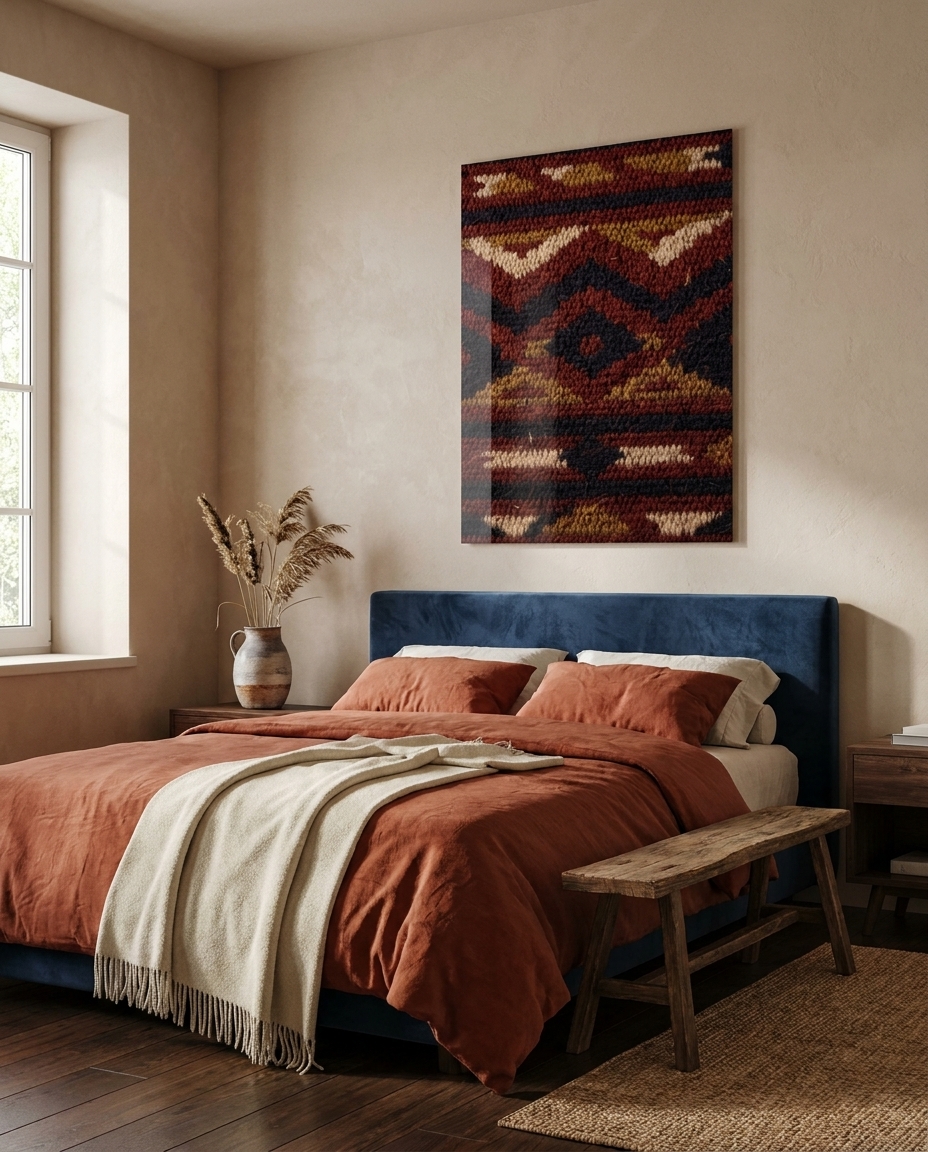
Eight original works in the manner of these traditions, none a copy of a surviving monument or museum piece, and none depicting sacrifice or human remains. A glyphic stela at dawn. Inca walls in morning light. A hammered gold disc. A jade mask with turquoise inlay. Terraced platforms in mist. A Moche stirrup-spout vessel. An Andean textile in cochineal and indigo. A weathered basalt colossus.
Living with it
This is grave, weighty work and it wants architectural settings: concrete, stone, plaster, dark wood. The stone pieces are almost monochrome and will hold a room together where colour would fragment it; the gold and jade pieces are the opposite, and want to be the single warm point in a cool space. Give them height and frontality — these are objects that were made to be approached, not glanced at.