

Seventh in our chronological journey through the history of art — a gallery survey unfolding from the first cave paintings toward the present day.
When Alexander died in 323 BCE, his empire broke into rival kingdoms that stretched from the Aegean to the edge of India. Greek art went with them — and in those cosmopolitan capitals it lost the calm composure of the Classical age and found something the ancient world had never quite permitted itself before: open, unguarded emotion.
The turn to feeling
Classical sculpture had been serene almost by rule, its faces held in a noble stillness that belonged to no particular hour or mood. Hellenistic artists broke that rule deliberately. Brows gather; a gaze falls away from the viewer; lips part as if a thought had just arrived. A marble head snapped from its body still grieves two thousand years later. For the first time, a sculpture invites you to wonder what it is thinking — and that question, once asked, never left Western art.
Marble that behaves like cloth
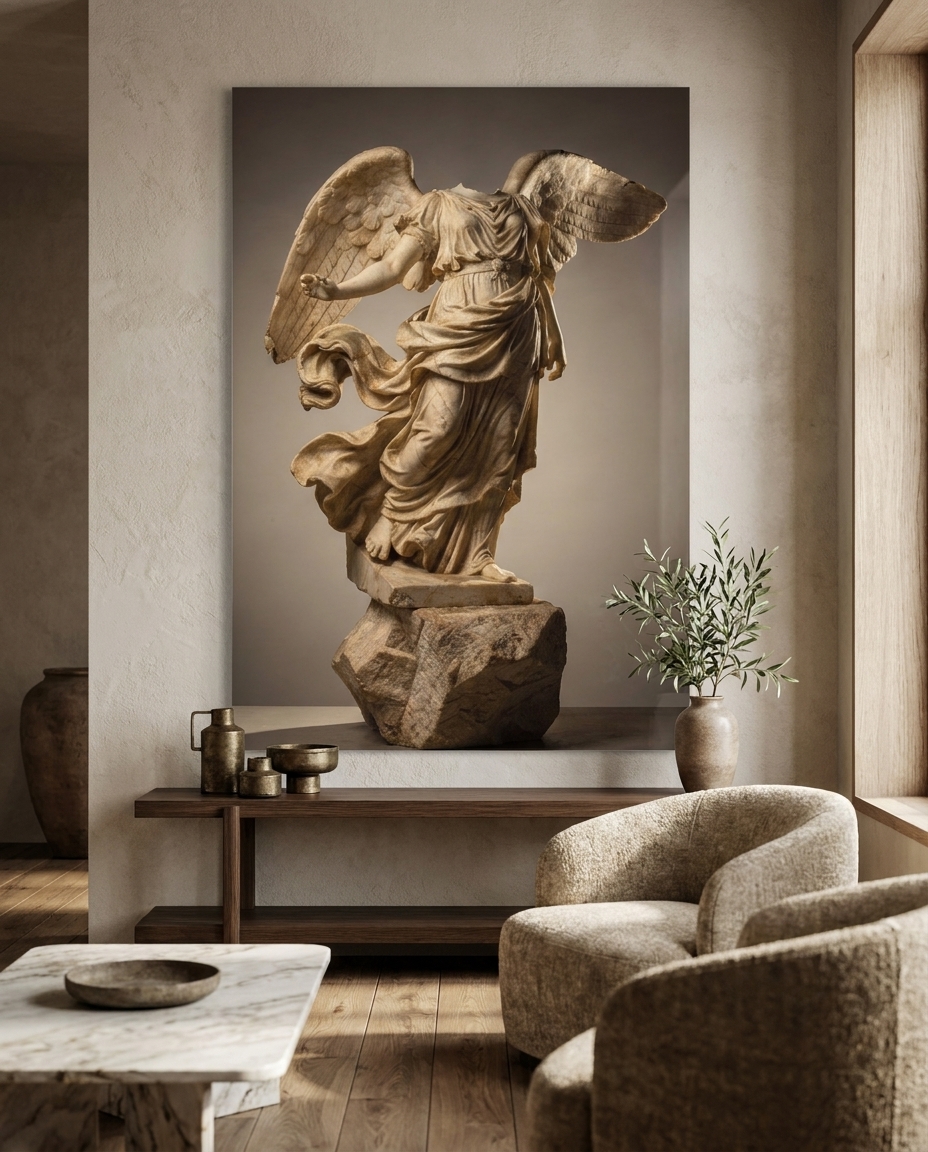
The age’s signature obsession was drapery. Sculptors carved stone until it pressed, clung, pooled and tore loose in the wind, using fabric to describe a body it simultaneously concealed. A winged figure braces against a sea gale, her layered chiton flattened across the advancing leg and streaming into deep shadowed folds behind; a dancer wrapped from crown to ankle turns inside her mantle, every part of her legible through the cloth alone. Movement became the subject, and technical bravura became a language of feeling rather than a display of skill.
Not only statues
The Hellenistic world was wide, wealthy and theatrical, and its art spilled far beyond sculpture. Goldsmiths beat sheet gold into oak leaves thin enough to tremble, wiring them into wreaths for the honoured and the dead. Architects gave the Corinthian capital its full luxuriance, two tiers of acanthus unfurling like foliage caught mid-growth. Ornamental carvers sent tendrils spiralling across friezes, deep-undercut so that real shadow pooled behind them, with eastern griffins emerging from the leaves. Mosaicists cut tesserae fine enough to shade a cheek and turned to the theatre for their subjects. Small-town workshops pressed terracotta figures of ordinary women in sun hats — no myth at all, simply life, judged at last to be worth depicting. This collection gathers those threads as original works in the movement’s spirit, an homage rather than a copy of any single surviving piece.
For the collector, for the room
Hellenistic art earns its place through presence rather than volume. A wind-struck figure or a downcast marble head brings a room the hush of a museum hall, while the gold and the mosaic answer warm interiors with jewel-toned depth. These are pieces for the entrance that should stop someone, the living room that wants one true statement, the study where thought is meant to slow down — sculptural, warm, and entirely at ease beside both antiques and clean modern lines.